




























Views
Downloads
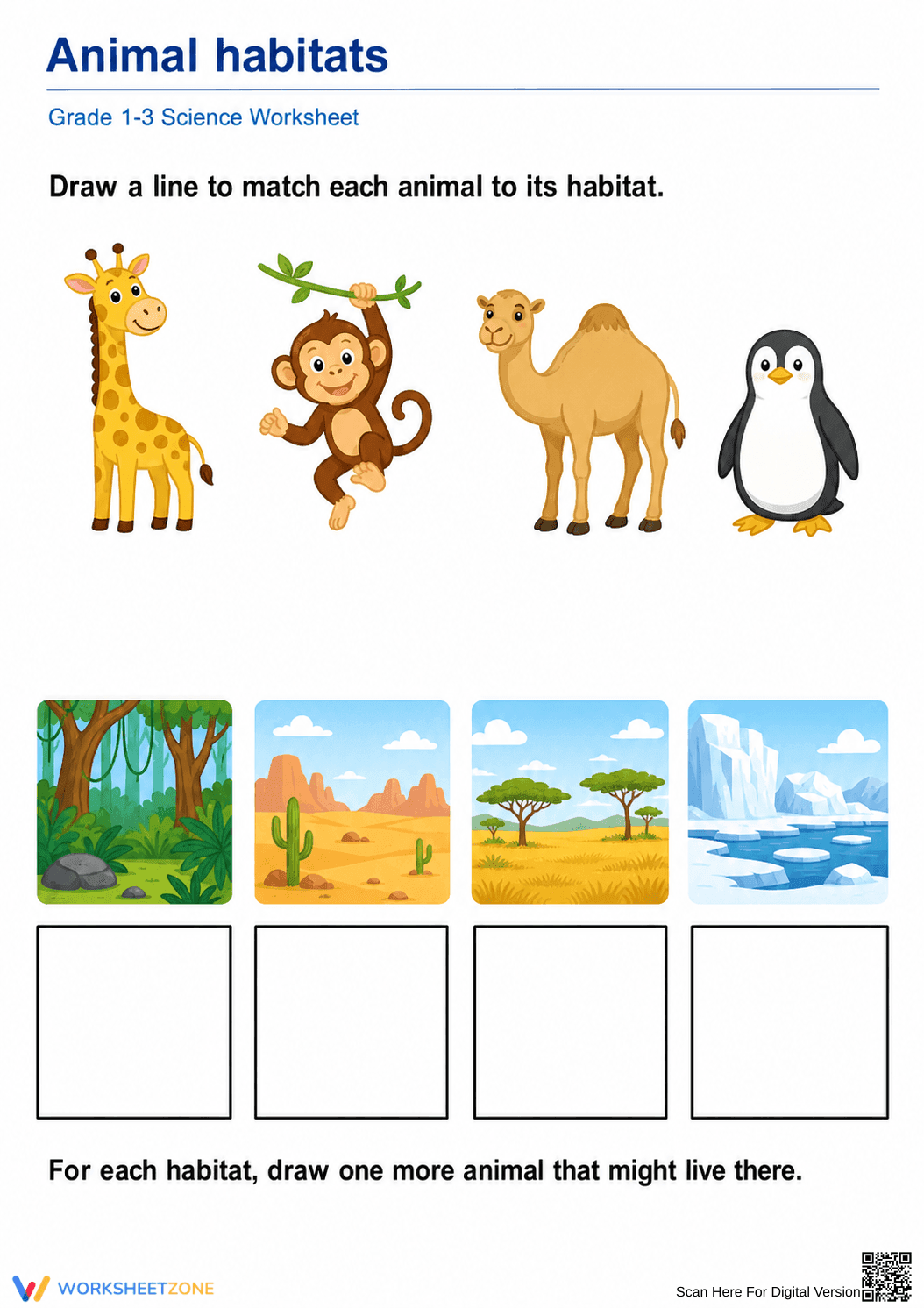

Essential Animal Habitats Worksheet | Grade 1-3 Science

Paste this activity's link or code into your existing LMS (Google Classroom, Canvas, Teams, Schoology, Moodle, etc.).
Students can open and work on the activity right away, with no student login required.
You'll still be able to track student progress and results from your teacher account.
This Animal Habitats worksheet provides an essential foundation for early elementary science students to understand the diverse environments that support life on Earth. Students practice identifying specific physical characteristics of animals and matching them to their corresponding natural homes. This focused activity bridges the gap between basic animal recognition and complex ecological understanding.
At a Glance
- Grade: 1-3 · Subject: Science
- Standard:
2-LS4-1— Observe and compare the diversity of animal life across different natural habitats- Skill Focus: Habitat Identification and Animal Adaptation
- Format: 1 page · 8 problems · Answer key included · PDF
- Best For: Early finishers or introduction to biomes
- Time: 15–20 minutes
This high-quality printable features eight distinct engagement points across a single, focused page. The first section contains four matching tasks where students connect vibrant illustrations of a giraffe, monkey, camel, and penguin to their respective ecosystems: the savanna, jungle, desert, and arctic. The second section provides four creative drawing prompts, challenging students to recall or research one additional animal for each featured habitat.
The zero-prep workflow for this resource allows teachers to integrate science instruction into busy schedules with minimal friction. Print the single-page PDF in under 30 seconds, distribute the copies to students for a focused 15-minute activity, and utilize the provided answer key for a rapid 2-minute class review or grading session. This streamlined process makes the worksheet an ideal solution for unexpected substitute plans or as a transition activity between core subjects.
The primary alignment for this resource is 2-LS4-1, which requires students to make observations of animals to compare the diversity of life in different habitats. By identifying which animals belong in specific biomes, students demonstrate an understanding of how environment dictates survival. This standard code can be copied directly into lesson plans, IEP goals, or district curriculum mapping tools to ensure instructional accountability.
Use this worksheet as a formative assessment after a direct instruction lesson on global biomes. Observe students during the matching phase to identify misconceptions about animal needs; for instance, a student matching a camel to the forest may need a review of desert adaptations. It also serves as an excellent extension task for advanced learners who can be challenged to label the specific climate characteristics of each habitat they have identified.
Designed for Grade 1 through Grade 3 students, this resource is particularly effective for visual learners and students developing fine motor skills through drawing. It pairs naturally with a classroom anchor chart detailing world climates or a short informational passage about animal survival. Differentiation is built-in, as students can provide simple animal names or detailed sketches depending on their individual skill levels.
Aligned with 2-LS4-1, this worksheet focuses on the fundamental science skill of identifying animal habitats and ecological relationships. Research from RAND AIRS 2024 indicates that visual matching tasks significantly improve long-term retention of scientific categories in early elementary learners by creating strong mental associations between organisms and their environments. The dual-modality approach—matching and drawing—caters to varied cognitive styles, ensuring that students not only recognize existing patterns but also synthesize their knowledge by generating new examples of habitat-specific life. This methodology mirrors the evidence-based practices outlined in recent STEM education frameworks, which emphasize the importance of observation-based learning. Educators can rely on this resource as a validated tool for building the conceptual scaffolds necessary for more advanced studies in biology and environmental science, providing students with the essential vocabulary and mental models required for academic success in higher grade levels.


