




























Views
Downloads

Animal Habitats Worksheet | Grade 2 Science Printable

Paste this activity's link or code into your existing LMS (Google Classroom, Canvas, Teams, Schoology, Moodle, etc.).
Students can open and work on the activity right away, with no student login required.
You'll still be able to track student progress and results from your teacher account.
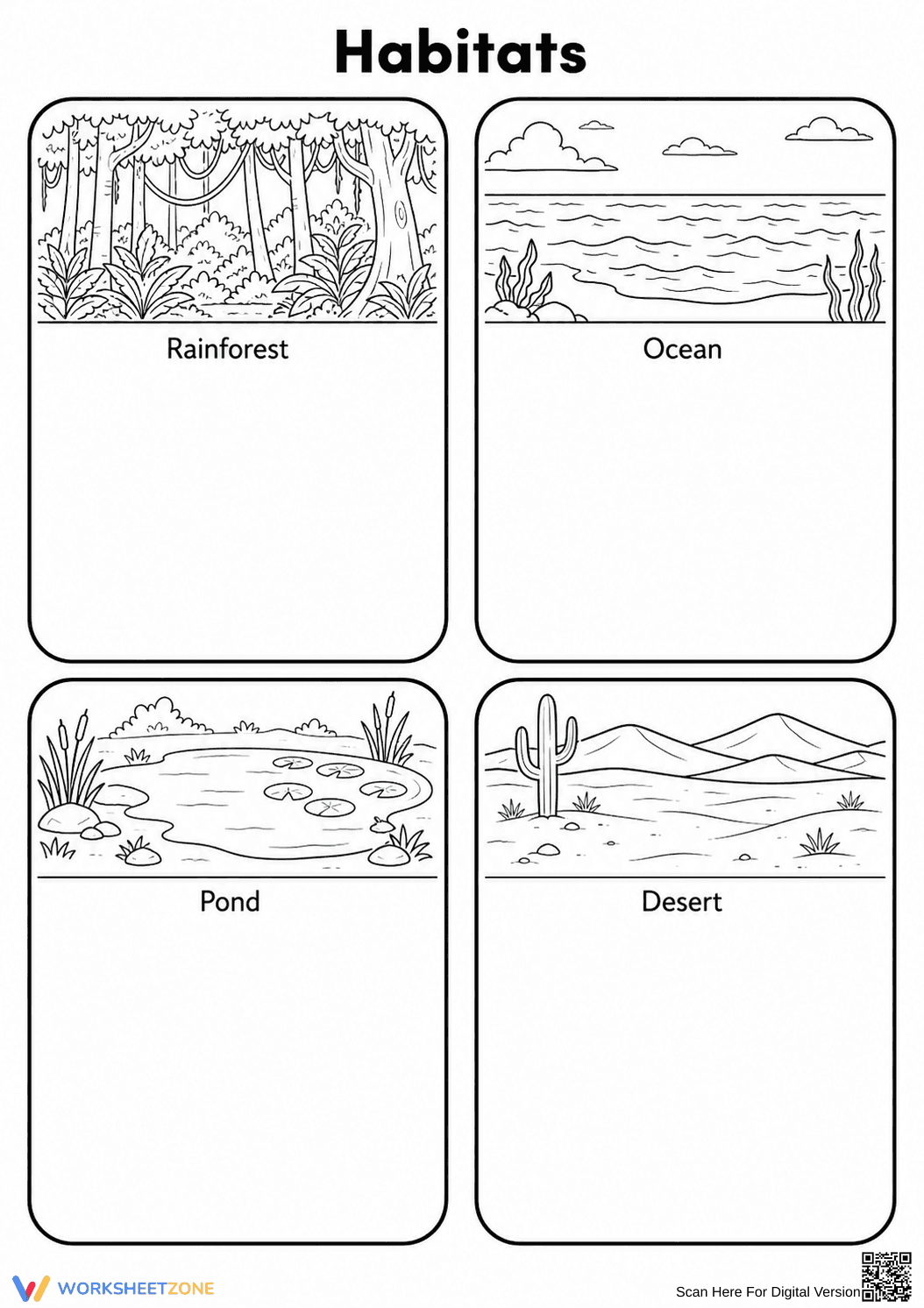
This Grade 2 science worksheet helps students identify and compare four distinct animal habitats: rainforest, ocean, pond, and desert. By providing clear visual boundaries for each environment, the activity allows young learners to organize their understanding of where different plants and animals live and thrive.
At a Glance
- Grade: 2 · Subject: Science
- Standard:
2-LS4-1— Compare the diversity of life in different habitats- Skill Focus: Identifying animal habitats
- Format: 1 page · 4 problems · No answer key · PDF
- Best For: Independent practice
- Time: 15–20 minutes
This single-page resource features four large, clearly labeled illustration boxes representing a rainforest, ocean, pond, and desert. Each section includes a simple background sketch to prompt student thinking. The open-ended format provides ample space for students to draw, write, or paste pictures of animals that belong in each specific ecosystem.
Zero-Prep Workflow
- Print (1 minute): Simply print the single-page PDF. No special materials or complex instructions are required.
- Distribute (1 minute): Hand out the sheets along with crayons, markers, or pre-cut animal magazines depending on your chosen activity style.
- Review (3 minutes): Briefly discuss the four environments as a class before letting students work independently.
With a total teacher prep time of under two minutes, this is an excellent option for a quick science center or a reliable emergency sub plan.
Standards Alignment
This activity aligns with primary standard 2-LS4-1, which requires students to make observations of plants and animals to compare the diversity of life in different habitats. It also supports foundational life science concepts by encouraging students to categorize organisms based on their environmental needs.
How to Use It
Use this worksheet during direct instruction as a guided note-taking tool where students draw animals as you introduce them. Alternatively, assign it as an independent sorting center after a lesson on ecosystems. For a formative assessment observation tip, watch to see if students correctly place amphibians in the pond rather than the ocean. Expected completion time is 15 to 20 minutes.
Who It's For
This resource is designed for Grade 2 students, though it works well for Kindergarten and Grade 1 with guidance. For differentiation, teachers can provide word banks for writing or pre-cut animal pictures for students who struggle with drawing.
Aligning early science instruction with 2-LS4-1 helps students systematically compare the diversity of life in different habitats. According to a recent ScienceDirect TpT Analysis, providing structured visual boundaries for categorization tasks significantly reduces cognitive load for early elementary learners. When students actively sort or draw organisms into specific environments like oceans, ponds, rainforests, or deserts, they build stronger mental models of ecological interdependence. This foundational skill focus—identifying animal habitats—prepares young learners for more complex biological concepts in later grades, such as food webs and adaptation. By utilizing clear, open-ended graphic organizers, educators can accurately assess student comprehension of environmental suitability without the barrier of heavy text processing. This approach ensures that all learners, regardless of reading level, can successfully demonstrate their understanding of where specific animals naturally thrive.


