


























Views
Downloads
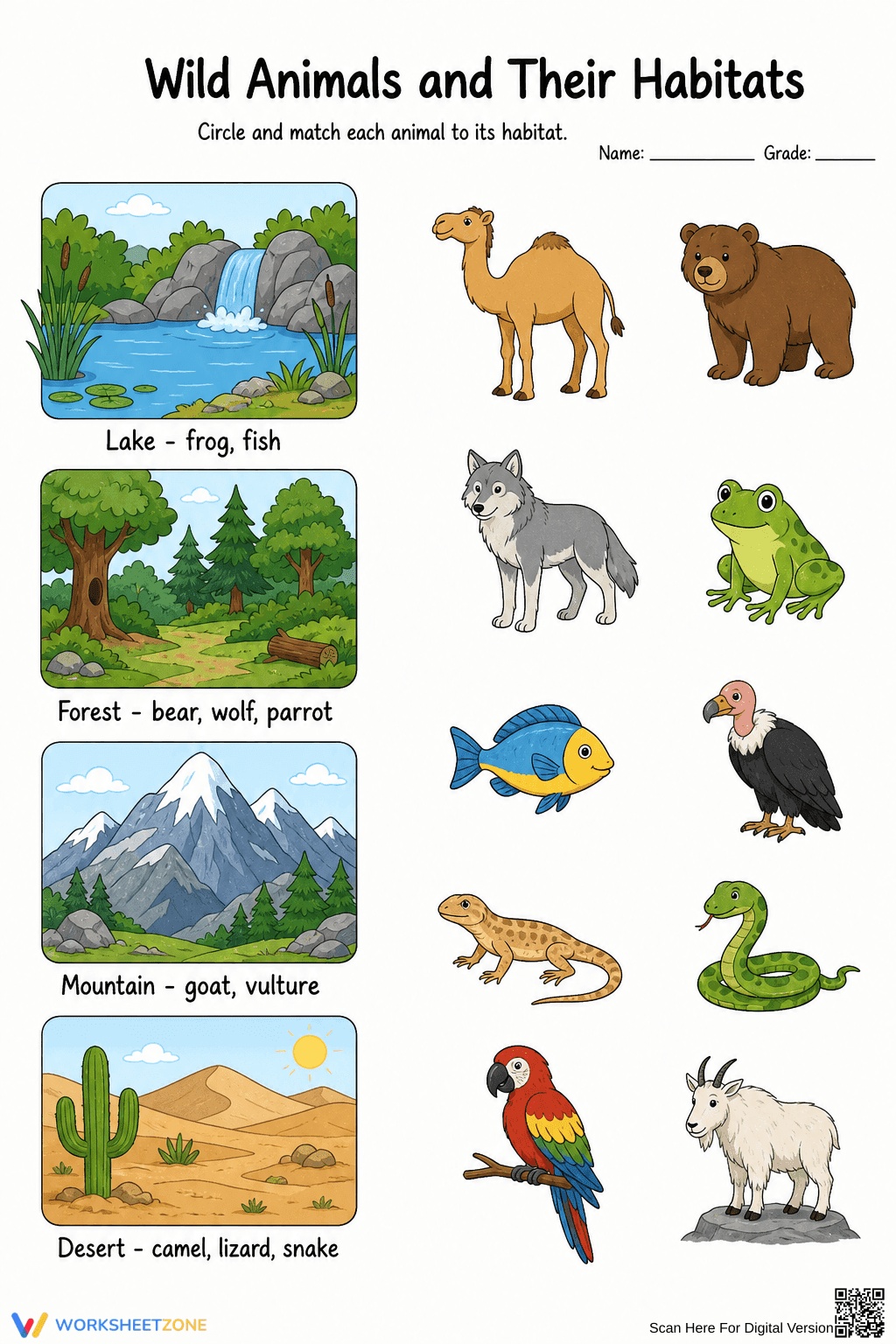

Essential Animal Habitats Worksheet | Grade 2 Ready
Paste this activity's link or code into your existing LMS (Google Classroom, Canvas, Teams, Schoology, Moodle, etc.).
Students can open and work on the activity right away, with no student login required.
You'll still be able to track student progress and results from your teacher account.
This Grade 2 worksheet provides a visual framework for identifying animal habitats. By matching 10 species to environments like lakes, forests, mountains, and deserts, learners develop a foundational understanding of biodiversity. It bridges the gap between observation and classification while building scientific literacy.
At a Glance
- Grade: 2 · Subject: Science
- Standard:
2-LS4-1— Compare the diversity of life in different habitats through observation- Skill Focus: Habitat identification and animal classification
- Format: 1 page · 10 problems · Answer key included · PDF
- Best For: Introductory science lessons and formative assessment
- Time: 15–20 minutes
What's Inside
This PDF features illustrations of four primary biomes: lake, forest, mountain, and desert. Students circle habitat labels and draw lines connecting animals like the camel, wolf, and parrot to their homes. The layout includes clear text labels and space for student names, making classroom organization easy. An answer key is included for quick grading or self-correction.
Zero-Prep Workflow
- Print: Generate class sets quickly with this printer-friendly design.
- Distribute: Hand out sheets as a standalone activity; visual cues make it self-explanatory.
- Review: Conduct a 5-minute whole-group review to reinforce correct pairings.
This process is ideal for sub plans, morning work, or quick transitions between science units.
Standards Alignment
This resource is primarily aligned with 2-LS4-1, which requires students to make observations of plants and animals to compare the diversity of life in different habitats. It also supports 3-LS4-3 by providing visual evidence needed to discuss why certain animals, like the camel, are uniquely suited for the desert. Both standard codes can be copied directly into lesson plans, IEP goals, or district curriculum mapping tools.
How to Use It
Use this worksheet as a formative assessment after a direct instruction lesson on biomes. As students work, circulate the room to observe if they can explain why a goat belongs in the mountains; this verbal reasoning provides deeper insight than the matching task alone. It also functions well as a quiet-time activity for students who finish their primary science lab early. Expected completion time ranges from 15 to 20 minutes depending on the grade level.
Who It's For
This worksheet is tailored for Grade 1 through Grade 3 students, particularly those who benefit from visual learning aids. It is also a highly effective resource for ESL/ELL students who are building their scientific vocabulary. Pair this with a classroom anchor chart showing real-world photographs of the four featured habitats to reinforce the connection between the illustrations and reality.
According to Fisher & Frey (2014), visual non-linguistic representations, such as matching animals to environments, significantly enhance retention of scientific concepts in early childhood. This worksheet leverages that research by providing distinct imagery that allows students to categorize information without heavy text barriers. By aligning with the 2-LS4-1 standard, the activity ensures students are actively engaging in scientific observation rather than just memorizing facts. Research indicates that when students visually map an organism to its habitat, they are more likely to understand subsequent lessons on adaptation and survival. This resource provides the necessary scaffolding for Grade 2 learners to master the skill of comparing life across different biomes, making it a reliable tool for any standards-based science curriculum.


