




























Views
Downloads
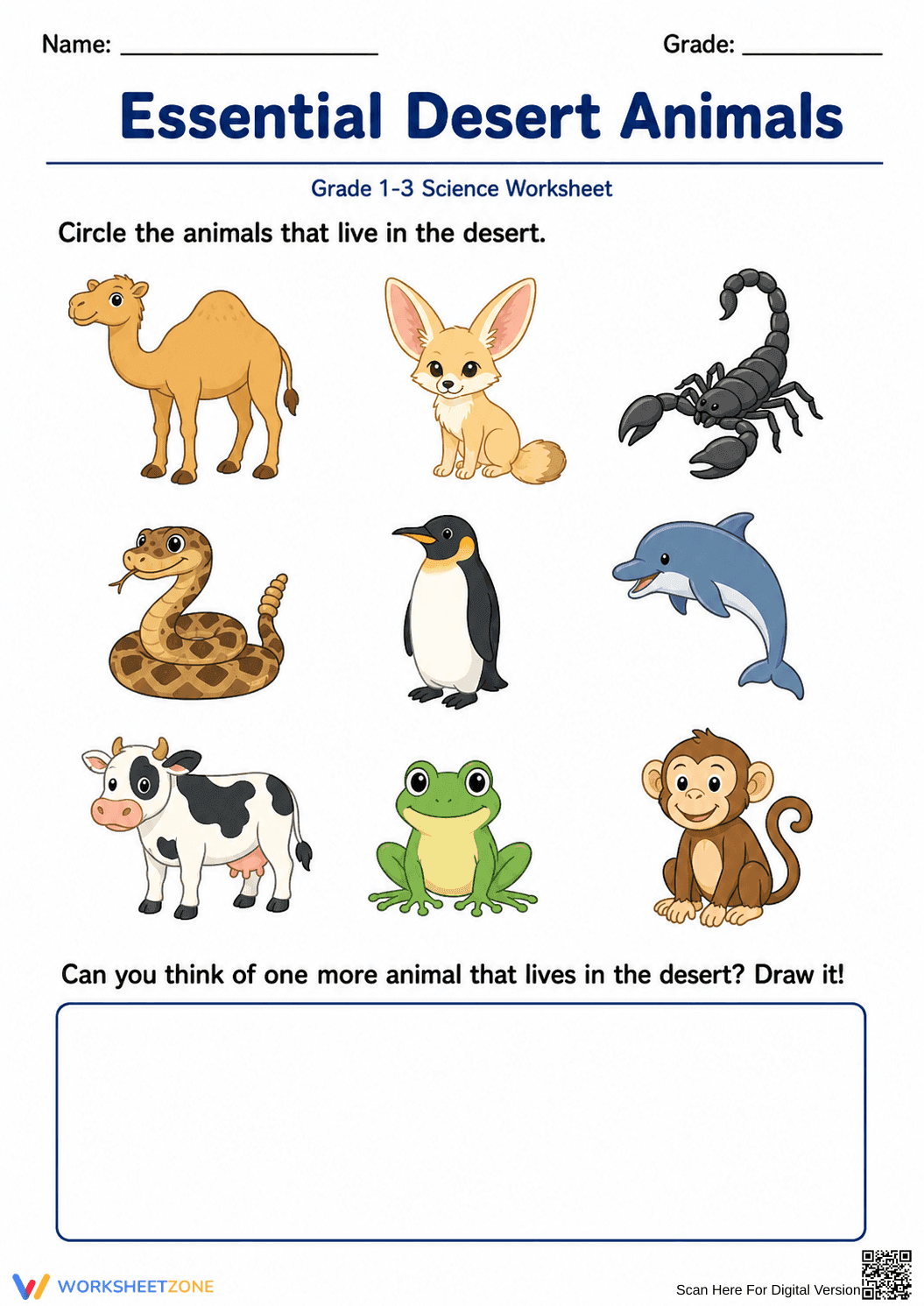

Essential Desert Animals Worksheet | Grade 1-3 Ready

Paste this activity's link or code into your existing LMS (Google Classroom, Canvas, Teams, Schoology, Moodle, etc.).
Students can open and work on the activity right away, with no student login required.
You'll still be able to track student progress and results from your teacher account.
This Grade 1-3 desert animals worksheet helps students identify species that thrive in arid environments. By distinguishing between desert dwellers and distractors like penguins, learners build foundational habitat knowledge. This single-page resource provides an immediate, high-success activity for young scientists to demonstrate their understanding of biodiversity.
At a Glance
- Grade: 1-3 · Subject: Science
- Standard:
2-LS4-1— Observe and compare the diversity of animal life across various natural habitats- Skill Focus: Desert Habitat Identification
- Format: 1 page · 10 tasks · Answer key included · PDF
- Best For: Independent practice and habitat review sessions
- Time: 10–15 minutes
What's Inside
This one-page printable PDF features two learning modalities to reinforce habitat knowledge. The primary section presents nine animal illustrations, requiring students to circle only those that thrive in arid environments. An extension prompt invites students to synthesize their learning by drawing an additional desert animal not already pictured on the page.
Zero-Prep Workflow
The zero-prep design ensures immediate classroom integration. First, print the single-page PDF, taking under 30 seconds. Second, distribute the materials; the visual instructions allow students to begin working without teacher modeling. Finally, review the completed work using the included answer key, a process requiring under two minutes for an entire class.
Standards Alignment
This resource aligns with 2-LS4-1, which mandates that students observe plants and animals to compare diversity in different habitats. By evaluating animals within the desert context, students engage in the observational science required by national frameworks. This code can be copied directly into lesson plans or curriculum mapping tools.
How to Use It
Use this worksheet as a formative assessment following a lesson on biomes. It serves as an "exit ticket" to gauge whether students distinguish between terrestrial and aquatic species. During the activity, observe students as they evaluate "distractor" images; these provide opportunities to ask probing questions about survival needs in arid environments.
Who It's For
This worksheet is designed for Grades 1-3 students exploring life sciences. It is well-suited for substitute folders or homework due to high visual support. Pair this resource with a non-fiction passage about desert survival or an anchor chart displaying global climates to provide a comprehensive learning experience for all students.
Independent practice worksheets remain the most consistently used formative tool in US K–12 classrooms. A 2024 RAND American Instructional Resources Survey found that nearly half of all US teachers now regularly use standards-aligned materials—and 96% of teachers on TeachersPayTeachers report that standards-aligned resources make it easier to teach content aligned to state requirements. 2-LS4-1, which this worksheet targets, is among the most frequently assessed standards in Grade 2 science across NGSS-adopting states. Resources that print with clear student directions, include answer keys, and surface the exact standard code directly on the page reduce the combined documentation and prep time teachers estimate spending 15–20 minutes on per practice activity—time this worksheet returns to instruction. Educators can confidently integrate this printable as a verified tool for measuring student mastery of basic habitat categorization. This structured practice is a proven method for building the foundational knowledge necessary for later studies in animal adaptation and ecology.


