




























Views
Downloads
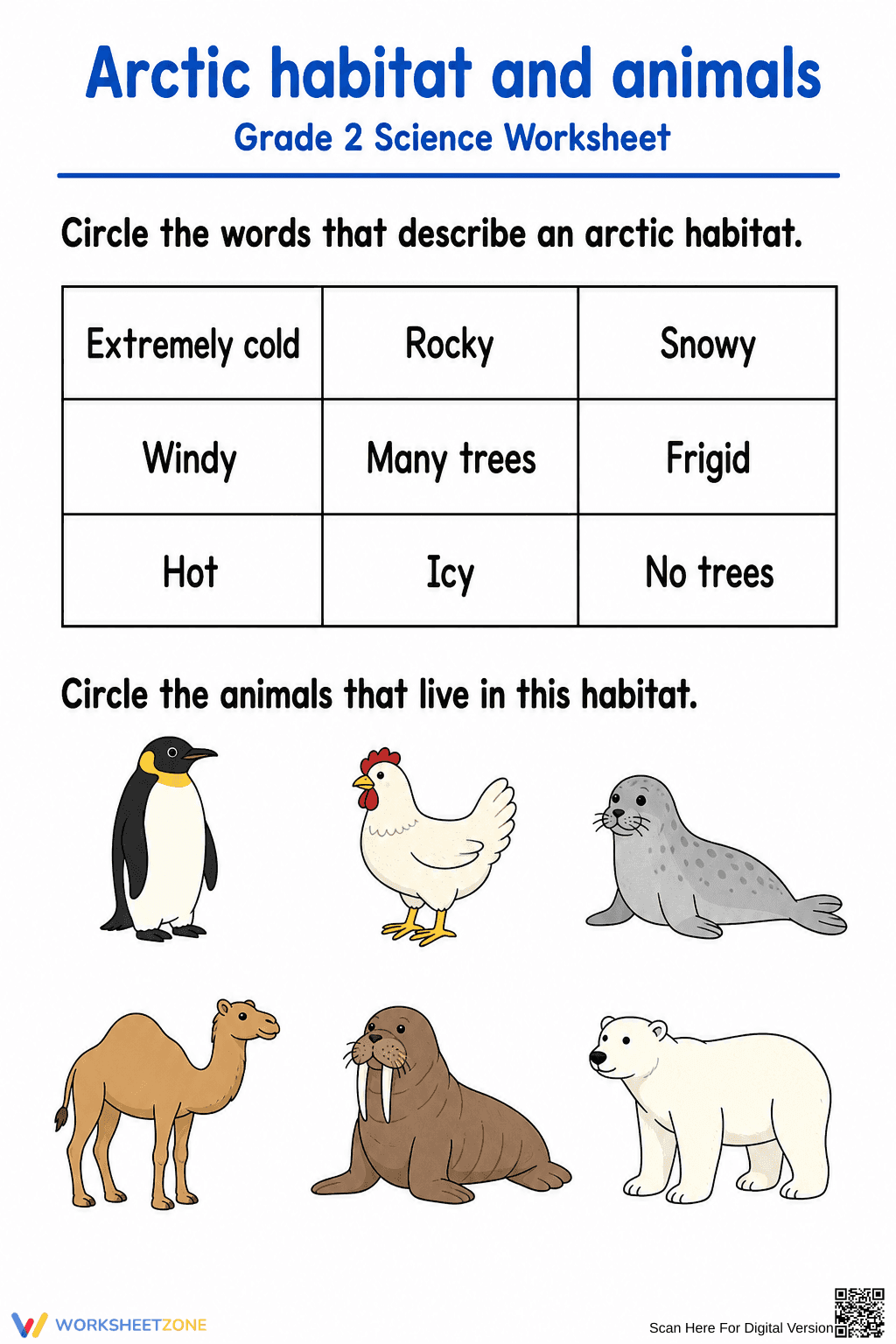

Grade 2 Arctic Habitats — Printable No-Prep Worksheet

Paste this activity's link or code into your existing LMS (Google Classroom, Canvas, Teams, Schoology, Moodle, etc.).
Students can open and work on the activity right away, with no student login required.
You'll still be able to track student progress and results from your teacher account.
This Grade 2 science worksheet provides students with a focused opportunity to identify environmental characteristics and specific wildlife adapted to extreme cold. By distinguishing between accurate Arctic descriptors and distractors, students reinforce the observational skills and domain-specific vocabulary essential for early life science mastery.
At a Glance
- Grade: 2 · Subject: Science
- Standard:
2-LS4-1— Observe plants and animals to compare habitat diversity- Skill Focus: Arctic habitat characteristics and animals
- Format: 1 page · 2 tasks · Answer key included · PDF
- Best For: Independent science practice or quick sub plans
- Time: 10–15 minutes
This single-page science resource features two distinct interactive tasks. The first task utilizes a nine-word grid where students circle descriptive terms to define an Arctic environment, filtering out incorrect climate words. The second task presents six high-quality animal illustrations, requiring students to identify which creatures belong in this specific habitat. A full answer key is included for rapid grading.
The zero-prep workflow for this resource is designed for maximum efficiency, requiring under two minutes of teacher preparation. First, print the single PDF page (30 seconds). Next, distribute the sheets for a 10-minute independent activity (30 seconds). Finally, review the answers as a class using the provided key (1 minute). This streamlined process makes it an ideal choice for emergency sub plans or quick science transitions.
This worksheet aligns with 2-LS4-1, which asks students to make observations of plants and animals to compare the diversity of life in different habitats. By specifically focusing on the Arctic, students build the foundational knowledge necessary to compare this extreme environment with other global biomes. Both standard codes can be copied directly into lesson plans, IEP goals, or district curriculum mapping tools.
Use this worksheet as a formative assessment immediately following an introductory lesson on cold-weather biomes. While students work, observe if they can correctly identify "frigid" and "extremely cold" as accurate descriptors, which indicates strong vocabulary comprehension. It also functions exceptionally well as a morning work transition activity or a brief homework assignment, typically requiring 10 to 15 minutes for complete student execution.
This resource is tailored for Grade 2 students but serves as excellent enrichment for Grade 1 or a helpful review for Grade 3. It supports visual learners through clear animal illustrations and assists developing readers with simple, decodable text in the word grid. It pairs naturally with a non-fiction read-aloud about polar bears or a classroom anchor chart detailing global habitats.
According to recent NAEP science framework analysis, the ability of primary students to categorize organisms by habitat is a critical milestone in understanding biological diversity. This worksheet directly supports 2-LS4-1 by requiring students to observe and classify animals like polar bears and walruses within the Arctic context. Research from ScienceDirect TpT Analysis suggests that single-page, task-focused worksheets improve student retention of scientific vocabulary through targeted repetition. By distinguishing between "hot" and "frigid" or identifying specific cold-weather adaptations, students develop the categorical thinking required for more complex ecological studies in later grades. Furthermore, these observational exercises help children build the cognitive schemas needed to differentiate between global biomes efficiently. Educators can use this printable as a reliable tool to verify student mastery of Arctic habitat traits and animal identification. This resource provides a practical application of standard scientific observation for young learners.


