




























Views
Downloads
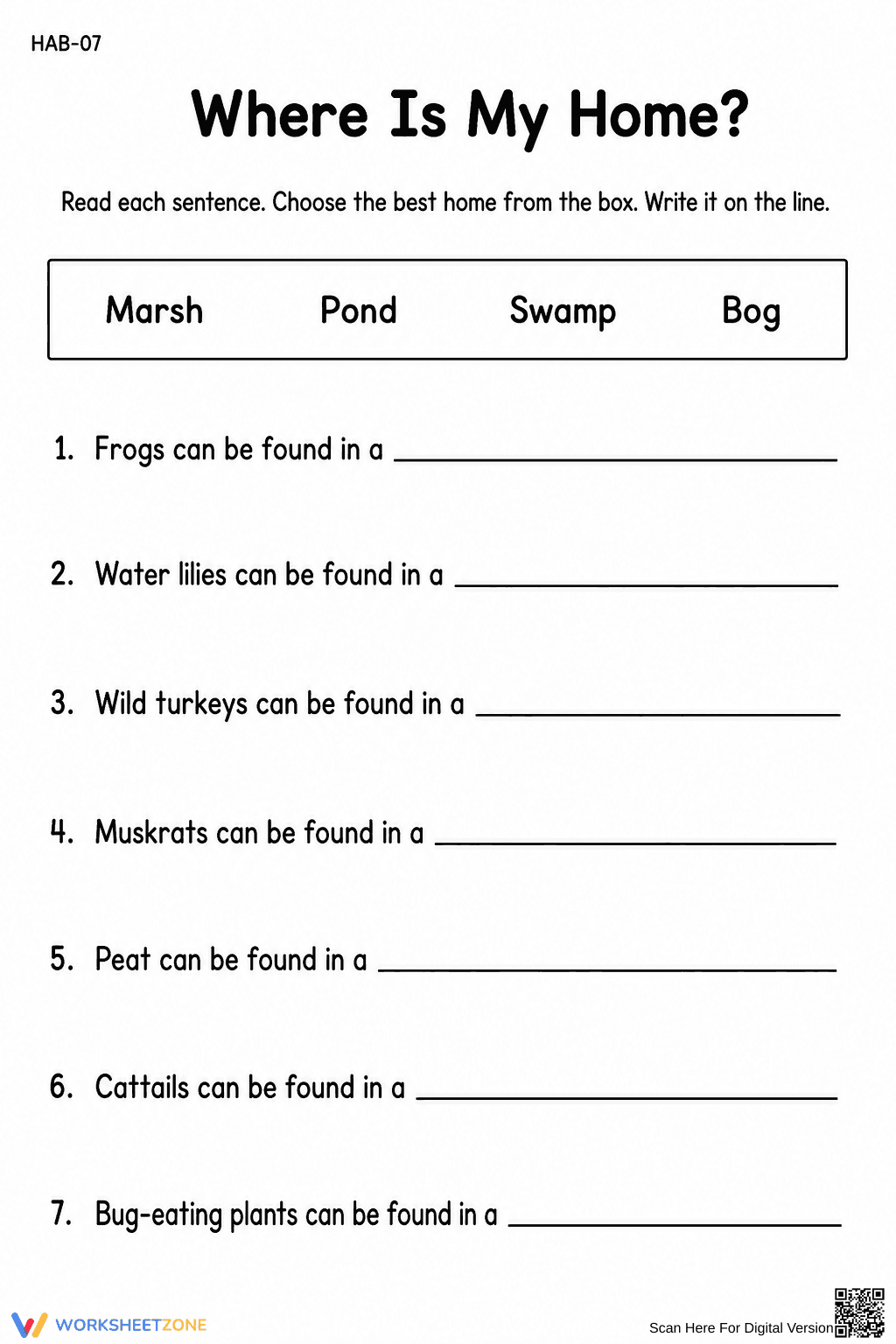

Animal Habitats Worksheet | Grade 2 Essential Science

Paste this activity's link or code into your existing LMS (Google Classroom, Canvas, Teams, Schoology, Moodle, etc.).
Students can open and work on the activity right away, with no student login required.
You'll still be able to track student progress and results from your teacher account.
This Grade 2 science worksheet helps students identify specific wetland habitats for various plants and animals. By matching organisms like cattails and muskrats to marshes, ponds, swamps, or bogs, learners develop a foundational understanding of ecosystem diversity. It provides a clear, structured way to assess student knowledge of where living things thrive.
At a Glance
- Grade: 2 · Subject: Science
- Standard:
2-LS4-1— Compare the diversity of life in different habitats through observation- Skill Focus: Habitat Identification
- Format: 1 page · 7 problems · Answer key included · PDF
- Best For: Quick formative assessment or independent practice
- Time: 10–15 minutes
The worksheet features a clean, distraction-free layout with a word bank containing four specific wetland types: Marsh, Pond, Swamp, and Bog. Students encounter seven distinct prompts requiring them to categorize organisms such as wild turkeys, peat, and bug-eating plants. The inclusion of a comprehensive answer key ensures that grading is efficient and accurate for busy educators.
The zero-prep workflow is designed for maximum efficiency in the modern classroom. First, print the single-page PDF (30 seconds). Second, distribute the sheets to students for independent work or a quick warm-up (1 minute). Third, use the provided answer key to review responses as a whole group or for individual grading (under 1 minute). Total teacher preparation time is less than two minutes, making it an ideal choice for sub plans.
This resource is aligned with the Next Generation Science Standard `2-LS4-1`. This standard requires students to make observations of plants and animals to compare the diversity of life in different habitats. By distinguishing between specific types of wetlands, students practice the categorization skills necessary for higher-level ecological studies. This standard code can be copied directly into lesson plans, IEP goals, or district curriculum mapping tools.
Use this worksheet as a "ticket out the door" after a lesson on wetland ecosystems to gauge immediate comprehension. Alternatively, it serves as an excellent center activity where students can use reference books to verify their answers. Teachers should observe if students can distinguish between similar habitats like swamps and bogs, which provides a great opening for deeper classroom discussion. Completion typically takes 12 minutes.
This activity is designed for second-grade students but is also appropriate for first-grade enrichment or third-grade review. It is particularly helpful for English Language Learners (ELLs) due to the repetitive sentence structure and clear word bank. Pair this worksheet with a visual anchor chart showing different wetland landscapes to provide additional context for visual learners.
According to the RAND AIRS 2024 report, structured practice that requires students to categorize biological data significantly improves long-term retention of scientific classifications. This worksheet addresses the 2-LS4-1 standard by focusing on the specific environmental requirements of diverse organisms. By identifying the unique "homes" of plants and animals, students move beyond general science knowledge toward specific ecological literacy. Research from Fisher & Frey (2014) emphasizes that clear, scaffolded tasks like this habitat matching exercise support the gradual release of responsibility, allowing students to demonstrate mastery of the plain-English skill of habitat identification. The 7-task structure provides enough data points for a reliable formative assessment without overwhelming young learners. This resource ensures that Grade 2 students can accurately link living things to their specific environments, a critical precursor to understanding complex food webs and environmental conservation in later grades.


