




























Views
Downloads
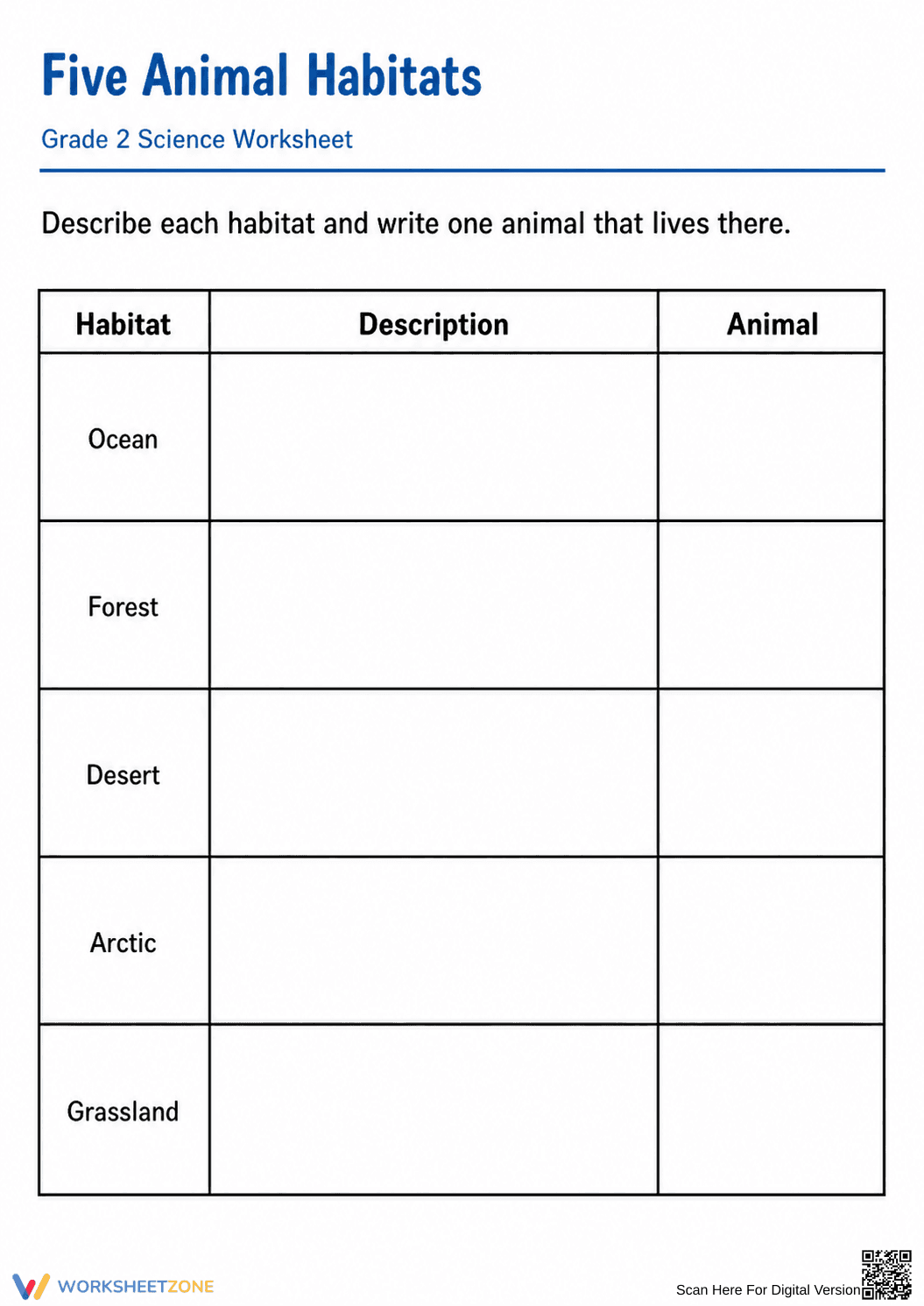

Grade 2 Animal Habitats — Printable No-Prep Worksheet

Paste this activity's link or code into your existing LMS (Google Classroom, Canvas, Teams, Schoology, Moodle, etc.).
Students can open and work on the activity right away, with no student login required.
You'll still be able to track student progress and results from your teacher account.
This Grade 2 science worksheet helps students investigate global biodiversity by describing five distinct animal habitats. By connecting environmental characteristics with specific animal residents, learners build a foundational understanding of ecological adaptation. This structured activity ensures students master life science concepts through focused observation and classification.
At a Glance
- Grade: 2 · Subject: Science
- Standard:
2-LS4-1— Compare the diversity of life in different habitats- Skill Focus: Habitat Description and Animal Identification
- Format: 1 page · 10 tasks · Answer key included · PDF
- Best For: Independent practice or quick formative assessment
- Time: 15–20 minutes
The worksheet features a clean, easy-to-read table structure presenting five primary habitats: Ocean, Forest, Desert, Arctic, and Grassland. Students are prompted to write a brief physical description of each environment and identify one animal that naturally lives there. This single-page PDF includes 10 total task entries, providing ample writing space for second-grade handwriting. A comprehensive answer key is provided to facilitate rapid grading and immediate classroom feedback.
Zero-Prep Workflow
- Print: Generate the single-page document for your entire class (30 seconds).
- Distribute: Pass out the worksheets and briefly review the five listed habitats (1 minute).
- Review: Check student responses using the included answer key during the lesson wrap-up (5 minutes).
This streamlined process requires under two minutes of total teacher preparation time, making it an ideal choice for emergency substitute plans, morning work, or quick science filler activities.
Standards Alignment
Aligned with 2-LS4-1, this resource requires students to make observations of plants and animals to compare the diversity of life in different habitats. By requiring both a physical description and a specific animal example, the worksheet ensures students analyze the direct relationships between organisms and their environments. Both standard codes can be copied directly into lesson plans, IEP goals, or district curriculum mapping tools.
How to Use It
Deploy this worksheet as a formative assessment immediately following direct instruction on global biomes. Students can work independently or utilize classroom library books to research specific habitat traits. Alternatively, use it as a collaborative "Station Rotation" activity paired with habitat-themed picture cards. While students work, observe whether they can accurately differentiate between extreme environments like the Arctic and the Desert. Expected completion time ranges from 15 to 20 minutes.
Who It's For
Designed specifically for second-grade science students, this resource is highly accessible for English Language Learners due to its predictable, highly structured table format. Teachers can easily differentiate the task by providing a pre-written word bank for the description column or allowing students to draw their animal examples. Pair this activity with a biome video tour or a whole-class anchor chart detailing the climate of each featured habitat.
Scientific inquiry in early elementary grades depends heavily on structured observation and the ability to categorize environmental data accurately. This 2-LS4-1 aligned worksheet facilitates habitat description and animal identification, which are key components of foundational biological literacy. According to the RAND AIRS 2024 report on elementary science instruction, utilizing structured graphic organizers significantly improves the retention of ecological concepts in Grade 2 learners by reducing cognitive load during complex classification tasks. By focusing on five distinct global biomes, students build a robust mental map of biodiversity that serves as a critical prerequisite for later studies in evolutionary adaptation. This tool provides educators with a quantifiable measure of a student's ability to link physical environments with biological residents. Furthermore, standard-aligned materials allow teachers to dedicate more instructional time to active student engagement rather than administrative setup.


