


























Views
Downloads

Grade 2 Ocean Habitats — Printable No-Prep Worksheet
Paste this activity's link or code into your existing LMS (Google Classroom, Canvas, Teams, Schoology, Moodle, etc.).
Students can open and work on the activity right away, with no student login required.
You'll still be able to track student progress and results from your teacher account.
This Grade 2 science worksheet gives students a focused opportunity to identify marine environments and resident animals. By practicing vocabulary classification and visual identification, learners reinforce their understanding of aquatic ecosystems. It builds foundational biological knowledge through clear, engaging exercises that yield immediate results for young scientists.
At a Glance
- Grade: 2 · Subject: Science
- Standard:
2-LS4-1— Observe animals to compare life in different habitats- Skill Focus: Ocean habitat characteristics
- Format: 2 pages · 4 problems · Answer key included · PDF
- Best For: Quick science review or sub plans
- Time: 10–15 minutes
What's Inside
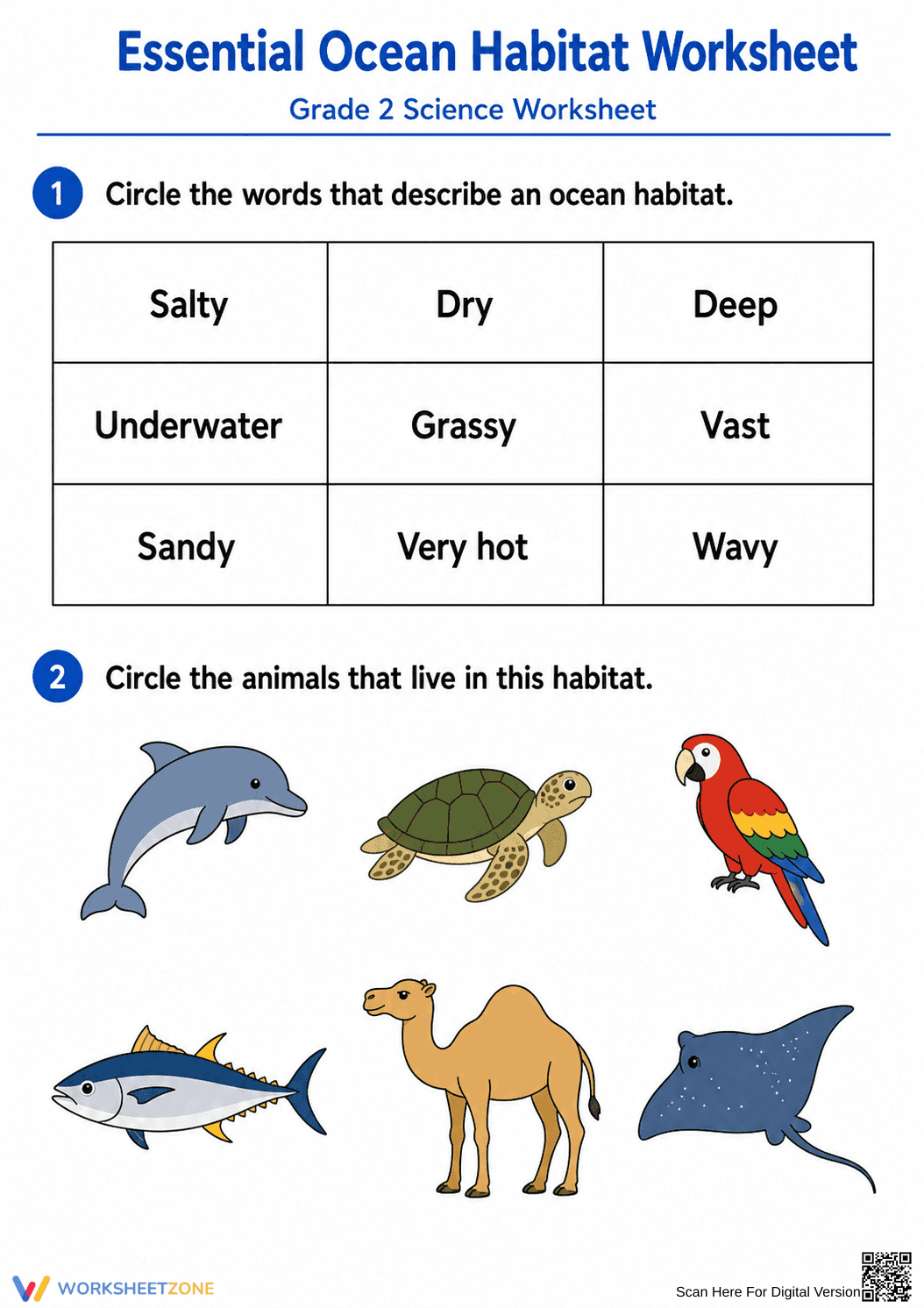
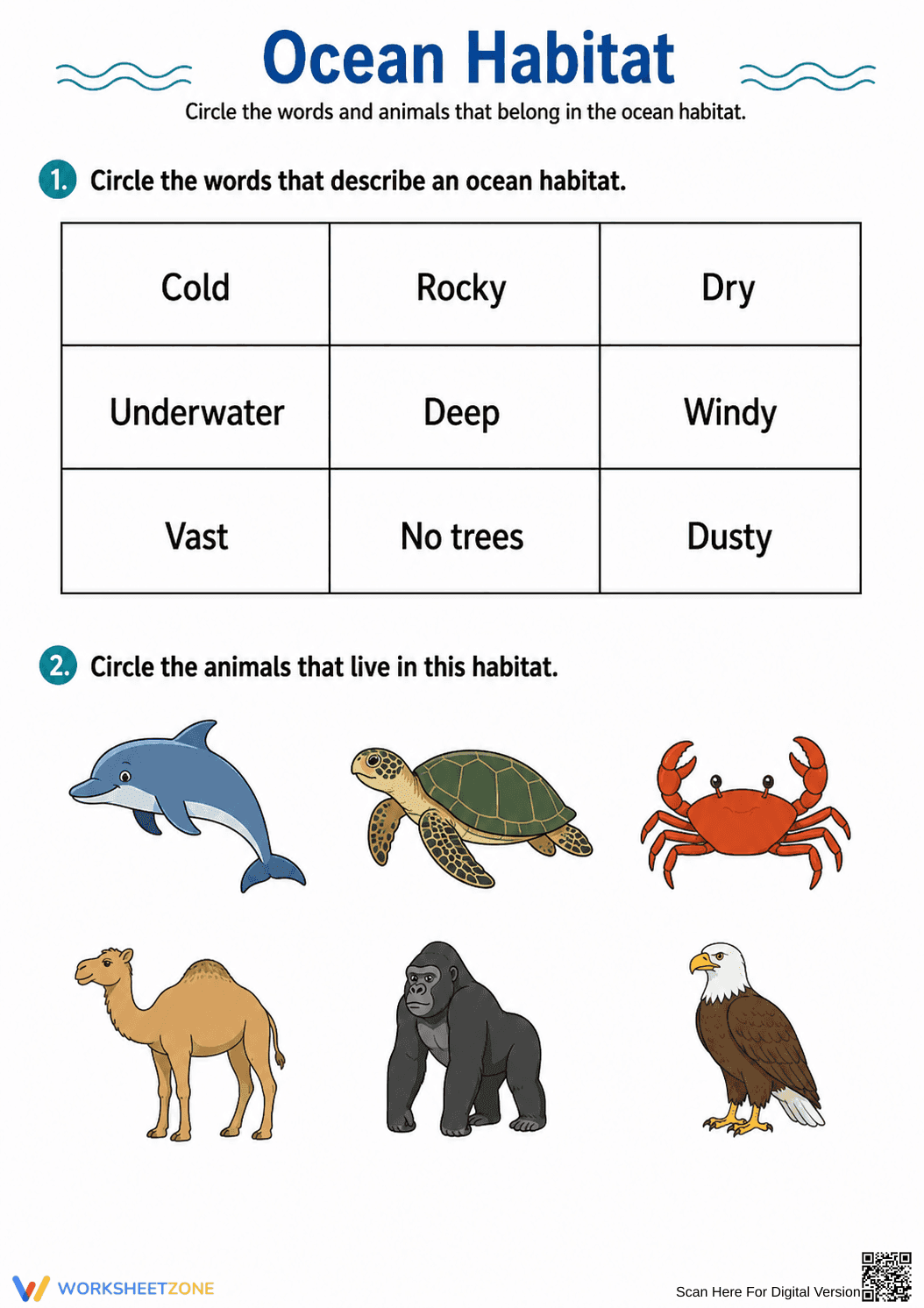
This resource consists of two worksheet pages and a comprehensive answer key. Each page features two distinct task types. The first section presents a grid of nine adjectives where students select words like "underwater" or "salty" to describe the sea. The second section features six animal illustrations, requiring students to distinguish marine life, such as dolphins and sea turtles, from land-dwelling creatures like gorillas and camels.
Zero-Prep Workflow
The zero-prep design allows for a three-step implementation that saves valuable instructional time. First, print the two-page document in seconds. Second, distribute the pages for immediate independent work without requiring complex teacher setup. Finally, use the provided answer key to review student responses in under two minutes. This highly efficient workflow makes it an ideal choice for emergency sub plans, morning work, or quick science fillers.
Standards Alignment
The primary standard is 2-LS4-1, which requires students to make observations of plants and animals to compare the diversity of life in different habitats. This worksheet focuses specifically on the ocean, allowing students to categorize physical traits and resident species. Both standard codes can be copied directly into lesson plans, IEP goals, or district curriculum mapping tools.
How to Use It
Use this as a formative assessment immediately following a direct instruction lesson on aquatic biomes. Teachers can observe students circling images to quickly identify and correct misconceptions about where specific animals live. It also serves as an excellent 10-minute warm-up activity to activate prior knowledge before starting a broader unit on marine biology or global ecosystems.
Who It's For
This material is tailored primarily for second-grade students but works exceptionally well for first-grade introductions or third-grade review sessions. It strongly supports visual learners and English Language Learners through structured vocabulary grids and clear illustrations. It pairs naturally with a classroom anchor chart on habitats or an informational reading passage about the ocean.
Aligned to the 2-LS4-1 standard, this worksheet facilitates the plain-English skill of identifying marine life and habitat traits through direct observation. According to the ScienceDirect TpT Analysis, high-quality visual scaffolds in early elementary science resources significantly improve retention of complex environmental concepts among diverse learner populations. By reducing cognitive load through clear categorizations, this worksheet allows students to focus on the essential differences between aquatic and terrestrial biomes. The inclusion of a dedicated answer key ensures that feedback is both immediate and accurate, supporting the iterative learning cycles necessary for mastery in the biological sciences. Educators can rely on this structured approach to provide rigorous, standards-aligned practice that meets the specific developmental needs of Grade 2 learners. This resource provides a verifiable data point for tracking student progress toward state and national science proficiency benchmarks in the living things category.


