




























Views
Downloads
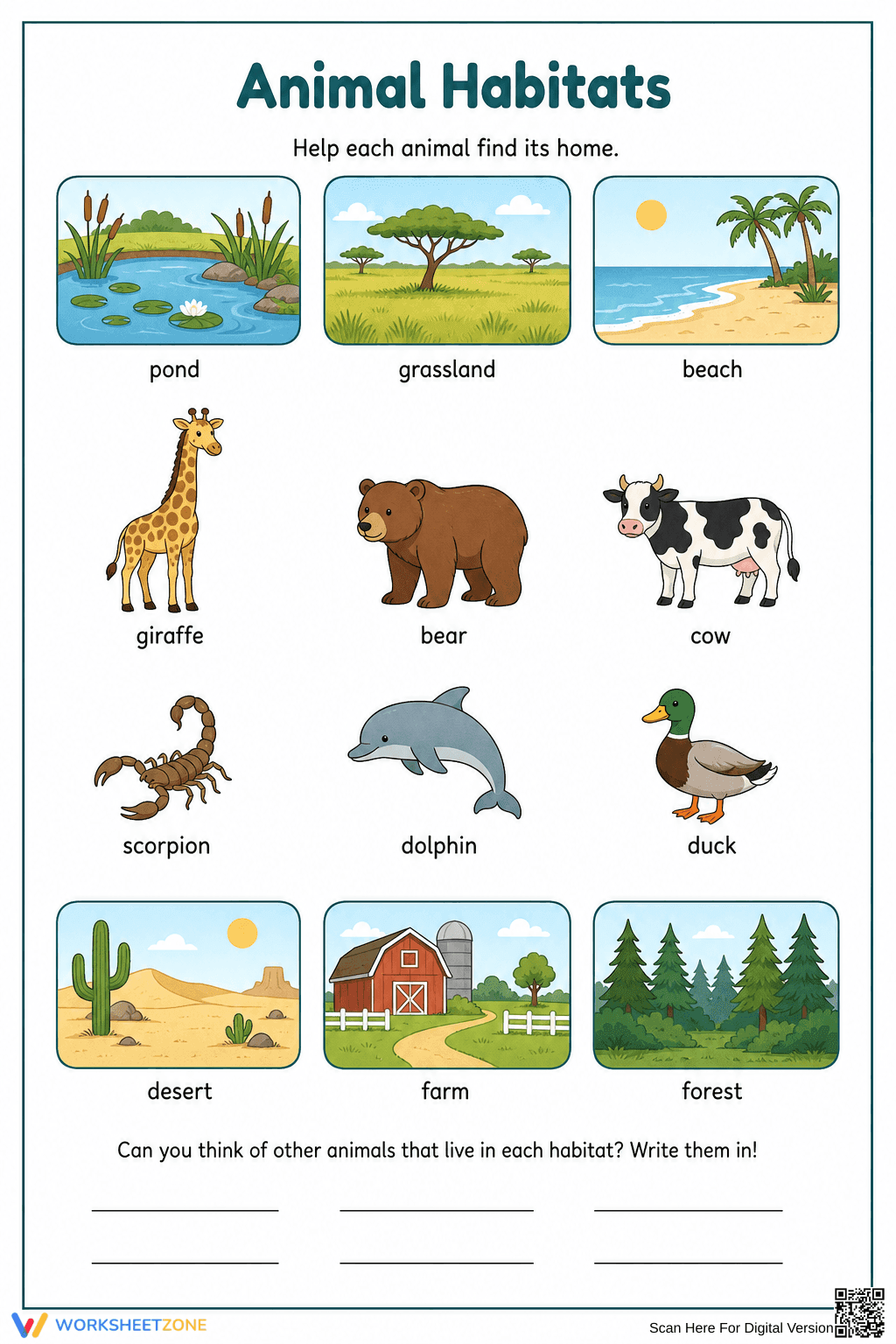

Grade 2 Animal Habitats — Printable No-Prep Worksheet

Paste this activity's link or code into your existing LMS (Google Classroom, Canvas, Teams, Schoology, Moodle, etc.).
Students can open and work on the activity right away, with no student login required.
You'll still be able to track student progress and results from your teacher account.
This Grade 2 science worksheet helps students identify where different creatures live by matching animals to their specific environments. Students explore six distinct ecosystems, including deserts and grasslands, to understand how animals survive in their natural homes. It provides a clear, visual way to introduce biological diversity.
At a Glance
- Grade: 2 · Subject: Science
- Standard:
2-LS4-1— Observe and compare the diversity of life in different habitats- Skill Focus: Habitat identification and animal classification
- Format: 1 page · 7 tasks · Answer key included · PDF
- Best For: Introduction to ecosystems or quick review
- Time: 10–15 minutes
The worksheet features high-quality illustrations of six animals and six corresponding habitats like the pond, forest, and beach. Students draw lines to connect the animal to its home. At the bottom, a critical thinking prompt asks students to brainstorm additional animals for each habitat, extending the learning beyond the page and encouraging independent research.
Zero-Prep Workflow
- Print: Generate the single-page PDF in under 30 seconds for your entire class.
- Distribute: Hand out the sheets; students can begin immediately with minimal verbal instructions.
- Review: Discuss the answers as a whole group for approximately 5 minutes to reinforce the concepts.
Total teacher preparation time is under 2 minutes, making this an ideal resource for sub plans or morning work.
Standards Alignment
This activity aligns with 2-LS4-1: "Make observations of plants and animals to compare the diversity of life in different habitats." It supports the foundational understanding that different environments support different types of living things. Both standard codes can be copied directly into lesson plans, IEP goals, or district curriculum mapping tools.
How to Use It
Use this worksheet during the "Explore" phase of a science lesson on ecosystems. After a brief discussion about what animals need to survive, hand this out to assess prior knowledge. It also serves as an excellent formative assessment tool; observe if students can correctly place the scorpion in the desert versus the dolphin in the ocean to gauge their understanding of environmental adaptations. Expect students to complete the matching and writing tasks in 10 to 15 minutes.
Who It's For
This is designed for Grade 2 students but is accessible for Grade 1 or Kindergarten with teacher support. It is particularly effective for English Language Learners (ELLs) due to the heavy reliance on visual matching and clear labeling. Pair this with a classroom anchor chart showing different world biomes for a comprehensive science unit.
Research from Fisher & Frey (2014) emphasizes the importance of visual scaffolding in early science education, noting that graphic organizers and matching tasks help students internalize complex biological classifications. This worksheet utilizes these principles by connecting specific animals to their ecological niches, meeting the 2-LS4-1 standard for observing life diversity. By requiring students to match a dolphin to a beach or a bear to a forest, the activity reinforces the concept that physical traits are linked to specific environments. The inclusion of an open-ended extension task encourages higher-order thinking, moving students from simple identification to generative categorization. Such structured practice is essential for developing the scientific literacy required by the NAEP frameworks for primary grade levels. This 1-page PDF provides a reliable, evidence-based method for assessing student mastery of basic habitat concepts in under 15 minutes of instructional time.


