


























Views
Downloads

Printable Habitat Song Worksheet | Grade 1 Science
Paste this activity's link or code into your existing LMS (Google Classroom, Canvas, Teams, Schoology, Moodle, etc.).
Students can open and work on the activity right away, with no student login required.
You'll still be able to track student progress and results from your teacher account.
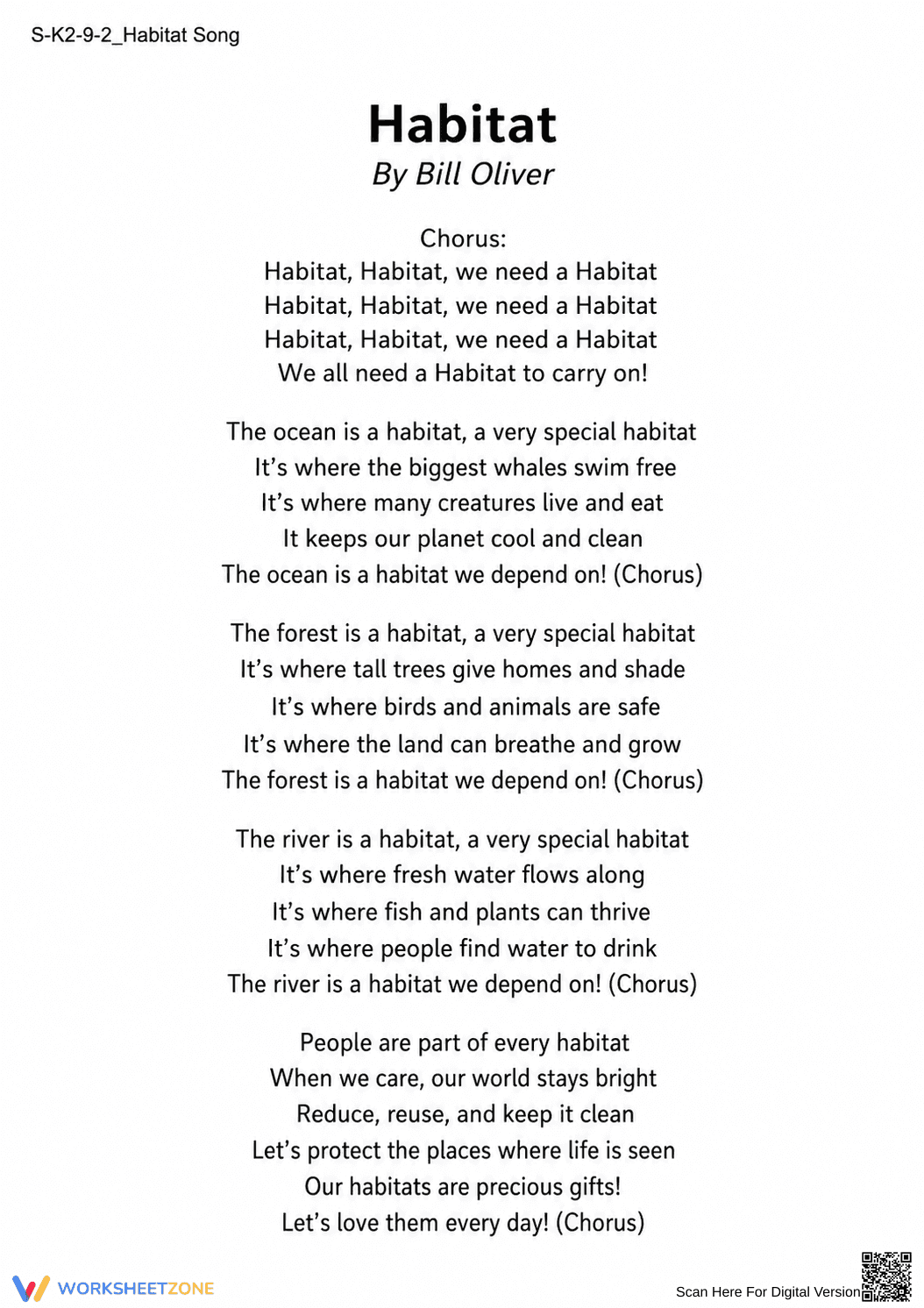
This Grade 1 science worksheet uses the power of music to help students identify diverse animal habitats and understand the human responsibility to protect them. By engaging with the "Habitat" song lyrics, learners recognize that oceans, forests, and rivers provide essential resources for survival. This activity builds foundational environmental literacy through rhythmic repetition and choral reading.
At a Glance
- Grade: 1 · Subject: Science
- Standard:
1-LS1-1— Identify how animals meet their survival needs within specific natural environments- Skill Focus: Habitat identification and environmental stewardship
- Format: 1 page · 1 song · Answer key not required · PDF
- Best For: Introduction to ecosystems and environmental care
- Time: 10–15 minutes
What's Inside
This single-page PDF contains the full lyrics to Bill Oliver's "Habitat." The text is organized into a chorus and three verses focusing on the ocean, forest, and river. Each verse highlights environmental characteristics, such as the ocean keeping the planet cool. The final stanza introduces "Reduce, reuse, and keep it clean," connecting biological needs to human conservation efforts.
Zero-Prep Workflow
This resource is designed for immediate classroom implementation with a total teacher prep time of under 2 minutes. First, print the single-page lyric sheet for each student (30 seconds). Second, distribute the copies and lead a choral reading of the lyrics to ensure all students can follow the rhythm (5 minutes). Third, review the key vocabulary—such as "habitat" and "precious"—through a brief discussion (5 minutes). This streamlined process makes it an ideal choice for a quick science hook.
Standards Alignment
The primary standard addressed is `1-LS1-1`, focusing on how organisms meet their needs. By identifying habitats like the ocean and forest, students understand the relationship between an environment and survival. Both standard codes can be copied directly into lesson plans, IEP goals, or district curriculum mapping tools.
How to Use It
Use this worksheet during the "Engage" phase of a 5E lesson cycle to spark interest in ecosystems. Teachers can play a recording of the song while students follow along with the text, pointing to words as they hear them. For a formative assessment, observe which students can identify the specific animals mentioned and link them to the correct habitat verse. This activity typically takes 15 minutes but can be extended into a creative writing prompt.
Who It's For
This resource is specifically tailored for Grade 1 students but is highly effective for Kindergarten and Grade 2 learners as well. It is particularly beneficial for English Language Learners (ELLs) who benefit from the repetitive structure and rhythmic nature of song lyrics to build vocabulary. It pairs naturally with a visual anchor chart showing different biomes.
The use of rhythmic text and music in early science education is a proven strategy for increasing student engagement and retention of complex concepts like environmental stewardship. According to the RAND AIRS 2024 report, multi-modal approaches that combine reading with auditory cues significantly improve the acquisition of domain-specific vocabulary in young learners. This worksheet aligns with these findings by utilizing the 1-LS1-1 standard to bridge the gap between biological facts and social responsibility. By focusing on the plain-English skill of identifying where organisms live, the "Habitat" song provides a memorable framework for conceptual mastery. Research from Fisher & Frey (2014) supports the use of choral reading as a high-leverage practice for building fluency and background knowledge in the primary grades, ensuring that students are prepared for more rigorous ecological studies in later years.


