




























Views
Downloads

Grade 1 Animal Habitats — Printable No-Prep Worksheet

Paste this activity's link or code into your existing LMS (Google Classroom, Canvas, Teams, Schoology, Moodle, etc.).
Students can open and work on the activity right away, with no student login required.
You'll still be able to track student progress and results from your teacher account.
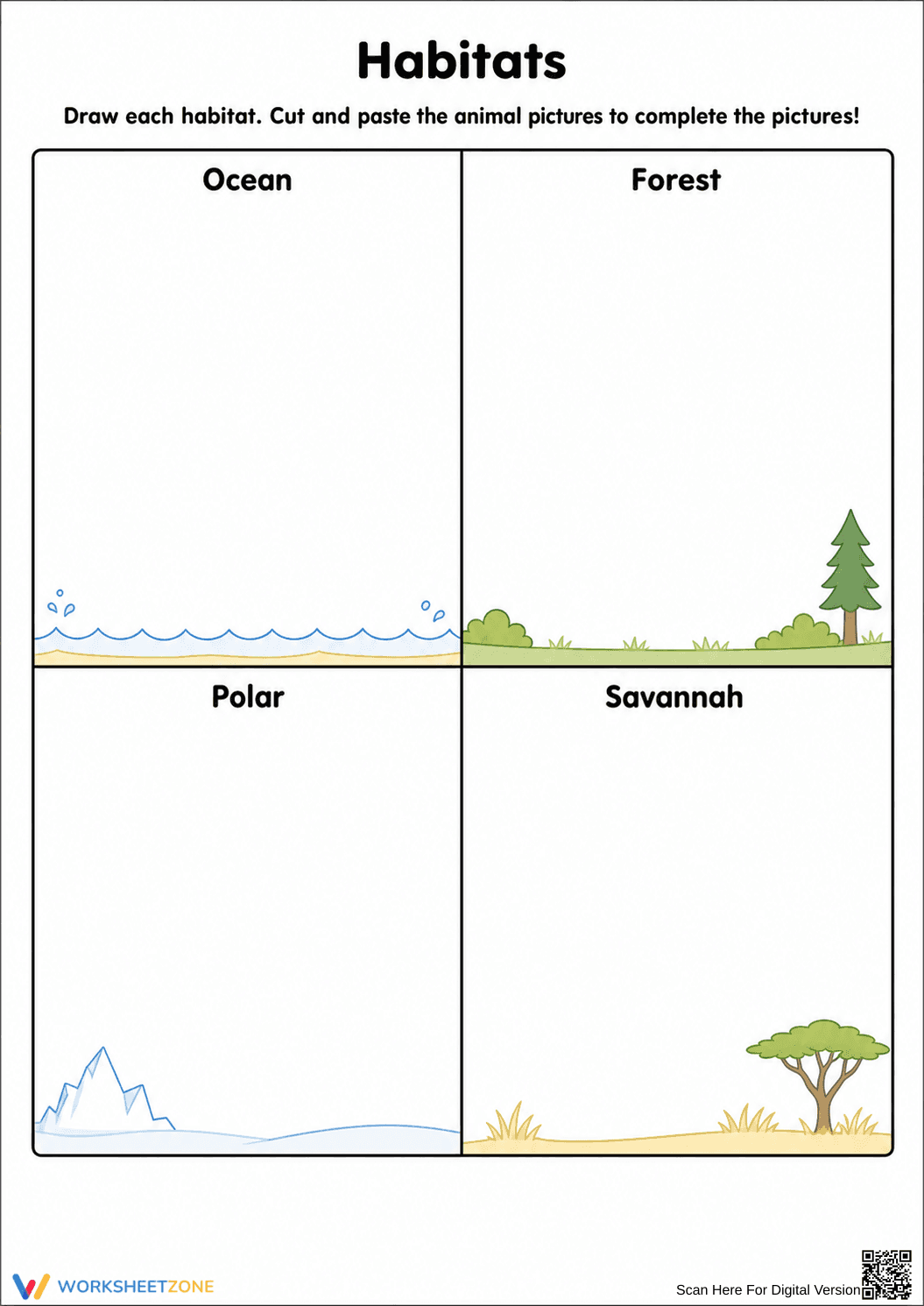
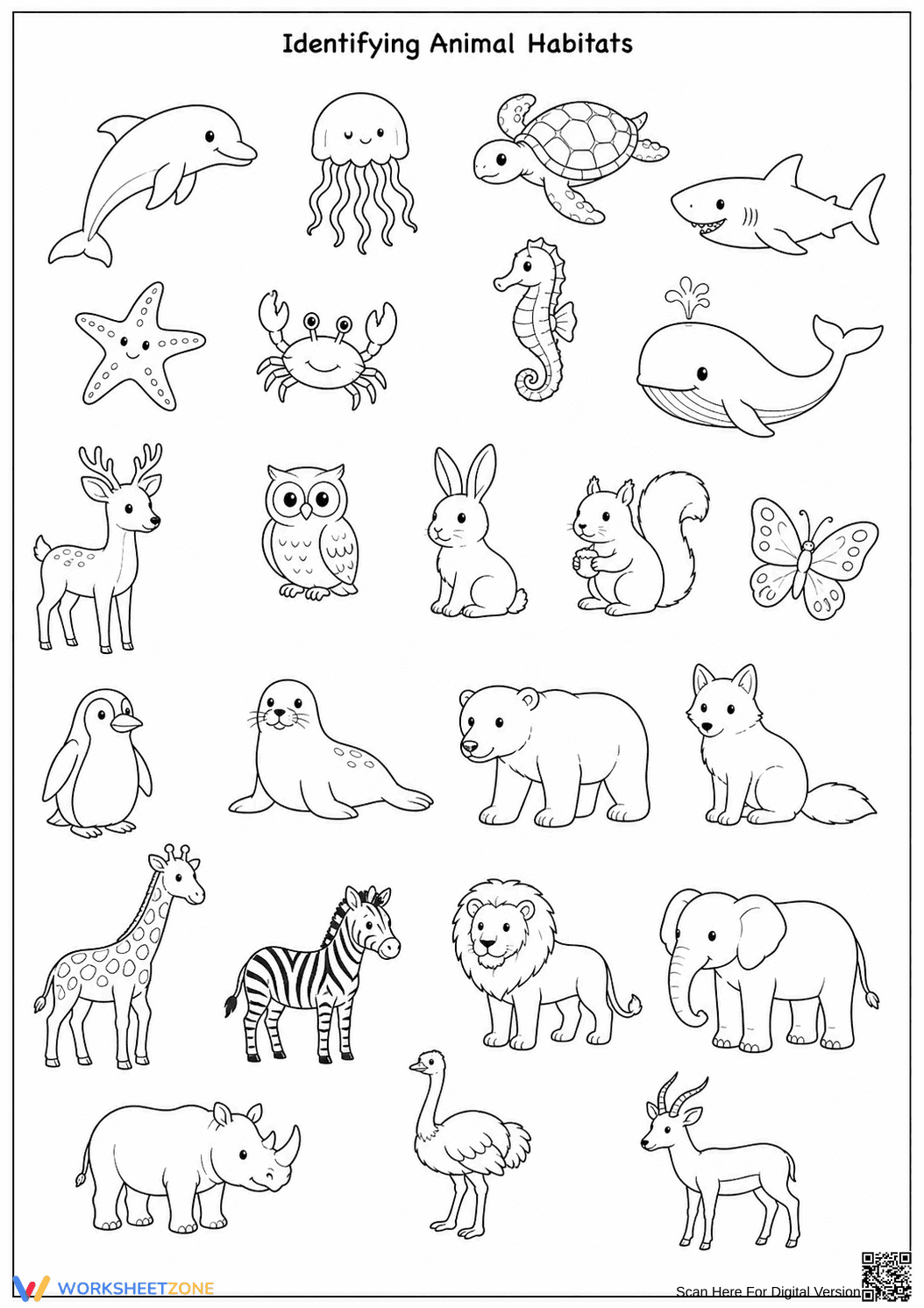
This hands-on science worksheet helps early learners identify animal habitats by matching 22 different species to their correct environments. Students will cut, sort, and paste animals into Ocean, Forest, Polar, and Savannah categories, building foundational ecology skills while practicing fine motor coordination.
At a Glance
- Grade: K-2 · Subject: Science
- Standard:
K-ESS3-1— Relate animal needs to where they live- Skill Focus: Identifying animal habitats
- Format: 2 pages · 22 problems · No answer key · PDF
- Best For: Independent practice or centers
- Time: 20–30 minutes
This two-page printable includes a primary sorting mat featuring four distinct habitat quadrants: Ocean, Forest, Polar, and Savannah. The second page provides a set of 22 clearly illustrated, black-and-white animal figures—ranging from whales and jellyfish to lions and polar bears—ready for students to color, cut out, and paste into the appropriate environmental sections. The open-ended design also encourages students to draw additional background details for each habitat.
Zero-Prep Workflow
- Print (1 minute): Simply print the two-page PDF for each student. No special materials are required beyond standard classroom scissors and glue.
- Distribute (1 minute): Hand out the worksheets along with coloring supplies. The visual instructions make the task immediately clear to early readers.
- Review (5 minutes): Circulate as students sort the animals, asking guiding questions about why specific physical traits belong in certain climates. Total teacher prep time is under two minutes, making this an excellent emergency sub plan.
Standards Alignment
This activity aligns with K-ESS3-1: Use a model to represent the relationship between the needs of different plants or animals and the places they live. By categorizing animals based on their natural environments, students demonstrate an understanding of how specific habitats support specific forms of life. Both standard codes can be copied directly into lesson plans, IEP goals, or district curriculum mapping tools.
How to Use It
Deploy this worksheet during independent science centers after a whole-class read-aloud about ecosystems. It also works beautifully as a Friday afternoon cross-curricular activity combining science with fine motor skills. As a formative assessment tip, observe whether students correctly place the transitional animals (like the seal or penguin) and ask them to verbally justify their choices. Expected completion time is 20 to 30 minutes depending on coloring detail.
Who It's For
This resource is designed for Kindergarten through 2nd-grade students exploring basic biology and ecology. It naturally differentiates for varied ability levels; advanced students can add detailed background drawings to the habitats, while students needing support can focus purely on the sorting mechanic. Pair this activity with a classroom anchor chart displaying real photographs of the four target biomes.
Integrating tactile sorting activities into early science instruction significantly reinforces conceptual retention regarding ecosystems. When students engage with K-ESS3-1 to relate animal needs to where they live, the physical act of cutting and categorizing visual models helps solidify abstract ecological relationships. According to Fisher & Frey (2014), instructional frameworks that combine motor skills with cognitive categorization tasks lead to deeper schema formation in primary-aged learners. This habitat matching exercise provides a concrete, visual method for young students to process environmental diversity, moving beyond passive observation into active classification. By requiring learners to justify why a polar bear cannot survive in a savannah, educators facilitate critical thinking about biological adaptations. This foundational understanding of habitats prepares students for more complex life science concepts in later grades.


