


























Views
Downloads

Grade 1 Animal Habitats — Printable No-Prep Worksheet
Paste this activity's link or code into your existing LMS (Google Classroom, Canvas, Teams, Schoology, Moodle, etc.).
Students can open and work on the activity right away, with no student login required.
You'll still be able to track student progress and results from your teacher account.
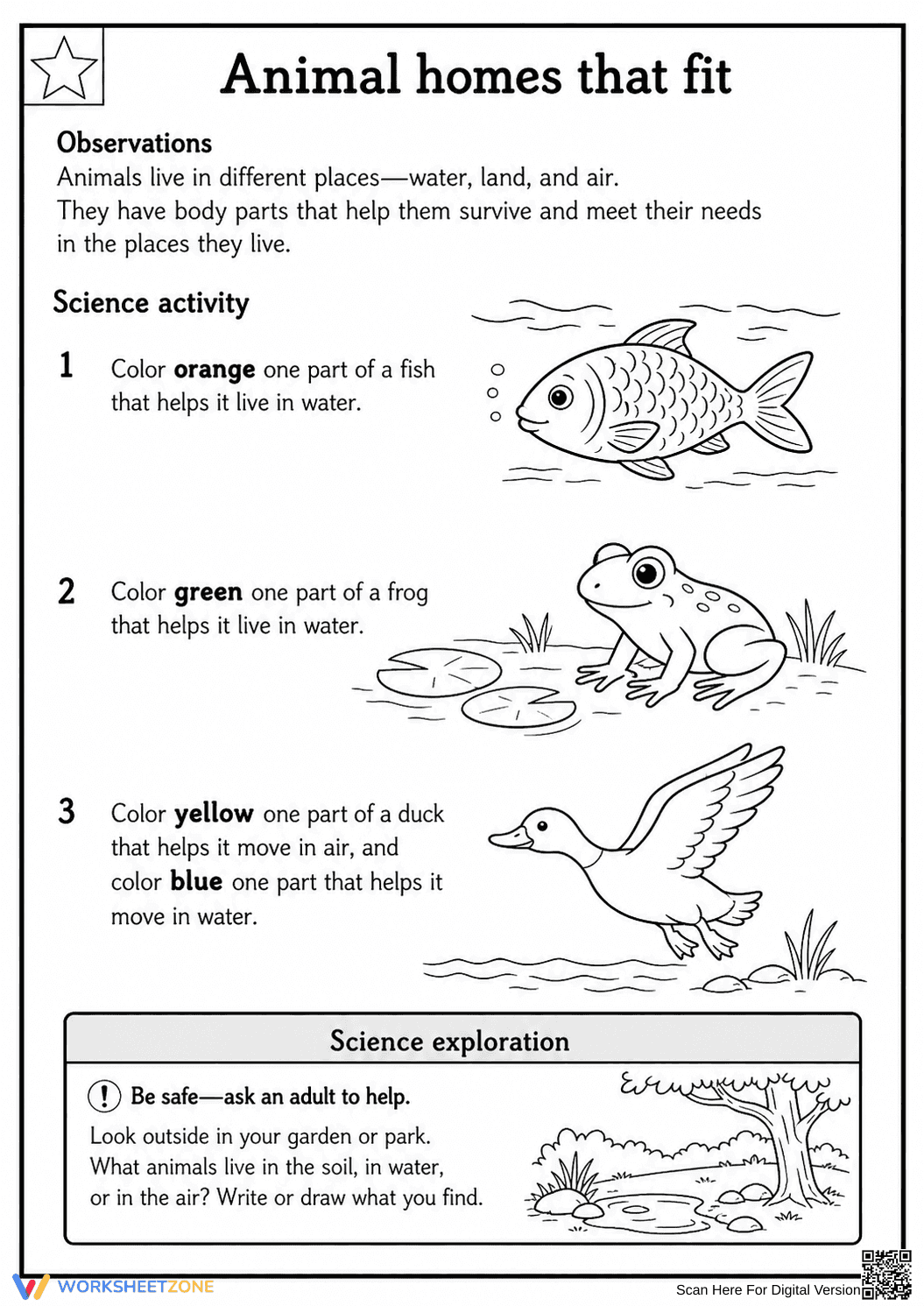
This animal habitats worksheet helps Grade 1 and Grade 2 students identify how specific physical features allow creatures to thrive in unique environments. By observing ducks, frogs, and goldfish, learners connect biological adaptations to survival needs. This resource simplifies complex science concepts into actionable observations that young scientists can easily apply in real-world settings.
At a Glance
- Grade: Grade 1 · Subject: Living Things
- Standard:
1-LS1-1— Use animal parts to help them survive, grow, and meet their needs- Skill Focus: Animal Adaptations and Habitats
- Format: 1 page · 4 problems · Answer key included · PDF
- Best For: Zero-prep science center or homework assignment
- Time: 15–25 minutes
What's Inside
The worksheet features a structured "Observations" introduction followed by a three-part "Science activity" where students use color-coding to identify adaptive traits like fins and webbed feet. It concludes with a "Science exploration" outdoor investigation prompt. This single-page PDF includes clear illustrations and a teacher-ready answer key to ensure a smooth transition to practical observation.
Zero-Prep Workflow
Implementing this resource requires minimal effort, making it ideal for busy educators or substitute plans. First, print the single-page PDF (30 seconds). Next, distribute sheets and explain the color-coding tasks (2 minutes). Finally, review the connections using the included key (5 minutes). The total teacher preparation time is under two minutes, allowing focus on the student-led exploration phase.
Standards Alignment
This resource is primarily aligned to 1-LS1-1, requiring students to understand how animals use external parts to survive. It also supports 2-LS4-1 by encouraging comparisons between different habitats. Both standard codes can be copied directly into lesson plans, IEP goals, or district curriculum mapping tools to ensure rigorous and accurate instructional compliance.
How to Use It
Use this worksheet during the "Explain" phase of a science lesson to reinforce the concept of biological niches. For formative assessment, observe students during the color-coding task to identify misconceptions about body functions in water versus air. The expected completion time is 15 minutes, with the optional outdoor exploration taking an additional 20 minutes if conducted.
Who It's For
Designed for Grade 1 and Grade 2, this worksheet offers scaffolds through visual cues and direct coloring prompts. It is effective for English Language Learners who benefit from the strong image-to-text correlation. Pair this with a picture book about animal homes or a video showing animals in their natural habitats to provide a multisensory learning experience.
This Grade 1 science resource focuses on animal adaptations, specifically targeting the 1-LS1-1 standard. By requiring students to identify external structures that facilitate survival in water, land, or air, the worksheet builds a foundational understanding of biological fitness. Research from ScienceDirect TpT Analysis indicates that structured observational activities for early elementary students significantly improve the retention of scientific vocabulary and the ability to synthesize relationships between organisms and their environments. The inclusion of an "exploration" component aligns with best practices in inquiry-based learning, ensuring that students transition from passive identification to active scientific inquiry. This evidence-based approach provides a robust framework for introducing life science concepts, making it a valuable addition to any standards-aligned curriculum. The worksheet serves as a clear indicator of mastery for early biological observations and habitat classification.


