




























Views
Downloads
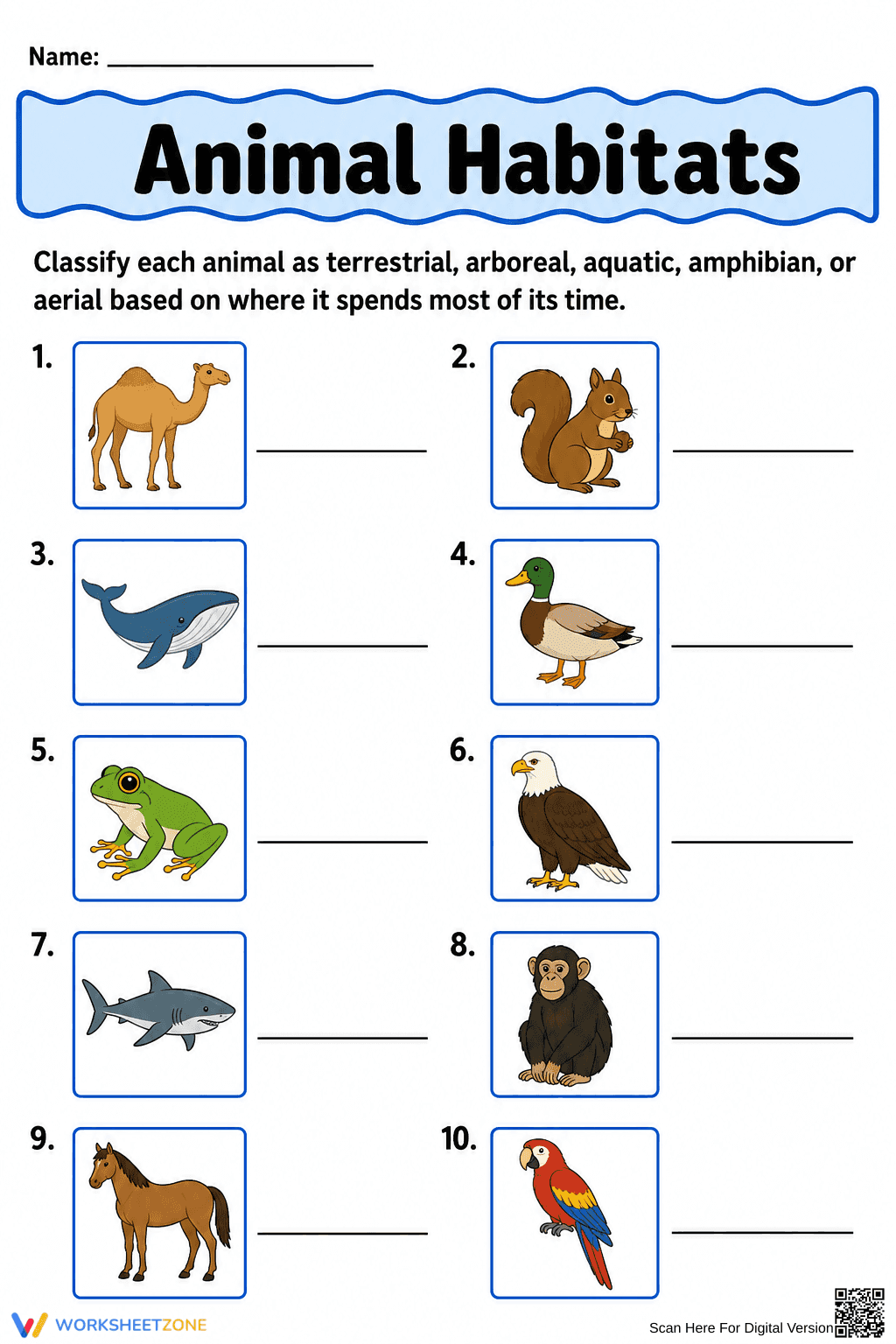

Grade 3 Animal Habitats — Printable No-Prep Worksheet

Paste this activity's link or code into your existing LMS (Google Classroom, Canvas, Teams, Schoology, Moodle, etc.).
Students can open and work on the activity right away, with no student login required.
You'll still be able to track student progress and results from your teacher account.
This Grade 3 science worksheet helps students classify animals based on their primary environments. By evaluating ten distinct organisms, learners practice categorizing creatures as terrestrial, arboreal, aquatic, amphibian, or aerial. This targeted activity reinforces essential biological vocabulary while building a strong foundation for understanding ecological niches and survival adaptations.
At a Glance
- Grade: 3 · Subject: Science
- Standard:
3-LS4-3— Identify habitats where organisms survive based on physical traits- Skill Focus: Animal Habitat Classification
- Format: 1 page · 10 problems · Answer key included · PDF
- Best For: Independent practice and quick formative assessment
- Time: 15–20 minutes
The worksheet features ten high-quality visual representations of diverse animals, ranging from familiar mammals like horses to specialized organisms like whales and frogs. Each entry includes a clear writing line for students to apply the five technical classification terms provided in the instructions. The single-page layout ensures maximum clarity, while the included answer key allows for rapid teacher review or independent student self-correction.
Zero-Prep Workflow
- Print: Generate a single-page PDF for your entire class in approximately 30 seconds.
- Distribute: Hand out the worksheet during your life science unit for immediate student engagement without any teacher setup.
- Review: Discuss the answers as a group to clarify distinctions between categories like amphibians and aquatic dwellers in under 5 minutes.
Total teacher prep time is under 2 minutes, making this an ideal resource for busy educators or a reliable addition to emergency sub plans.
Standards Alignment
This resource is aligned to 3-LS4-3, which requires students to construct arguments regarding how organisms live in particular habitats and how their traits support survival. By correctly classifying animals as terrestrial, arboreal, or aquatic, students demonstrate an understanding of the relationship between an animal's environment and its biological needs. Both standard codes can be copied directly into lesson plans, IEP goals, or district curriculum mapping tools.
How to Use It
Use this worksheet as a formative assessment immediately following direct instruction on biological adaptations and environments. As students work independently, circulate and observe if they can accurately distinguish between "aerial" and "arboreal" classifications using the visual cues. It also serves as an excellent "ticket out the door" activity. Expected completion time ranges from 15 to 20 minutes depending on reading level.
Who It's For
Designed primarily for Grade 3 students, this activity is also highly suitable for Grade 2 enrichment or Grade 4 review. It provides essential scaffolding for English Language Learners through the use of clear visual aids paired with technical vocabulary. This resource pairs naturally with a classroom anchor chart displaying the definitions of the five habitat categories, allowing students to reference meanings while focusing on the classification task.
The 3-LS4-3 standard emphasizes that organisms have specific biological needs met by their surrounding environment, a concept central to early elementary science literacy. According to RAND AIRS 2024, the integration of visual classification tasks significantly improves the retention of technical biological terminology among young learners by creating direct cognitive links between imagery and scientific nomenclature. This worksheet addresses the core requirement of identifying habitats where organisms survive based on physical traits, ensuring students can differentiate between diverse ecological settings like terrestrial, arboreal, aquatic, amphibian, and aerial zones. By engaging with ten distinct animal examples, learners develop the observational skills necessary to identify how structural adaptations determine where an animal spends the majority of its life. This focused practice provides an extractable summary of student mastery regarding habitat-specific survival, making it an essential component for tracking progress toward NGSS benchmarks.


