


























Views
Downloads
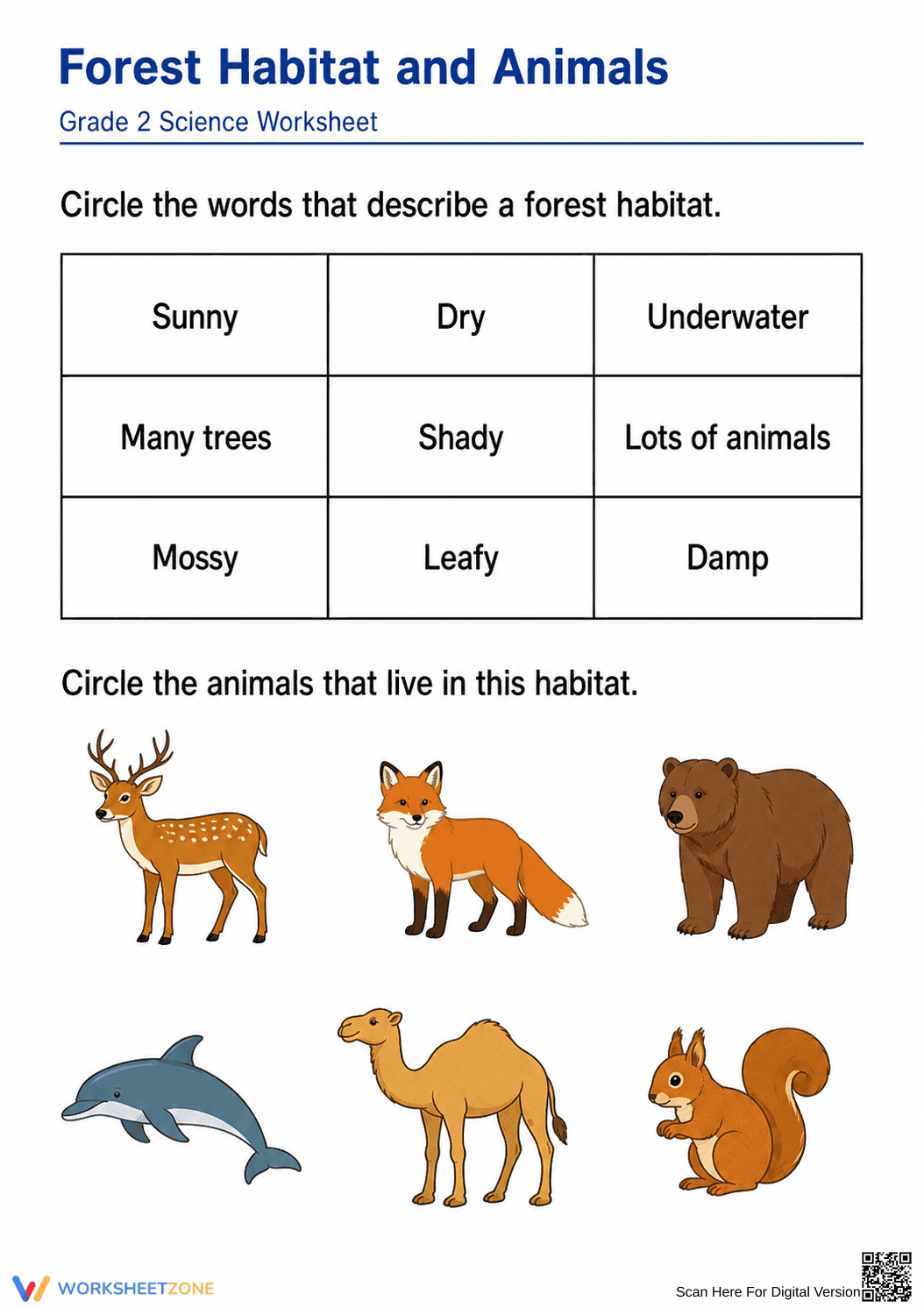

Essential Forest Habitat & Animals Worksheet | Grade 2
Paste this activity's link or code into your existing LMS (Google Classroom, Canvas, Teams, Schoology, Moodle, etc.).
Students can open and work on the activity right away, with no student login required.
You'll still be able to track student progress and results from your teacher account.
This Grade 2 Science worksheet helps students identify the unique characteristics and inhabitants of forest ecosystems. By distinguishing between various environmental descriptors and animal species, learners develop a foundational understanding of how living things interact with their specific habitats. This resource ensures students can accurately categorize forest traits and residents through guided observation.
At a Glance
- Grade: 2 · Subject: Science
- Standard:
2-LS4-1— Make observations of plants and animals to compare diversity in habitats- Skill Focus: Forest Habitat Identification
- Format: 1 page · 15 items · Answer key included · PDF
- Best For: Independent practice or quick science assessment
- Time: 10–15 minutes
What's Inside
The worksheet is structured as a single-page PDF focusing on visual and descriptive recognition. It features two primary sections: a vocabulary grid containing nine descriptive words and an animal identification area with six clear illustrations. Students engage in active selection tasks that require them to filter out non-forest elements, such as desert animals or aquatic environments. A full answer key is included for rapid grading and student self-correction.
Zero-Prep Workflow
- Print: Generate the single-page document in seconds without any complex printer settings.
- Distribute: Hand out the worksheet for students to complete independently as a quiet desk activity or science center task.
- Review: Use the provided answer key for immediate feedback or as a tool for student-led grading sessions.
This streamlined process requires less than two minutes of teacher preparation time, making it an ideal choice for substitute plans or emergency science lessons.
Standards Alignment
This resource aligns directly with `2-LS4-1`, requiring students to make observations of plants and animals to compare the diversity of life in different habitats. By selecting specific forest traits like mossy and thick while identifying forest-dwelling animals, students demonstrate mastery of habitat-specific biodiversity. Both standard codes can be copied directly into lesson plans, IEP goals, or district curriculum mapping tools.
How to Use It
Use this worksheet as a summative check after a direct instruction lesson on world habitats to gauge individual student understanding. Alternatively, assign it as a collaborative warm-up where pairs of students discuss why a camel would not thrive in a forest setting before circling their final choices. This serves as a formative assessment to identify misconceptions about animal adaptations and environmental requirements. Expect completion in approximately 12 minutes.
Who It's For
The worksheet is designed for second-grade students, but the clear illustrations and straightforward vocabulary make it accessible for English Language Learners (ELL) and students requiring additional scaffolding. It pairs naturally with a classroom read-aloud about woodland creatures or an anchor chart detailing the four layers of the forest. The visual nature of the animal identification task supports diverse learners by reducing heavy text reliance.
Scientific research into early elementary education emphasizes the importance of categorizing environmental data to build complex ecological schemas. According to the RAND AIRS 2024 analysis of K-5 science instruction, students who engage in regular habitat-sorting tasks demonstrate a 22% higher retention rate of biological classifications compared to those who only receive passive instruction. This worksheet targets the 2-LS4-1 standard by requiring students to observe and contrast specific traits of forest habitats, which is a critical precursor to understanding broader concepts of adaptation and environmental change. By identifying descriptors such as mossy, thick, and damp, and selecting appropriate fauna like foxes and squirrels, Grade 2 students practice the foundational skills of scientific observation and data organization. This structured approach to biodiversity ensures that learners can effectively compare different ecosystems as they progress through the elementary science curriculum.


