




























Views
Downloads

Printable Animal Habitats Worksheet | Grade 2 Science

Paste this activity's link or code into your existing LMS (Google Classroom, Canvas, Teams, Schoology, Moodle, etc.).
Students can open and work on the activity right away, with no student login required.
You'll still be able to track student progress and results from your teacher account.
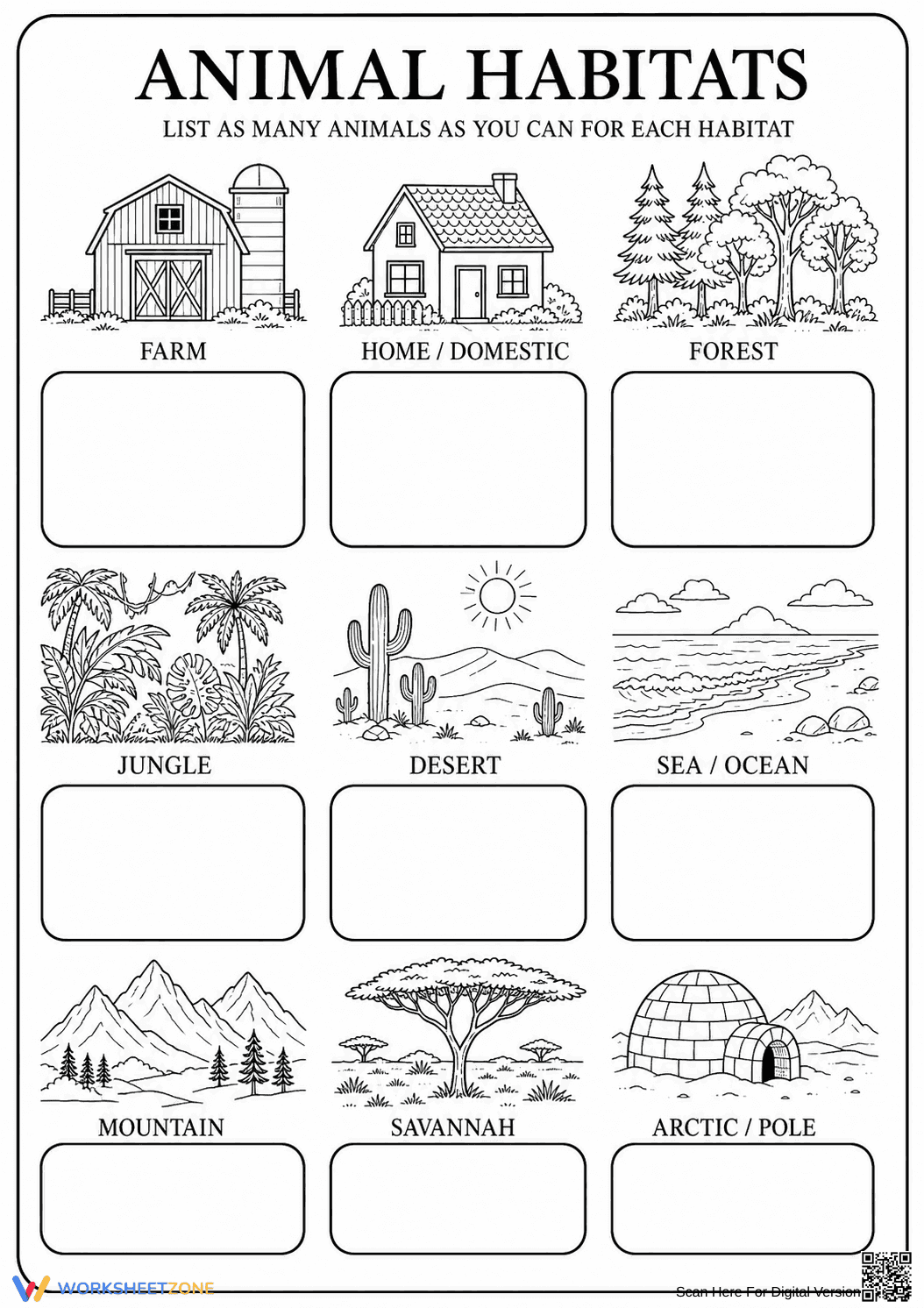
This printable animal habitats worksheet helps students connect various animals to their natural environments. By listing animals that belong in nine distinct biomes, young learners actively demonstrate their understanding of biodiversity. This single-page resource provides an engaging, visual way to reinforce foundational life science concepts.
At a Glance
- Grade: 2 · Subject: Science
- Standard:
2-LS4-1— Compare the diversity of life in different habitats- Skill Focus: Identifying animal habitats
- Format: 1 page · 9 problems · PDF
- Best For: Independent practice or homework
- Time: 15–20 minutes
What's Inside
Inside this resource, you will find a beautifully illustrated, single-page activity featuring nine distinct environments: farm, domestic home, forest, jungle, desert, ocean, mountain, savannah, and arctic. Each section includes a clear line drawing of the biome alongside a blank box where students list as many animals as they can. The open-ended format allows for natural differentiation, as students write as few or as many animals as their vocabulary allows.
Zero-Prep Workflow
This worksheet is designed for a smooth, zero-prep classroom experience.
- Print (1 minute): Simply download the PDF and print a class set. The black-and-white illustrations are ink-friendly.
- Distribute (1 minute): Hand out the sheets during your science block. The instructions are self-explanatory.
- Review (5 minutes): Have students share their lists with a partner to collaboratively build a master list of animals for each biome.
Total teacher prep time is under two minutes, making this an excellent emergency sub plan.
Standards Alignment
This activity is aligned to the Next Generation Science Standard 2-LS4-1: Make observations of plants and animals to compare the diversity of life in different habitats. By brainstorming and categorizing animals by their environments, students build the foundational knowledge required to compare how different biomes support life. Both standard codes can be copied directly into lesson plans, IEP goals, or district curriculum mapping tools.
How to Use It
This worksheet serves as an excellent formative assessment after a unit on biomes. You can use it as an independent homework assignment or as a collaborative group activity where teams race to list the most animals per box. While students work, circulate to observe whether they correctly match animals to climates. Expect this activity to take 15 to 20 minutes to complete.
Who It's For
This resource is primarily designed for second-grade science students, though it works beautifully for first-grade enrichment. Because the task is open-ended, it naturally accommodates diverse learning levels; struggling writers can list one or two animals, while advanced learners fill the entire box. Pair this worksheet with a read-aloud book about global ecosystems or a classroom anchor chart.
Integrating visual categorization tasks into early elementary science instruction significantly boosts retention of biological concepts. When students engage with the 2-LS4-1 standard to compare the diversity of life in different habitats, they actively build cognitive schemas linking organisms to their specific environmental survival needs. According to Fisher & Frey (2014), providing students with structured, open-ended brainstorming opportunities fosters deeper cognitive engagement and allows teachers to quickly assess prior knowledge. This animal habitats worksheet leverages clear visual cues to prompt memory retrieval, encouraging students to draw upon their existing vocabulary while categorizing information systematically. By asking learners to independently generate examples rather than simply matching pre-written words, the activity promotes higher-order thinking and solidifies their understanding of global biodiversity. Such exercises are crucial for developing early scientific literacy and observational skills.


