


























Views
Downloads
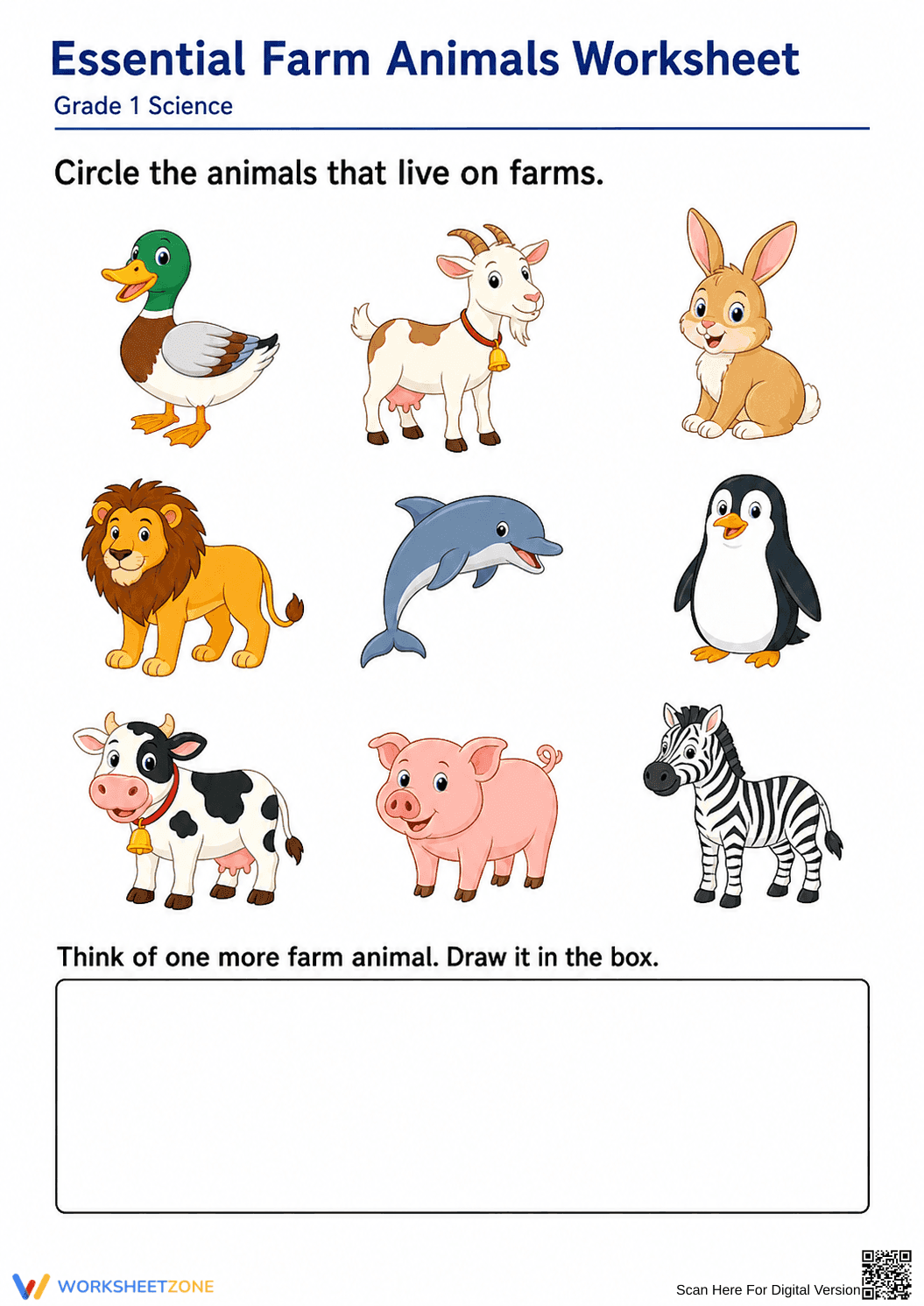

Grade 1 Farm Animals — Printable No-Prep Worksheet
Paste this activity's link or code into your existing LMS (Google Classroom, Canvas, Teams, Schoology, Moodle, etc.).
Students can open and work on the activity right away, with no student login required.
You'll still be able to track student progress and results from your teacher account.
This Grade 1 Science worksheet helps students identify farm animals and distinguish them from creatures in other habitats. By evaluating nine different animals and drawing one of their own, young learners practice foundational classification skills and demonstrate their understanding of specific environmental needs and biological diversity.
At a Glance
- Grade: 1 · Subject: Science
- Standard:
1-LS1-1— Identify animals that live on a farm- Skill Focus: Animal Habitats
- Format: 1 page · 10 problems · Answer key included · PDF
- Best For: Quick science review
- Time: 10–15 minutes
This single-page PDF features a vibrant array of animal illustrations, including livestock, wild animals, and sea creatures. Students complete nine primary identification tasks by circling the correct farm-dwelling animals. A final extension task provides a blank box where students apply their knowledge by brainstorming and drawing an additional farm animal not shown on the page. A complete answer key is included for easy grading.
Zero-Prep Workflow
The streamlined design ensures this worksheet is ready for immediate classroom use with under two minutes of teacher preparation. First, Print the single-page document (30 seconds). Next, Distribute to students for a quick warm-up or bell-ringer activity (1 minute). Finally, Review student choices as a whole group to discuss why certain animals like dolphins or penguins do not belong on a farm (2 minutes). It is an ideal, self-explanatory resource for emergency sub plans.
Standards Alignment
This worksheet aligns primarily with 1-LS1-1, focusing on how animals meet their needs within specific environments and habitats. By identifying farm animals, students begin to understand the relationship between an organism's characteristics and its surroundings. Both standard codes can be copied directly into lesson plans, IEP goals, or district curriculum mapping tools.
How to Use It
Assign this worksheet as a formative assessment after an introductory direct instruction lesson on animal habitats to check for student understanding. Alternatively, use it as an independent morning work activity. For a deeper formative observation, ask students to explain verbally why they did not circle the lion or the zebra, noting their ability to articulate specific habitat requirements. Expected completion time ranges from 10 to 15 minutes.
Who It's For
Designed primarily for first-grade students, this resource is also highly suitable for kindergarten enrichment or second-grade review. For students needing extra support, limit the choices by covering half the page. It pairs naturally with a classroom anchor chart on animal homes or a read-aloud book about life on a farm.
According to the RAND AIRS 2024 report on early childhood science education, structured classification tasks are vital for developing categorical reasoning in primary students during their foundational years. This Grade 1 worksheet focuses on the plain-English skill of identifying animals within their appropriate habitats, specifically targeting farm environments to build early environmental literacy. By engaging with 1-LS1-1 concepts through visual identification and creative drawing, students solidify their understanding of biological diversity and environmental suitability in a highly concrete way. The research emphasizes that such scaffolds support the gradual release of responsibility, moving students from simple visual recognition to the independent application of scientific concepts. This resource provides a practical, research-based method for evaluating student progress in early life science curricula while encouraging creative thinking. Educators can utilize these findings to better map student growth against district-wide benchmarks for scientific observation.


