




























Views
Downloads
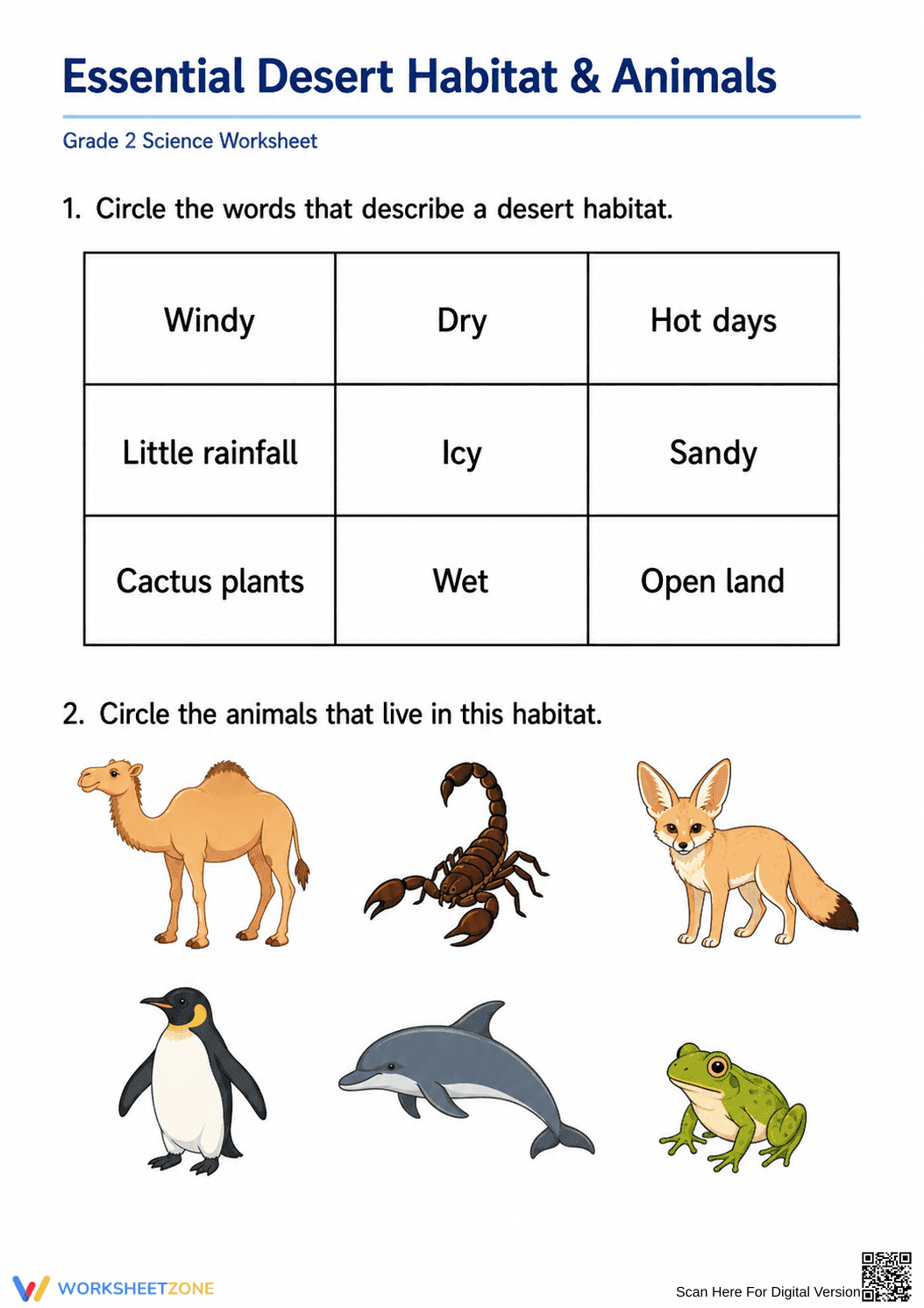

Essential Desert Habitat & Animals Worksheet | Grade 2 Ready

Paste this activity's link or code into your existing LMS (Google Classroom, Canvas, Teams, Schoology, Moodle, etc.).
Students can open and work on the activity right away, with no student login required.
You'll still be able to track student progress and results from your teacher account.
This Grade 2 science worksheet provides a clear and focused exploration of desert ecosystems, helping students identify key environmental characteristics and the animals that thrive in arid conditions. By engaging with both descriptive vocabulary and visual animal identification, learners develop a robust understanding of how specific traits define one of Earth's most extreme biomes.
At a Glance
- Grade: 2 · Subject: Science
- Standard:
2-LS4-1— Make observations of plants and animals to compare the diversity of life- Skill Focus: Desert habitat characteristics and animal identification
- Format: 1 page · 2 tasks · Answer key included · PDF
- Best For: Introduction to biomes and animal adaptations
- Time: 15–20 minutes
What's Inside
This single-page PDF features two distinct sections designed for early elementary learners. The first task presents a 3x3 grid of environmental descriptors, challenging students to select terms like "dry" and "little rainfall" that accurately define a desert. The second task provides six high-quality animal illustrations, requiring students to distinguish desert-dwelling creatures from those found in other habitats. A full answer key is provided for rapid grading.
Zero-Prep Workflow
- Print (1 minute): Generate copies of the high-resolution PDF for your entire class or science center.
- Distribute (1 minute): Hand out the sheets; the self-explanatory instructions require no additional teacher explanation.
- Review (5 minutes): Use the included answer key to conduct a quick whole-class check or formative assessment.
Total teacher prep time is under two minutes, making this an ideal choice for emergency sub plans or morning work.
Standards Alignment
This resource is aligned to the primary standard 2-LS4-1, which requires students to make observations of plants and animals to compare the diversity of life in different habitats. It specifically supports the understanding of how physical characteristics of an environment determine the types of life that can survive there. This standard code can be copied directly into lesson plans, IEP goals, or district curriculum mapping tools.
How to Use It
Use this worksheet as a concluding activity during your initial lesson on Earth's biomes to check for understanding. It works exceptionally well as a formative assessment after watching a video about desert life or reading a short informational text. During the activity, observe if students can differentiate between "icy" and "sandy" to gauge their grasp of climate extremes. Expect completion in approximately 15 minutes.
Who It's For
Designed primarily for second-grade science students, this worksheet is also suitable for third-grade review or for ELL students who benefit from visual aids in science vocabulary building. It pairs naturally with an anchor chart showing different world habitats or a reading passage about animal adaptations. The clear layout supports independent work during science centers or integrated literacy blocks.
According to RAND AIRS 2024 research, visual identification tasks in primary science help solidify complex ecological concepts like adaptation and biome characteristics. This Grade 2 desert habitat worksheet aligns with the 2-LS4-1 standard, focusing on the diversity of life in specific environments. By requiring students to differentiate between climate descriptors such as "dry" or "sandy" and identify specific fauna like camels and scorpions, the resource builds a foundational understanding of how organisms interact with their physical surroundings. ScienceDirect TpT Analysis suggests that high-interest visuals coupled with structured vocabulary selection significantly improve retention of scientific terminology in early elementary learners. This worksheet serves as a reliable instrument for formative assessment, allowing educators to quickly gauge student mastery of habitat-specific traits and animal distribution without the need for extensive preparatory materials or specialized equipment.


