


























Views
Downloads
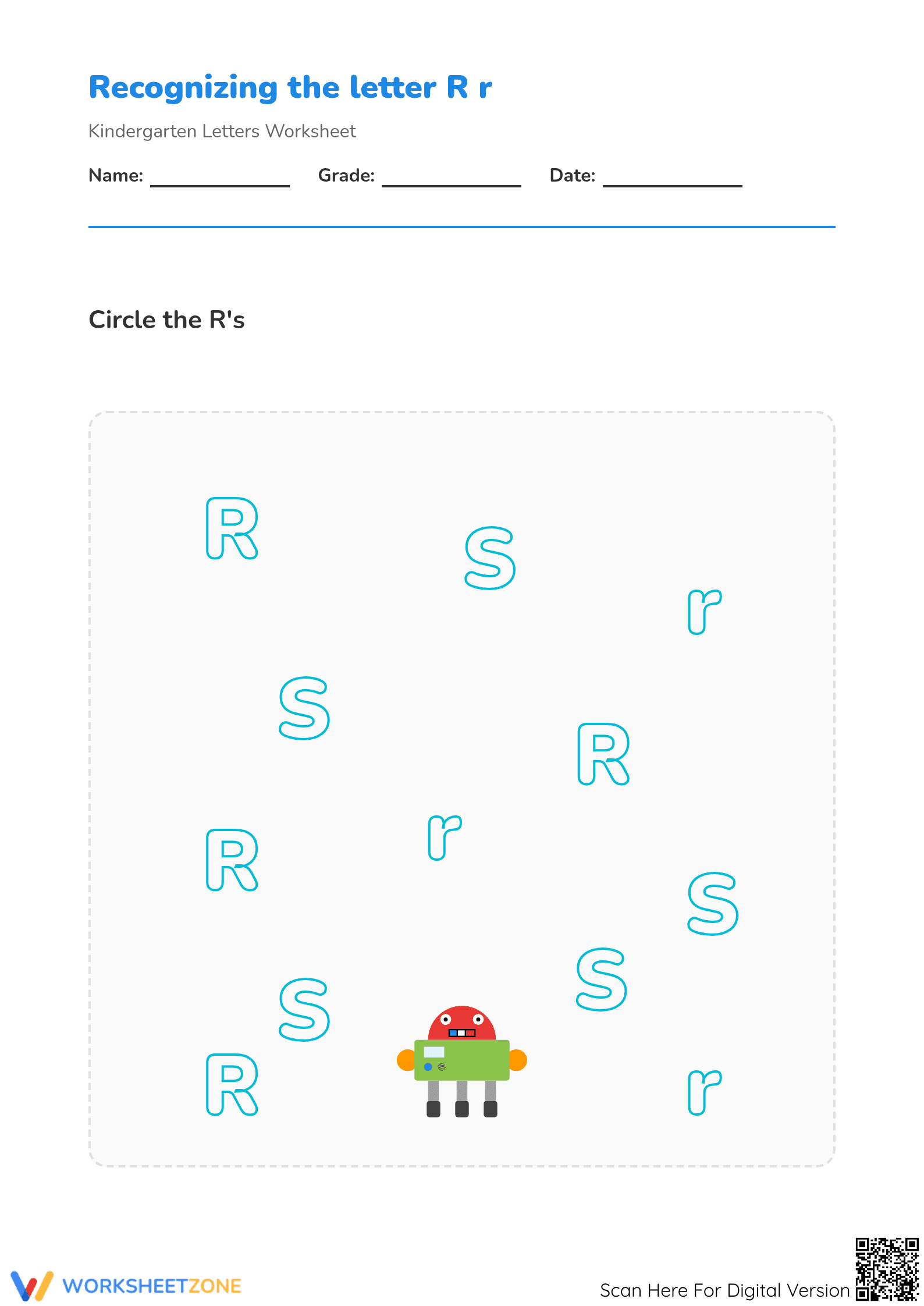

Letter R Recognition Printable Worksheet | Kindergarten
Paste this activity's link or code into your existing LMS (Google Classroom, Canvas, Teams, Schoology, Moodle, etc.).
Students can open and work on the activity right away, with no student login required.
You'll still be able to track student progress and results from your teacher account.
This foundational letter recognition worksheet helps early learners identify both uppercase and lowercase forms of the letter R. By visually scanning and selecting the correct letters among distractors, kindergarten students develop essential alphabet fluency and visual discrimination skills required for early reading success.
At a Glance
- Grade: Kindergarten · Subject: ELA
- Standard:
CCSS.ELA-LITERACY.RF.K.1.D— Recognize and name all upper- and lowercase letters- Skill Focus: Letter R Recognition
- Format: 1 page · 7 problems · Answer key included · PDF
- Best For: Independent practice and centers
- Time: 5–10 minutes
Inside this single-page resource, educators will find a straightforward, visually engaging activity centered on the letter R. The page features a mix of uppercase and lowercase R's scattered alongside distractor letters to challenge students' visual tracking. A friendly robot graphic anchors the page, keeping young learners engaged as they complete the task of circling the target letters.
This resource offers a highly efficient zero-prep workflow:
- Print (1 min): Download the PDF and print. The design ensures quick, low-ink printing.
- Distribute (1 min): Hand out during morning work or literacy centers. Instructions are self-explanatory.
- Review (1 min): Teachers can assess student accuracy at a single glance.
Total prep time is under two minutes, making this an excellent option for substitute plans.
This activity is directly aligned to CCSS.ELA-LITERACY.RF.K.1.D, which requires students to recognize and name all upper- and lowercase letters of the alphabet. By isolating the letter R and requiring students to distinguish it from similar shapes, the worksheet provides targeted practice for this foundational literacy standard. Both standard codes can be copied directly into lesson plans, IEP goals, or district curriculum mapping tools.
Use this worksheet as an independent literacy center activity after direct instruction on the letter R. Alternatively, it serves as excellent morning work to settle students with a familiar task. Expected completion time is 5 to 10 minutes. As a formative assessment tip, observe if students systematically scan the page left-to-right or randomly search; this provides insight into their developing print awareness.
This resource is primarily designed for kindergarten students, though it is also highly appropriate for preschool learners who are ready for formal alphabet instruction, or first-grade students needing targeted intervention. For differentiation, teachers can provide highlighters or dot markers instead of pencils to support students developing fine motor control. This worksheet pairs perfectly with a read-aloud focused on the R sound or a classroom alphabet anchor chart.
Mastering alphabet recognition is a critical milestone in early childhood education. According to a comprehensive EdReports 2024 analysis of foundational reading skills, students who can rapidly and accurately identify letters are significantly better positioned to develop phonemic awareness and decoding abilities. This specific worksheet targets CCSS.ELA-LITERACY.RF.K.1.D, ensuring students can recognize and name all upper- and lowercase letters. By requiring learners to visually discriminate the letter R from distractors, the activity reinforces the neural pathways necessary for fluent reading. Early intervention and consistent, focused practice on individual letters reduce cognitive load during later reading tasks. Providing structured, distraction-free environments for this practice allows young learners to build confidence and automaticity, which are essential components of long-term literacy success, reading comprehension, and overall academic achievement in the primary grades.


