


























Views
Downloads
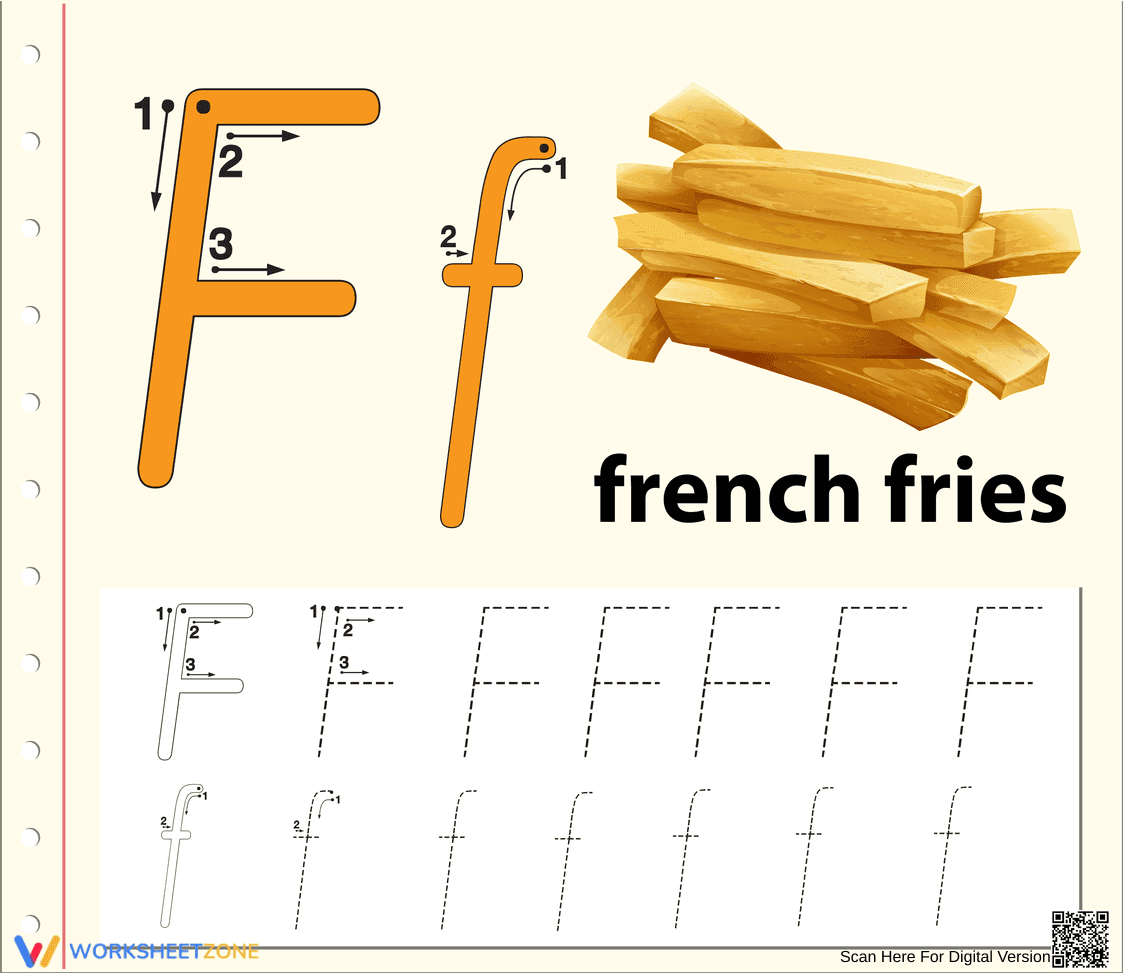

Letter F Tracing Worksheet | Printable Kindergarten ELA
Paste this activity's link or code into your existing LMS (Google Classroom, Canvas, Teams, Schoology, Moodle, etc.).
Students can open and work on the activity right away, with no student login required.
You'll still be able to track student progress and results from your teacher account.
This printable handwriting worksheet provides focused practice for early learners mastering the letter F. Students develop fine motor control and proper stroke sequence by tracing both uppercase and lowercase forms. Featuring a clear visual model and guided dashed lines, this resource builds foundational literacy skills essential for independent writing.
At a Glance
- Grade: Kindergarten · Subject: ELA
- Standard:
CCSS.ELA-LITERACY.L.K.1.A— Print upper- and lowercase letters- Skill Focus: Letter F Tracing
- Format: 1 page · 14 problems · No answer key · PDF
- Best For: Independent practice
- Time: 10–15 minutes
This single-page PDF offers structured handwriting practice for the letter F. The top section features a numbered stroke-order guide for capital and lowercase letters, alongside a "french fries" illustration. The bottom contains two rows of tracing practice: seven uppercase Fs and seven lowercase fs, formatted with primary dashed lines for proper sizing.
Zero-Prep Workflow
- Print (1 minute): Download the PDF and print. The dashed lines render clearly on standard school printers.
- Distribute (1 minute): Hand out sheets with pencils. Visual stroke guides make the task obvious to young learners.
- Review (1 minute): Scan student work to ensure they follow numbered arrows rather than drawing letters backward.
Total teacher prep time is under two minutes, making this excellent for sub plans.
Standards Alignment
This activity aligns with CCSS.ELA-LITERACY.L.K.1.A, requiring students to print many upper- and lowercase letters. Explicit stroke-order models and repetitive tracing build the muscle memory required to meet this standard. Both standard codes can be copied directly into lesson plans, IEP goals, or district curriculum mapping tools.
How to Use It
This tracing sheet is ideal for morning work or small-group literacy centers after direct instruction. As a formative assessment tip, observe students tracing the first few letters to ensure they start at the top line and pull down, correcting bottom-up strokes early. Expected completion time is 10 to 15 minutes.
Who It's For
Designed for Kindergarten and Preschool students developing basic handwriting skills, this also serves as intervention for first graders needing stroke correction. For differentiation, pair this worksheet with a tactile activity, like tracing the letter F in sand, before moving to pencil and paper.
Effective handwriting instruction remains a critical component of early literacy development. According to Fisher & Frey (2014), explicit instruction in letter formation, combined with guided repetition, significantly improves both writing fluency and subsequent reading comprehension. When students practice printing upper- and lowercase letters, as outlined in CCSS.ELA-LITERACY.L.K.1.A, they reduce the cognitive load required for basic transcription. This allows young learners to eventually focus their mental energy on idea generation and sentence structure. Worksheets that provide numbered directional arrows and dashed primary lines offer the exact visual scaffolding necessary to build accurate muscle memory. By integrating structured tracing tasks into daily routines, educators ensure that foundational transcription skills do not become a bottleneck for future academic achievement. Consistent, targeted practice with individual letters like F establishes the fine motor pathways essential for long-term writing success.


