


























Views
Downloads
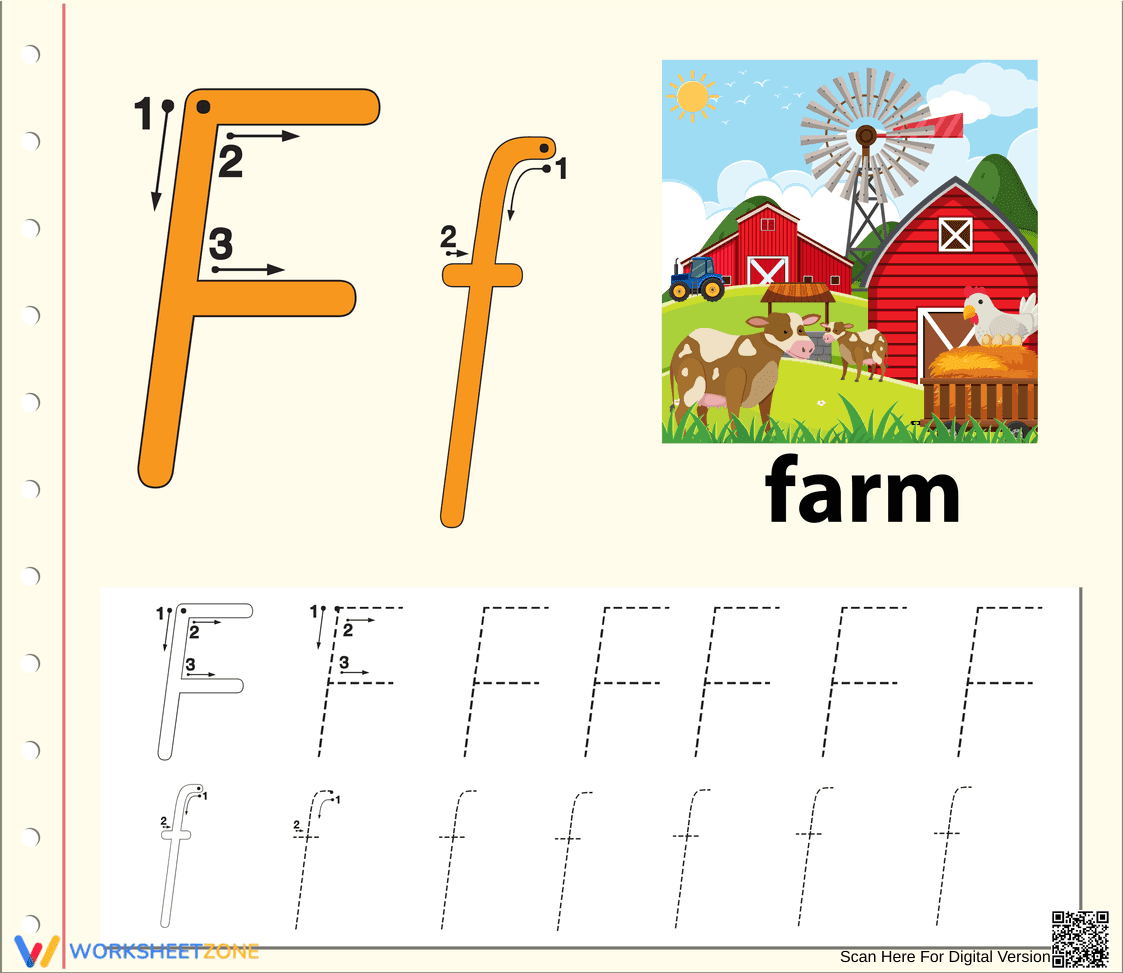

Printable Letter F Tracing Worksheet | Grade K
Paste this activity's link or code into your existing LMS (Google Classroom, Canvas, Teams, Schoology, Moodle, etc.).
Students can open and work on the activity right away, with no student login required.
You'll still be able to track student progress and results from your teacher account.
This foundational handwriting worksheet helps early learners master the formation of the uppercase and lowercase letter F. By combining guided stroke directions with independent tracing practice, students develop the fine motor control necessary for fluent writing. The farm theme keeps young learners focused while building alphabet recognition.
At a Glance
- Grade: Kindergarten · Subject: English Language Arts
- Standard:
CCSS.ELA-LITERACY.L.K.1.A— Print upper- and lowercase letters- Skill Focus: Letter F formation and tracing
- Format: 1 page · 12 problems · No answer key needed · PDF
- Best For: Morning work and literacy centers
- Time: 10–15 minutes
This single-page resource features a clear layout designed for early writers. At the top, students find large, numbered stroke models for the uppercase and lowercase letter F, accompanied by a colorful farm illustration. The bottom half provides two dedicated rows of dashed tracing practice—six uppercase and six lowercase letters—giving students ample repetition to build muscle memory.
Zero-Prep Workflow
This worksheet is designed for immediate classroom implementation with no teacher preparation required.
- Print (1 minute): Download the PDF and print. The dashed lines print clearly in grayscale.
- Distribute (1 minute): Hand out the worksheets. The visual stroke guides make the task self-explanatory.
- Review (3 minutes): Circulate to ensure students follow the numbered arrows.
With total prep time under two minutes, this is ideal for emergency sub plans.
Standards Alignment
This practice aligns directly with CCSS.ELA-LITERACY.L.K.1.A, requiring students to print many upper- and lowercase letters. Explicit directional arrows ensure students practice correct letter formation, preventing bad habits. Both standard codes can be copied directly into lesson plans, IEP goals, or district curriculum mapping tools.
How to Use It
This printable fits perfectly into morning work routines. Place it on desks before the bell rings for a focused task. Alternatively, use it during literacy centers after introducing the "F" sound. As a formative assessment tip, watch students trace to ensure they start at the top line and pull down. Expected completion time is 10 to 15 minutes.
Who It's For
Designed for Kindergarten students developing fine motor skills, this also serves as an intervention tool for first graders struggling with letter reversals. Pair this tracing sheet with a read-aloud book about farms or a phonics anchor chart featuring other "F" words.
Mastering early handwriting skills like those practiced in this CCSS.ELA-LITERACY.L.K.1.A aligned resource is critical for long-term academic success. When students learn to print upper- and lowercase letters automatically, they free up cognitive working memory to focus on higher-order tasks like spelling and composition. According to a comprehensive EdReports 2024 review of foundational literacy practices, explicit instruction in letter formation, combined with guided repetition, significantly reduces the incidence of letter reversals and writing fatigue in early elementary grades. This worksheet provides that exact structured repetition, using numbered stroke paths to build correct muscle memory. By integrating visual vocabulary cues—like the farm illustration—alongside the physical act of writing, educators can simultaneously reinforce phonemic awareness and fine motor control, creating a much more robust foundation for early literacy development.


