


























Views
Downloads
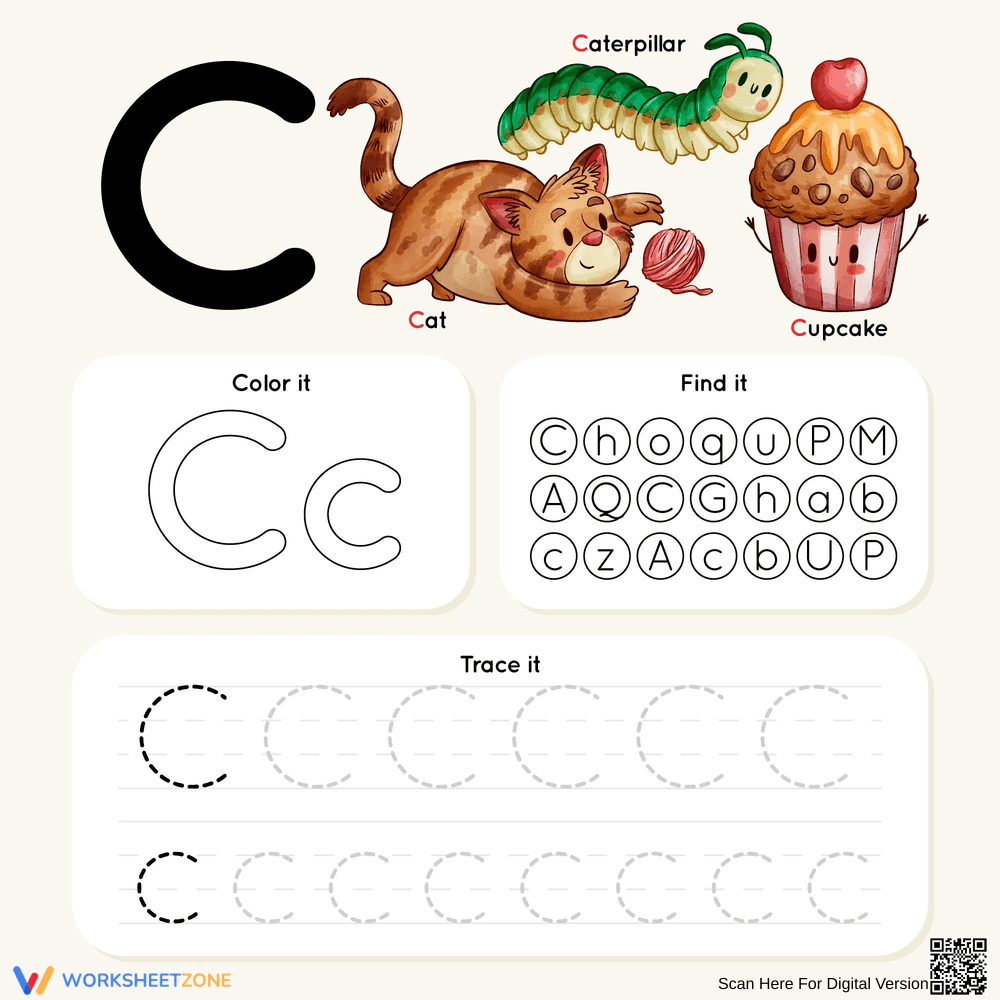

Printable Letter C Tracing Worksheet | Grade K
Paste this activity's link or code into your existing LMS (Google Classroom, Canvas, Teams, Schoology, Moodle, etc.).
Students can open and work on the activity right away, with no student login required.
You'll still be able to track student progress and results from your teacher account.
This foundational Letter C worksheet helps early learners develop essential alphabet recognition and fine motor skills. By combining visual vocabulary, letter identification, and guided handwriting practice, students build the confidence needed for early reading and writing success.
At a Glance
- Grade: K · Subject: English
- Standard:
CCSS.ELA-LITERACY.RF.K.1.D— Recognize and name all upper- and lowercase letters- Skill Focus: Letter Recognition and Tracing
- Format: 1 page · 3 activities · No answer key needed · PDF
- Best For: Independent practice centers
- Time: 10–15 minutes
This single-page resource features three distinct activity zones designed to reinforce the letter C. At the top, vibrant illustrations of a caterpillar, cat, and cupcake introduce initial consonant sounds. The middle section includes a "Color it" block for bubble letters and a "Find it" letter hunt to distinguish 'C' and 'c' from other alphabet characters. Finally, the bottom "Trace it" section provides two lines of dashed uppercase letters for structured handwriting practice.
This zero-prep resource is designed for immediate classroom implementation with a streamlined workflow:
- Print (30 seconds): Generate enough copies for your literacy centers or morning work bins directly from the PDF.
- Distribute (1 minute): Hand out to students with crayons and pencils; the visual instructions make the tasks self-evident.
- Review (30 seconds): Quickly scan the letter hunt and tracing lines to check for understanding and proper pencil grip.
With under two minutes of total teacher preparation, this worksheet is an excellent addition to emergency sub plans or spontaneous skill-review sessions.
This activity is directly aligned to CCSS.ELA-LITERACY.RF.K.1.D: Recognize and name all upper- and lowercase letters of the alphabet. It also supports early handwriting development by encouraging proper letter formation. Both standard codes can be copied directly into lesson plans, IEP goals, or district curriculum mapping tools.
Deploy this worksheet during morning work to establish a calm, productive routine as students arrive. Alternatively, use it as a standalone station during literacy centers. While students complete the tracing section, teachers can conduct quick formative assessments by observing pencil grip and stroke direction, correcting any bottom-to-top tracing habits before they become ingrained. Most kindergarteners will complete the page within 10 to 15 minutes.
This resource is ideal for kindergarten students mastering the alphabet, as well as first graders needing a quick refresher on letter formation. The clear, uncluttered layout provides built-in differentiation for students with attention difficulties, keeping them focused on one task at a time. It pairs perfectly with a whole-class read-aloud focusing on the "hard C" sound or an interactive anchor chart building a class vocabulary list.
Early alphabet knowledge, specifically the ability to recognize and name all upper- and lowercase letters (CCSS.ELA-LITERACY.RF.K.1.D), is a critical predictor of later reading achievement. According to a comprehensive EdReports 2024 analysis of foundational literacy programs, explicit instruction in letter recognition combined with immediate handwriting practice significantly accelerates phonics acquisition. When students physically trace the letter C while simultaneously identifying it among distractors, they engage multiple cognitive pathways, reinforcing both visual memory and fine motor automaticity. This multimodal approach ensures that foundational skills are deeply embedded, reducing the cognitive load required for subsequent decoding tasks. By integrating visual vocabulary, targeted letter hunts, and guided tracing into a single exercise, educators provide the structured repetition necessary for early literacy mastery, setting a strong foundation for future reading fluency and writing proficiency.


