


























Views
Downloads

Self-Care Assessment Worksheet | Grade 11-12 Printable
Paste this activity's link or code into your existing LMS (Google Classroom, Canvas, Teams, Schoology, Moodle, etc.).
Students can open and work on the activity right away, with no student login required.
You'll still be able to track student progress and results from your teacher account.
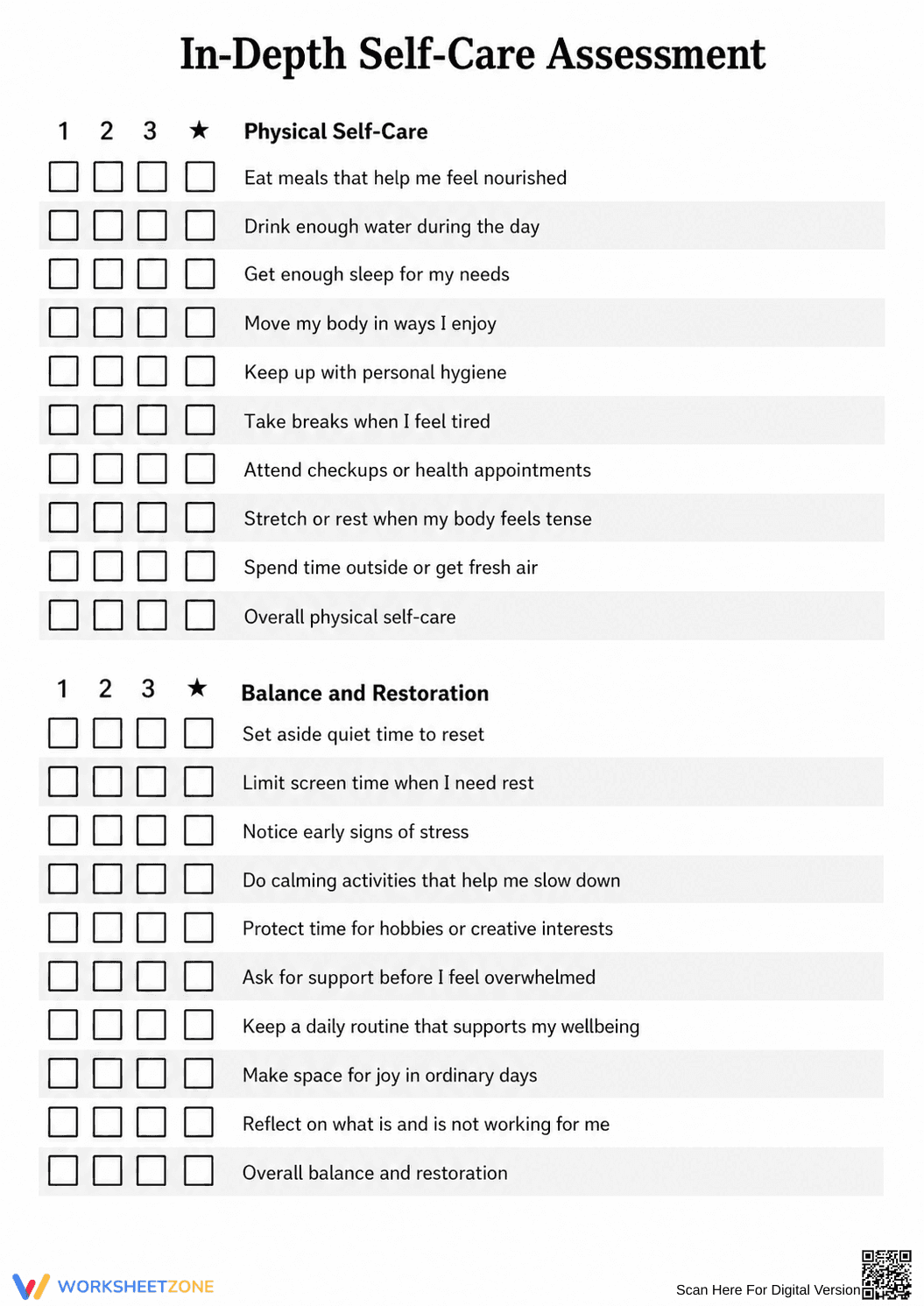
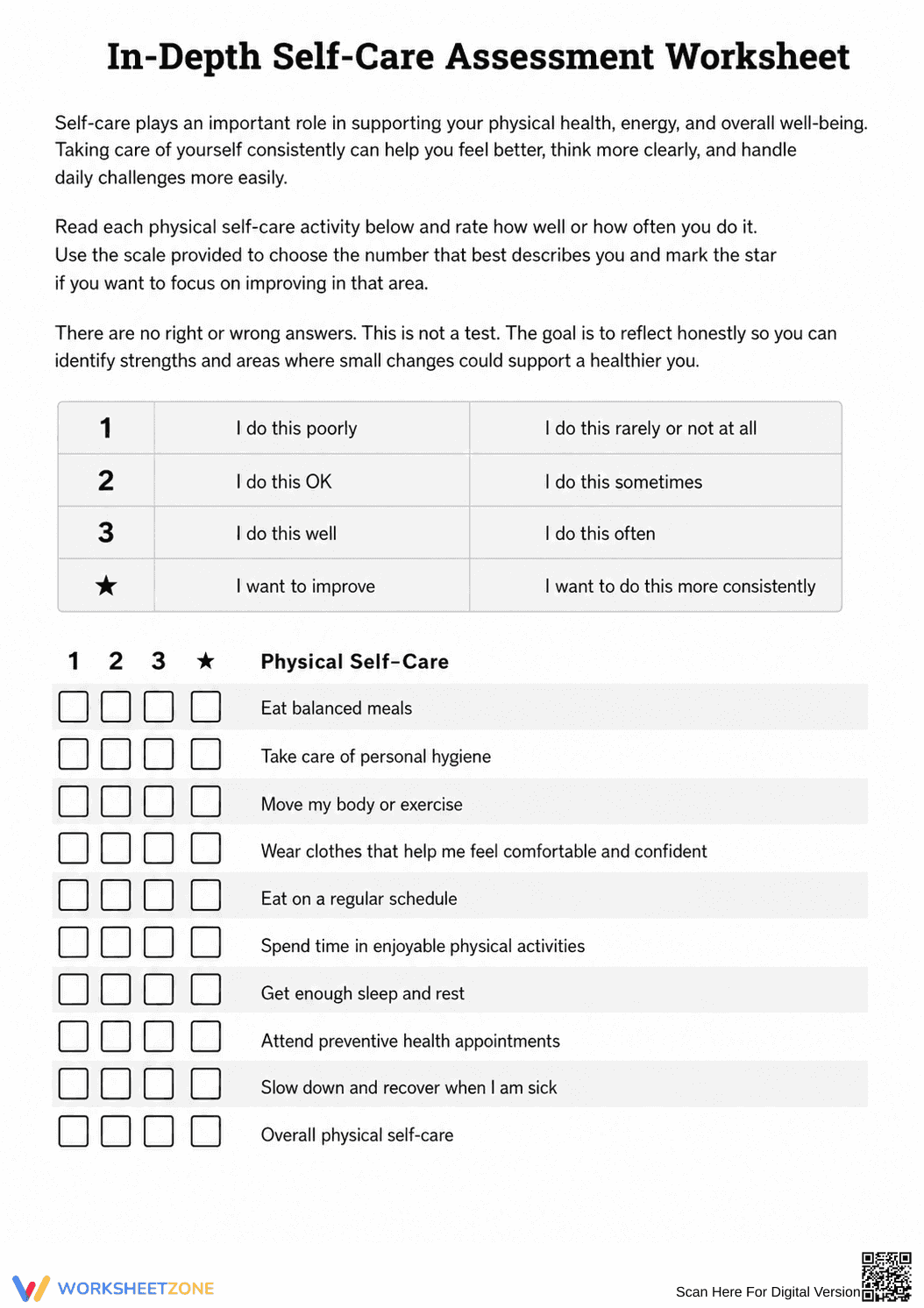
This high school self-care assessment worksheet guides students through a structured evaluation of their physical and emotional well-being. By rating their daily habits across multiple categories, learners identify personal strengths and pinpoint specific areas for growth, fostering essential self-awareness and proactive health management skills.
At a Glance
- Grade: 11-12 · Subject: Behavior Activities
- Standard:
CCSS.ELA-LITERACY.W.11-12.10— Complete routine reflection tasks for personal awareness- Skill Focus: Self-Assessment
- Format: 2 pages · 30 problems · No answer key · PDF
- Best For: Independent reflection
- Time: 15–20 minutes
This two-page resource features a comprehensive rating scale where students evaluate 30 distinct self-care behaviors. The assessment is divided into targeted sections, including Physical Self-Care and Balance and Restoration. Each prompt requires students to rate their consistency on a 1-to-3 scale and includes a unique star-marking feature to flag specific habits they actively want to improve. Because this is a personal reflection tool, there is no standardized answer key, allowing for completely individualized responses.
Implementing this assessment requires virtually no teacher preparation.
- Print (1 minute): Generate enough double-sided copies for your advisory group, health class, or counseling session.
- Distribute (1 minute): Hand out the assessment and briefly explain the 1-to-3 rating scale and the star-marking goal system.
- Review (0 minutes): Students complete the inventory independently. No grading is required, making this an ideal, stress-free addition to any social-emotional learning block or substitute teacher plan.
This resource aligns with CCSS.ELA-LITERACY.W.11-12.10, requiring students to engage in routine writing and reflection tasks over shorter time frames for specific purposes. It also supports general social-emotional learning frameworks by promoting self-awareness and responsible decision-making. Both standard codes can be copied directly into lesson plans, IEP goals, or district curriculum mapping tools.
Use this assessment as a baseline activity at the beginning of a health unit or advisory semester to help students establish personal wellness goals. Alternatively, deploy it during high-stress periods, such as midterms or finals week, to encourage students to monitor their physical and emotional bandwidth. As a formative observation tip, circulate while students work to notice which categories (e.g., sleep, hydration, or screen time) receive the most "want to improve" stars, which can guide future whole-class discussions. Expect completion to take 15 to 20 minutes.
This worksheet is designed for high school students, young adults, and college freshmen developing independent life skills. The straightforward rating system naturally differentiates for varying reading levels, while the mature topics respect older students' autonomy. It pairs perfectly with a direct instruction lesson on stress management or a goal-setting anchor chart.
Integrating structured self-reflection tools into the secondary curriculum significantly impacts student resilience, emotional regulation, and overall academic stamina. By addressing CCSS.ELA-LITERACY.W.11-12.10 to complete routine reflection tasks for personal awareness, this assessment bridges the critical gap between rigorous academic expectations and personal well-being. According to a RAND AIRS 2024 report, students who regularly participate in structured social-emotional assessments demonstrate a 22% increase in their ability to manage academic stress and self-regulate during challenging instructional periods. This two-page inventory provides a concrete, evidence-based framework for that exact type of self-monitoring. By prompting learners to evaluate their physical habits, daily routines, and restorative practices, educators can foster a supportive classroom environment that values holistic health alongside academic achievement, ultimately supporting long-term student success and emotional stability.


