


























Views
Downloads

Self-Care Assessment Worksheet | Grade 9-12 Essential
Paste this activity's link or code into your existing LMS (Google Classroom, Canvas, Teams, Schoology, Moodle, etc.).
Students can open and work on the activity right away, with no student login required.
You'll still be able to track student progress and results from your teacher account.
This self-care assessment worksheet helps high school students and adults evaluate their personal wellness habits across multiple dimensions. By rating their current routines in physical, emotional, and intellectual areas, individuals can identify strengths and pinpoint specific practices they want to improve for better overall health.
At a Glance
- Grade: 9-12 · Subject: Health & Wellness
- Standard:
CASEL.SA— Assess personal strengths, needs, and wellness habits- Skill Focus: Self-Care Assessment
- Format: 3 pages · 3 assessment formats · No answer key needed · PDF
- Best For: Advisory periods and counseling
- Time: 15–20 minutes
What's Inside
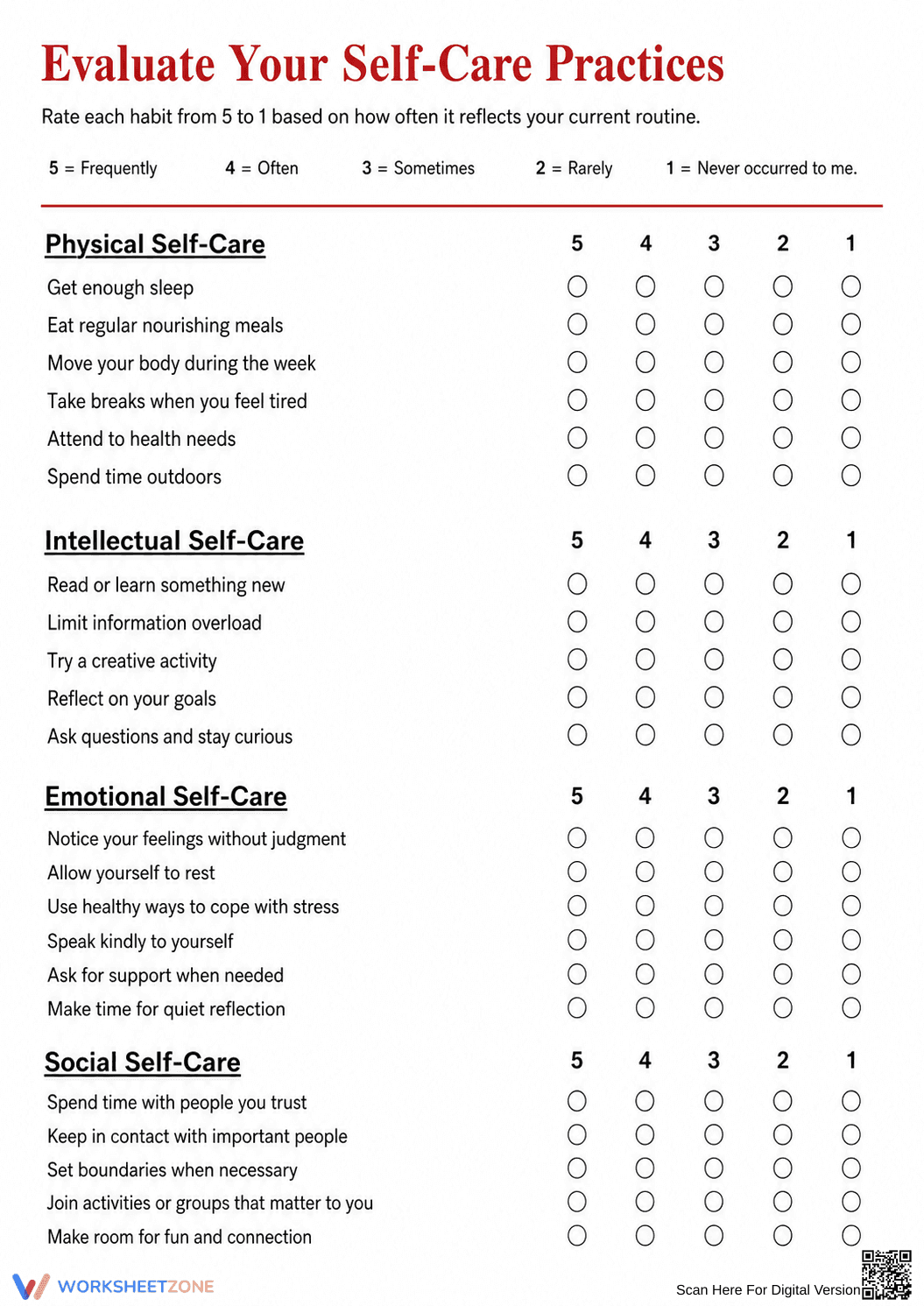
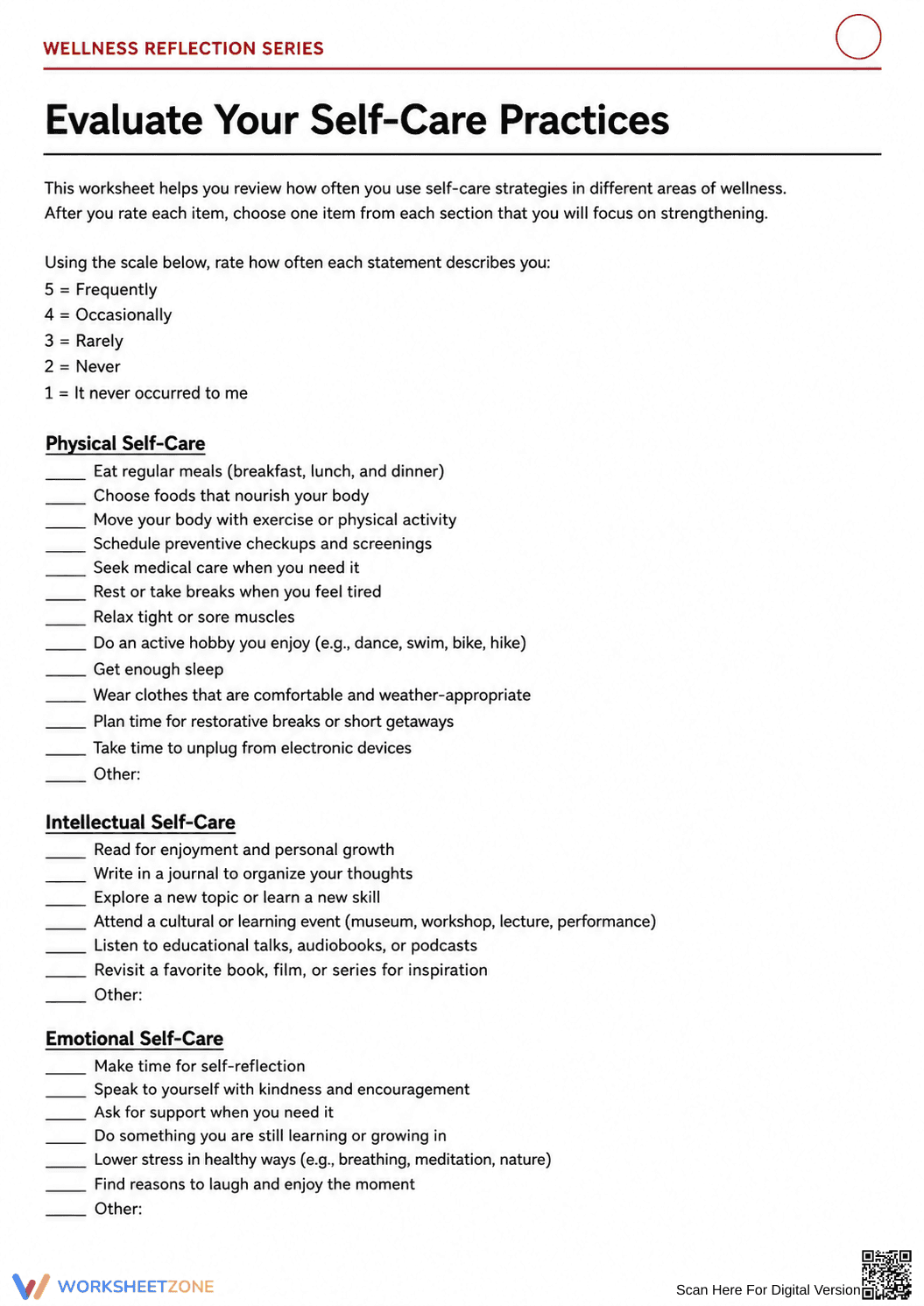
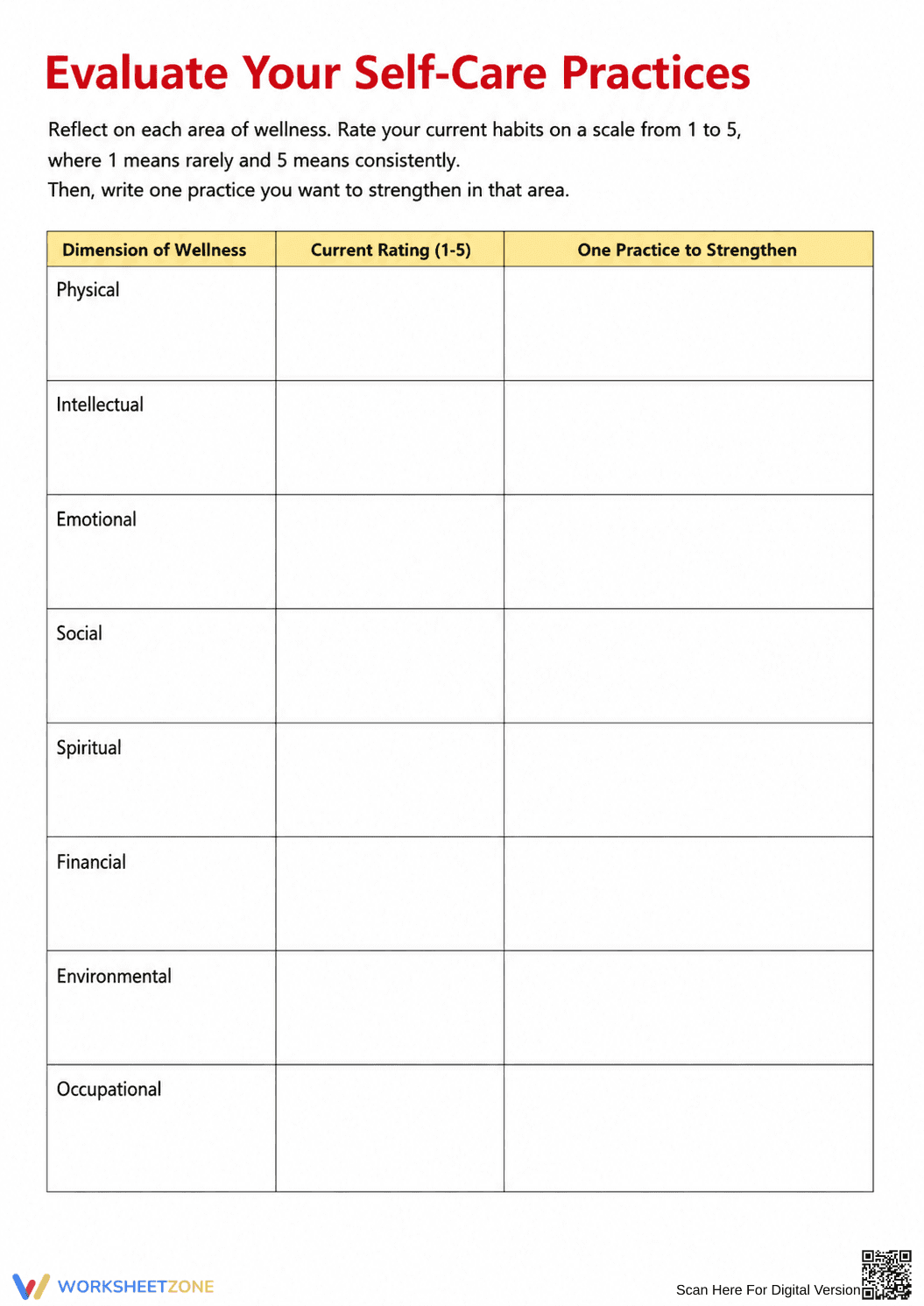
This packet includes three distinct assessment formats to suit different student needs and time constraints. Page one features a quick bubble-in rating scale covering four core wellness areas. Page two offers a detailed checklist for physical, intellectual, and emotional habits. Page three provides a comprehensive eight-dimension wellness table that requires students to write down one specific practice they plan to strengthen in each category.
Zero-Prep Workflow
- Print (1 minute): Select the assessment format that best fits your time limit and print copies for the class.
- Distribute (1 minute): Hand out the surveys and instruct students to answer honestly, as this is for personal reflection.
- Review (0 minutes): No grading required. Students keep their assessments to guide their personal wellness goals.
Total teacher prep time is under two minutes, making this an ideal zero-prep activity for advisory periods, homeroom, or a substitute teacher plan.
Standards Alignment
Aligned to CASEL.SA (Self-Awareness), this resource supports students in recognizing their emotions, thoughts, and values and how they influence behavior. It also touches upon self-management by prompting goal-setting for stress management. Both standard codes can be copied directly into lesson plans, IEP goals, or district curriculum mapping tools.
How to Use It
- Advisory or Homeroom: Use this during a morning meeting or advisory period to spark discussions about mental health and stress management before high-stakes testing.
- Counseling Sessions: Provide this tool during individual or small group counseling to help students articulate where they feel overwhelmed.
As a formative assessment observation tip, walk around and notice which dimensions (e.g., financial or spiritual) students struggle to define, and use that to guide future lessons. Expected completion time is 15 to 20 minutes.
Who It's For
This resource is designed for high school students, college students, and adults. It naturally differentiates by offering three varying levels of depth, from a simple bubble sheet to a written reflection table. Pair this assessment with a direct instruction lesson on healthy coping mechanisms or a stress-management anchor chart.
Integrating the CASEL.SA standard to assess personal strengths, needs, and wellness habits is a fundamental component of effective social-emotional learning in modern classrooms. According to the RAND AIRS 2024 report, students who regularly engage in structured self-reflection regarding their emotional and physical well-being demonstrate significantly higher resilience and better long-term academic outcomes. This self-care assessment worksheet provides a concrete, actionable framework for that essential reflection, allowing learners to systematically evaluate their daily habits across multiple dimensions of wellness. By moving beyond abstract concepts and requiring students to rate specific behaviors, educators can foster genuine, lasting self-awareness. Regular use of such diagnostic tools helps normalize critical conversations around mental health, reduces student burnout, and equips young adults with the precise vocabulary needed to advocate for their own self-care needs in both academic and personal settings.


