


























Views
Downloads

Self-Care Assessment Worksheet | Essential Grade 8-10 Guide
Paste this activity's link or code into your existing LMS (Google Classroom, Canvas, Teams, Schoology, Moodle, etc.).
Students can open and work on the activity right away, with no student login required.
You'll still be able to track student progress and results from your teacher account.
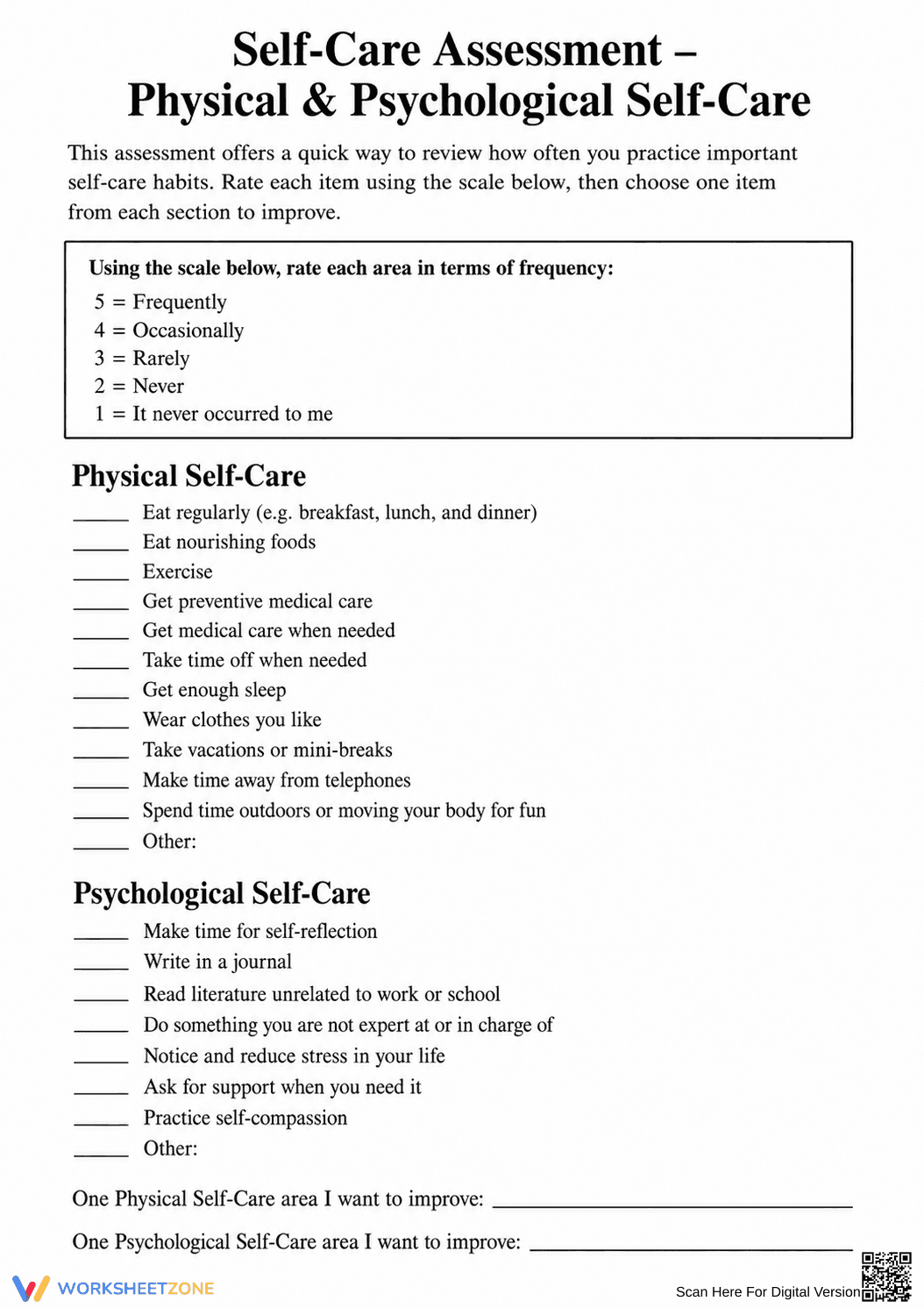
This comprehensive self-care assessment provides students with a structured framework to evaluate their personal well-being across physical, psychological, emotional, and spiritual domains. By rating current habits, learners identify specific strengths and growth areas, fostering the self-awareness necessary for long-term mental health and academic success.
At a Glance
- Grade: 8-10 · Subject: Social Skills / Health
- Standard:
CCSS.ELA-LITERACY.W.9-10.10— Write routinely over extended time frames for reflection and self-analysis- Skill Focus: Self-reflection and wellness goal setting
- Format: 3 pages · 64 items · Personal assessment · PDF
- Best For: SEL blocks and health education units
- Time: 20–30 minutes
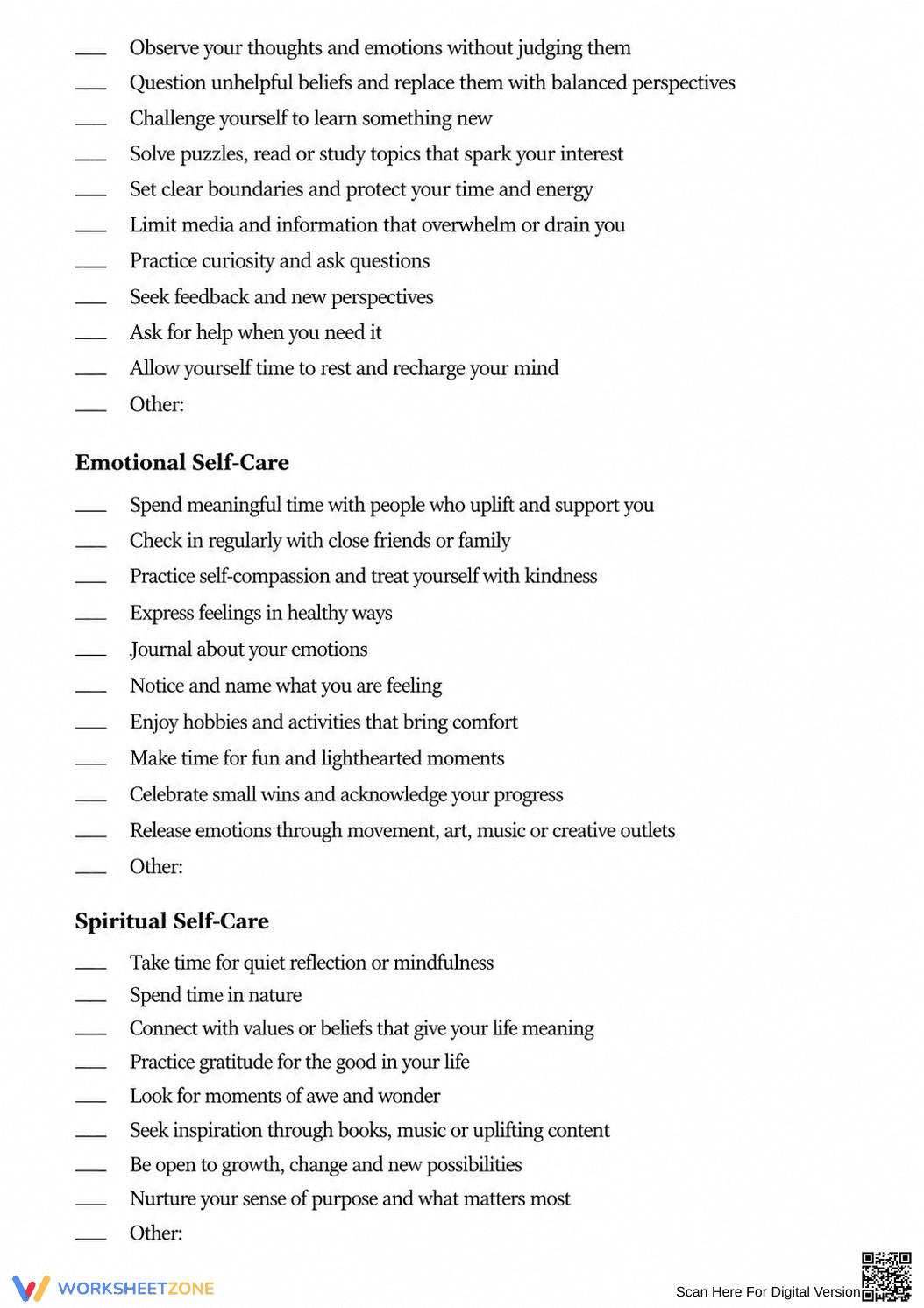
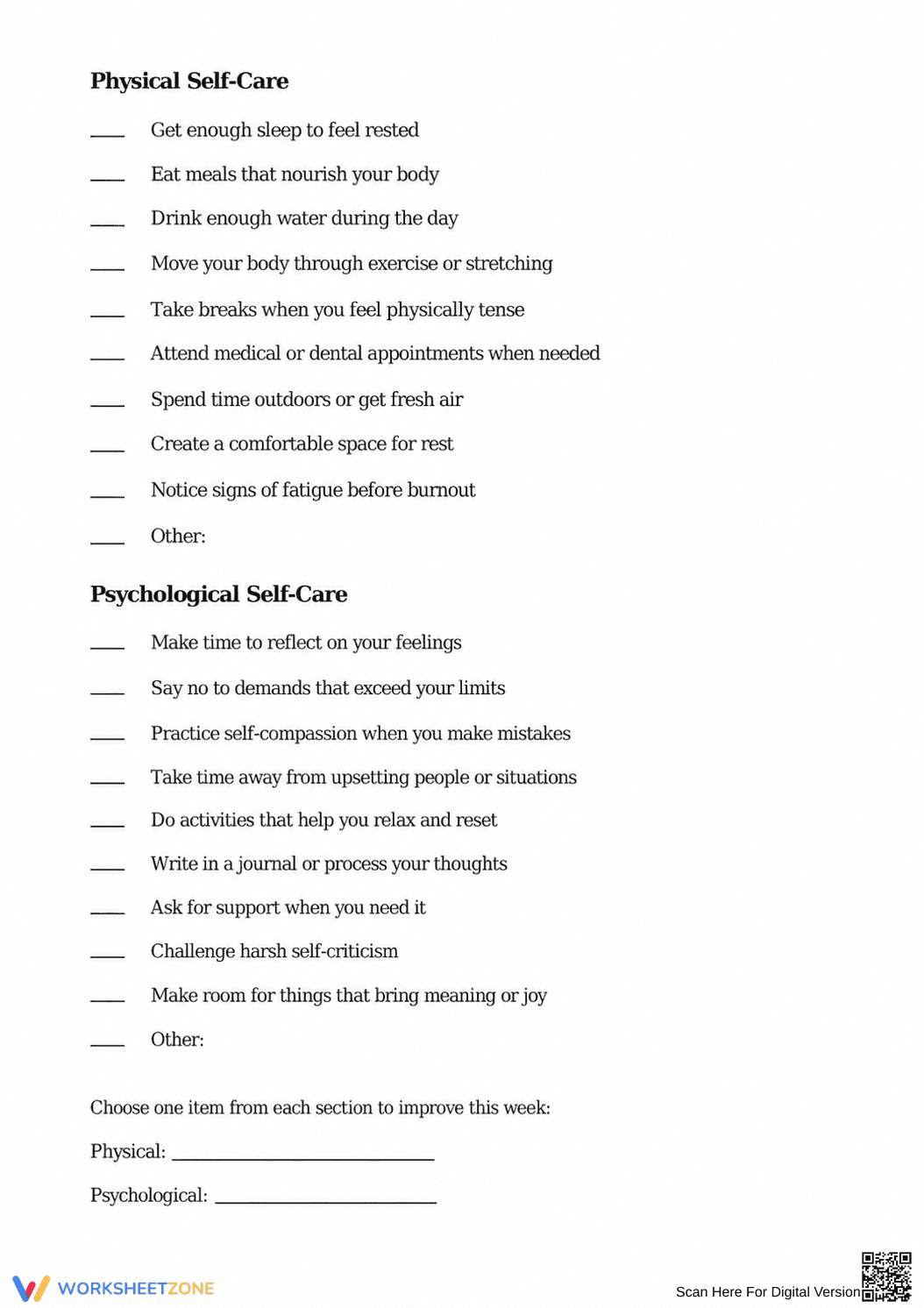
This 3-page PDF contains four distinct assessment sections: Physical, Psychological, Emotional, and Spiritual self-care. Each section features a 1-5 frequency scale ranging from "It never occurred to me" to "Frequently." The layout includes dedicated space for students to select one specific improvement goal for each category, ensuring the assessment leads directly to actionable behavior change through 64 unique reflection prompts.
Zero-Prep Workflow
- Print: Generate the 3-page packet for each student in your cohort (1 minute).
- Distribute: Hand out the assessment and explain the 5-point frequency rating scale (30 seconds).
- Review: Allow students to work independently through the prompts, concluding with the goal-setting lines at the bottom of each page (under 1 minute of teacher setup).
This makes it an ideal resource for substitute plans, advisory periods, or counseling sessions where immediate implementation is required.
Standards Alignment
This resource aligns with `CCSS.ELA-LITERACY.W.9-10.10`, which requires students to write routinely over various time frames for a range of tasks, purposes, and audiences. By engaging in structured self-reflection and documenting personal wellness goals, students practice the metacognitive writing skills essential for high school success. Both standard codes can be copied directly into lesson plans, IEP goals, or district curriculum mapping tools.
How to Use It
Use this assessment at the beginning of a health unit or during a dedicated Social-Emotional Learning (SEL) block to establish a baseline for student well-being. It serves as an excellent formative assessment for teachers to observe student self-awareness levels. Completion typically takes 20 to 30 minutes, depending on the depth of student reflection during the goal-setting phase at the end of each section.
Who It's For
This worksheet is designed for middle and high school students, particularly those in Grades 8 through 10. It is highly effective for students working on IEP goals related to self-regulation or social skills. Pair this assessment with a guided meditation or a direct instruction lesson on stress management techniques to provide a complete wellness experience for your classroom.
According to the RAND AIRS 2024 report on social-emotional learning, structured self-reflection tools are critical for developing student agency and emotional regulation. This assessment utilizes a Likert-style frequency scale to help students quantify abstract wellness habits into observable data points. By aligning with CCSS.ELA-LITERACY.W.9-10.10, the worksheet bridges the gap between health education and literacy, requiring students to synthesize their personal experiences into written goals. Research from Fisher & Frey (2014) emphasizes that metacognitive tasks, such as evaluating one's own self-care routines, enhance a student's ability to monitor their own learning and emotional states. This 3-page printable provides the necessary scaffolding for adolescents to transition from passive awareness to active self-improvement. It is a reliable tool for educators seeking to integrate wellness into the secondary curriculum without increasing teacher workload or requiring extensive preparation time.


