


























Views
Downloads

Grade 9-12 Self-Care Plan — Printable No-Prep Worksheet
Paste this activity's link or code into your existing LMS (Google Classroom, Canvas, Teams, Schoology, Moodle, etc.).
Students can open and work on the activity right away, with no student login required.
You'll still be able to track student progress and results from your teacher account.
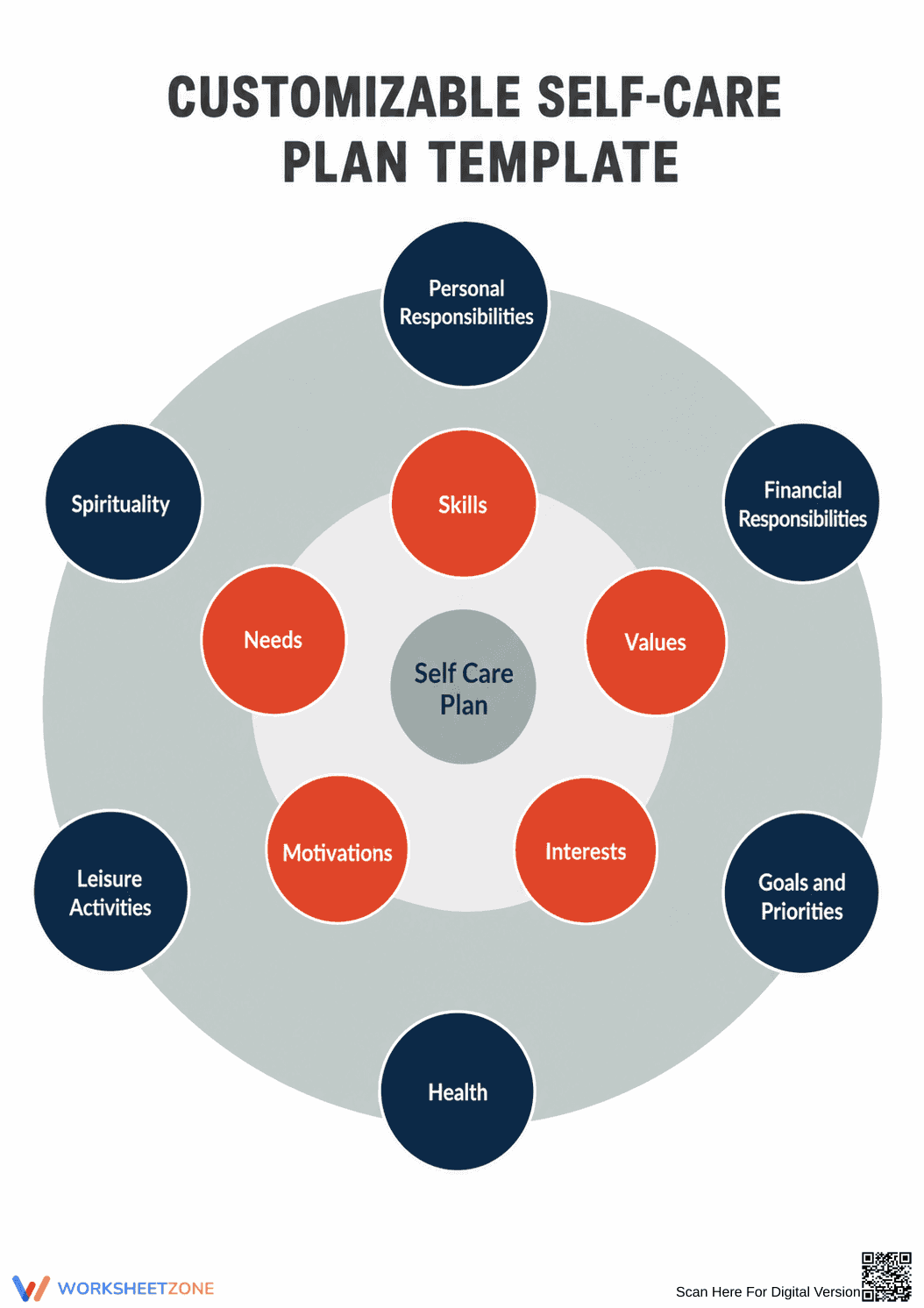
This high school self-care plan template helps students evaluate their personal wellbeing and set actionable goals. By mapping out 11 distinct life areas—from personal values to financial responsibilities—students develop critical self-awareness. This visual organizer provides a structured way to reflect on current habits and identify areas for personal growth.
At a Glance
- Grade: 9-12 · Subject: SEL
- Standard:
CASEL.SA— Assess personal strengths, needs, and values- Skill Focus: Self-Assessment & Goal Setting
- Format: 1 page · 11 reflection areas · No answer key needed · PDF
- Best For: Advisory periods and counseling
- Time: 15–25 minutes
This single-page visual template features a central self-care plan hub surrounded by interconnected life domains. Students will find specific prompts for internal factors like skills, needs, motivations, interests, and values, alongside external factors such as personal responsibilities, financial responsibilities, health, leisure, and spirituality. The graphic organizer format makes complex self-reflection accessible and engaging.
- Print (1 min): Generate enough copies for your advisory group or health class. The high-contrast design prints beautifully in grayscale.
- Distribute (1 min): Hand out the templates along with colored pencils or highlighters for students who want to color-code their reflection areas.
- Review (3 mins): Briefly explain the difference between internal values and external responsibilities before letting students work independently.
Total teacher prep time is under two minutes, making this an excellent resource for sub plans, morning meetings, or impromptu counseling sessions.
Aligned to CASEL.SA (Self-Awareness), this resource asks students to accurately recognize one's own emotions, thoughts, and values and how they influence behavior. It also supports general health education standards for personal goal setting. Both standard codes can be copied directly into lesson plans, IEP goals, or district curriculum mapping tools.
Use this template during a dedicated advisory period or mental health awareness week. Have students rate their current satisfaction in each of the 11 circles on a scale of 1-10, then choose two areas to focus on improving over the next month. As a formative assessment observation tip, walk the room and note which categories students hesitate on most, using this data to guide future whole-class SEL discussions. Expected completion time is 15 to 25 minutes.
This resource is primarily designed for high school students, young adults, and counseling groups. To differentiate for students who might feel overwhelmed by 11 categories, instruct them to focus only on the inner circle (Skills, Needs, Motivations, Interests, Values) first. It pairs perfectly with a direct instruction lesson on stress management or a SMART goal-setting anchor chart.
Integrating structured self-reflection tools aligned with CASEL.SA helps students assess personal strengths, needs, and values effectively. According to a RAND AIRS 2024 report, explicit instruction in self-awareness and self-care planning significantly improves emotional regulation and reduces chronic absenteeism in high school populations. By breaking down wellbeing into specific, manageable domains like health, leisure, and responsibilities, educators provide a concrete framework for abstract emotional concepts. This targeted approach ensures that students not only identify areas of stress but also recognize their existing personal assets, fostering resilience and long-term academic engagement.


