


























Views
Downloads
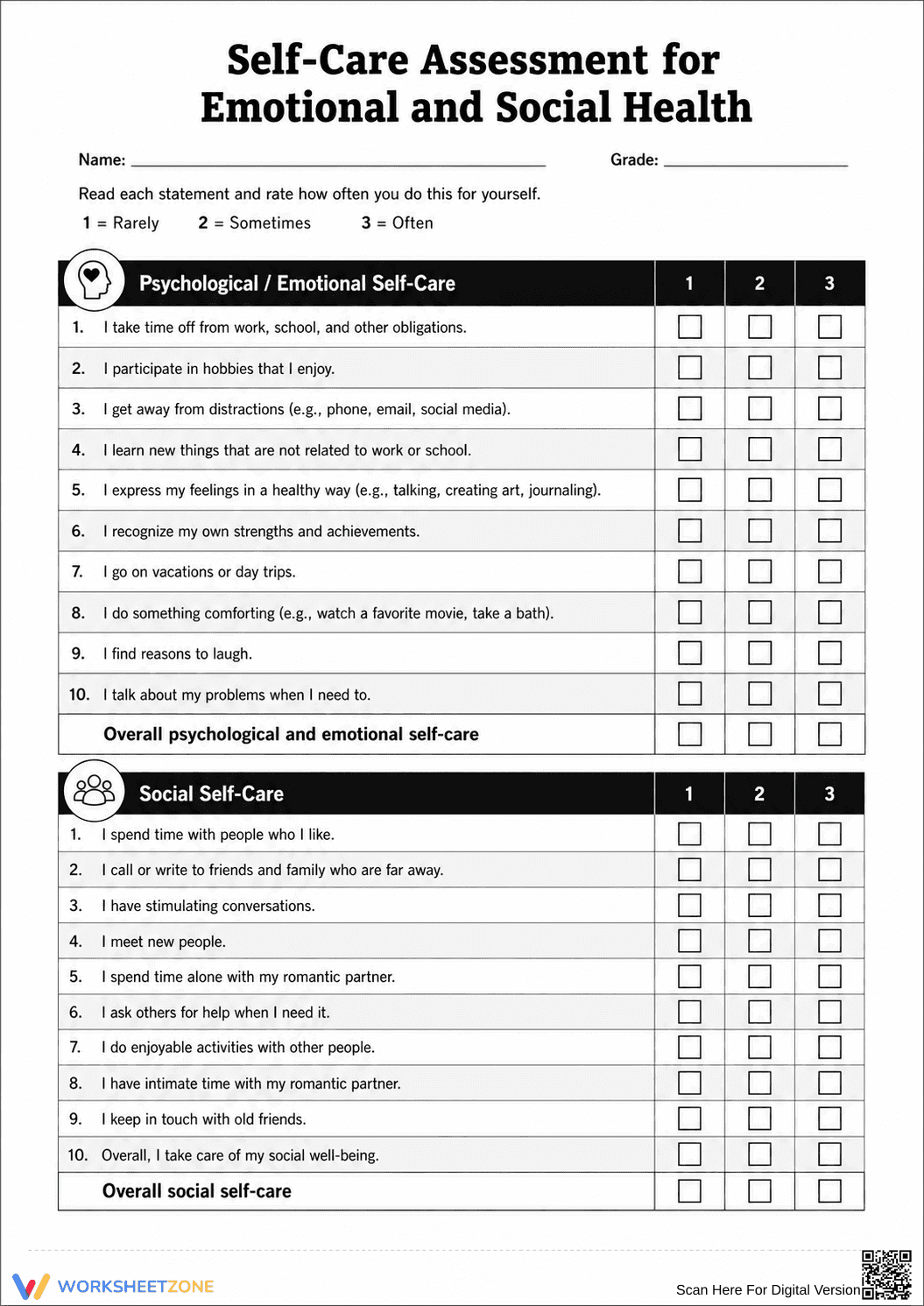

Printable Self-Care Assessment | Grade 9-12 Health
Paste this activity's link or code into your existing LMS (Google Classroom, Canvas, Teams, Schoology, Moodle, etc.).
Students can open and work on the activity right away, with no student login required.
You'll still be able to track student progress and results from your teacher account.
This high school self-care assessment worksheet helps students evaluate their emotional and social well-being. By rating their daily habits on a simple frequency scale, learners identify personal strengths and areas for growth. This reflective exercise builds essential self-awareness skills crucial for managing stress and maintaining healthy relationships.
At a Glance
- Grade: 9-12 · Subject: Health & SEL
- Standard:
NHES.1.12.2— Evaluate how emotional and social factors impact personal health- Skill Focus: Self-Reflection and Emotional Awareness
- Format: 1 page · 20 problems · No answer key needed · PDF
- Best For: Independent reflection and advisory periods
- Time: 10–15 minutes
Inside this single-page resource, students will find a comprehensive 20-item questionnaire divided into two distinct categories: Psychological/Emotional Self-Care and Social Self-Care. Each section features ten targeted statements, such as "I express my feelings in a healthy way" and "I have stimulating conversations." Students use a straightforward 1-to-3 rating scale (Rarely, Sometimes, Often) to evaluate how frequently they engage in these supportive behaviors. Because this is a subjective personal inventory, no answer key is required.
This resource is designed for immediate classroom implementation with a zero-prep workflow.
- Print (1 minute): The single-page layout is optimized for quick, black-and-white copying.
- Distribute (1 minute): Hand out the assessment during homeroom, advisory, or the beginning of a health class.
- Review (3 minutes): Briefly explain the 1-to-3 rating scale and encourage honest self-reflection.
Total teacher preparation time is under two minutes, making this an excellent, self-explanatory activity for substitute teacher plans or mental health awareness week.
This worksheet aligns with NHES.1.12.2, requiring students to describe the interrelationships of emotional, intellectual, physical, and social health. It also supports core CASEL competencies for Self-Awareness by prompting students to recognize their emotions and thoughts and how they influence behavior. Both standard codes can be copied directly into lesson plans, IEP goals, or district curriculum mapping tools.
Use this assessment as a bell-ringer activity before a broader unit on mental health and stress management. It allows students to privately gauge their baseline habits before direct instruction begins. Alternatively, assign it during a dedicated advisory period as a springboard for goal-setting. As a formative assessment observation tip, circulate the room to ensure students understand the vocabulary in the prompts, but respect their privacy as they score their personal habits. Expected completion time is 10 to 15 minutes.
This resource is ideal for high school students (grades 9-12) and young adults developing independent life skills. The straightforward language makes it accessible, while the mature themes provide appropriate differentiation for older learners who might find typical SEL worksheets too juvenile. Pair this assessment with a lesson on creating a personalized self-care plan or a stress-reduction anchor chart.
Integrating structured self-reflection tools like this assessment is vital for adolescent development and overall well-being. Aligned with NHES.1.12.2, this activity requires students to evaluate how emotional and social factors impact personal health. According to a recent RAND AIRS 2024 report, regular self-assessment of social-emotional competencies significantly improves students' ability to self-regulate during high-stress academic periods. When learners actively monitor their psychological and social habits, they are better equipped to advocate for their own needs and seek appropriate support when necessary. This simple 20-item inventory provides a concrete framework for that abstract reflection, transforming vague concepts of well-being into actionable data points. By routinely evaluating these behaviors, educators can foster a supportive classroom environment that prioritizes holistic health alongside academic achievement, ultimately supporting long-term student resilience and success.


