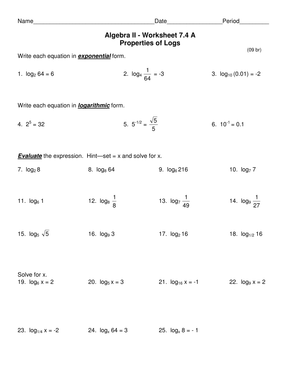
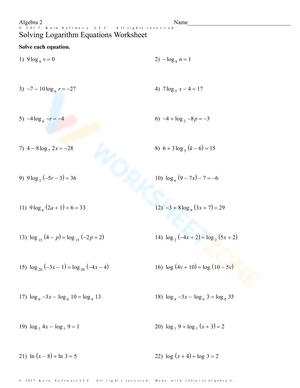
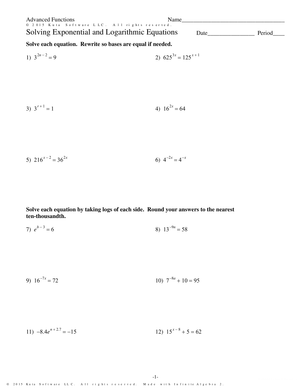
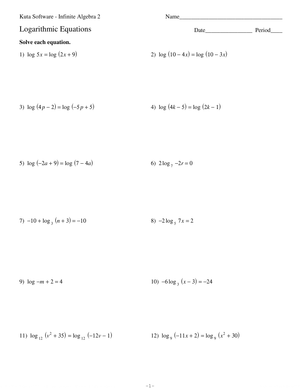
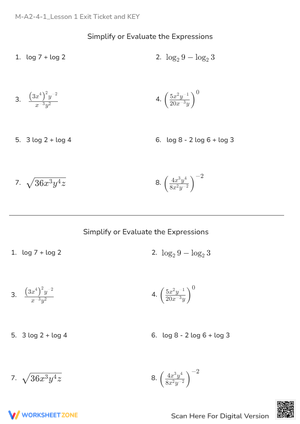
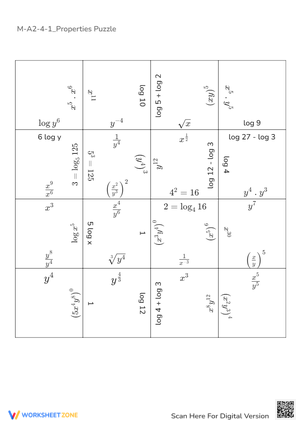
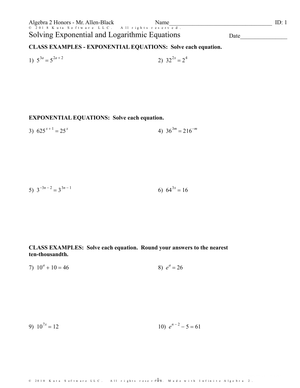
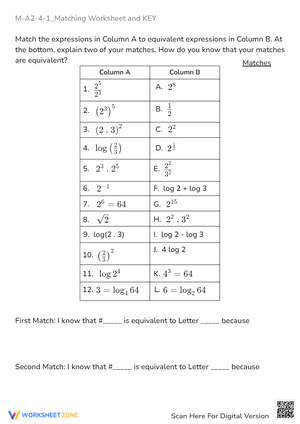
What Solving Logarithmic Equations Worksheets Should Cover
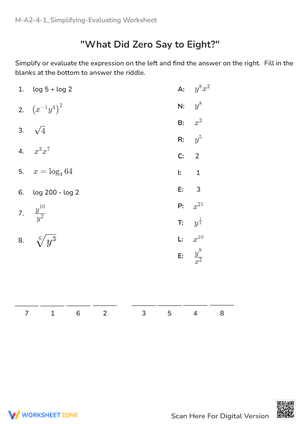
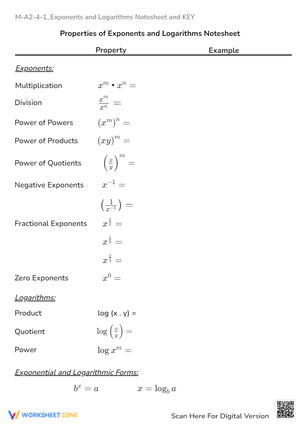
By the time students reach logarithmic equations, they've usually mastered exponent rules and the definition of a logarithm as the inverse of exponentiation. That places this topic mid-way through an Algebra 2 or Precalculus unit on exponential and logarithmic functions. A worksheet that lands well at this point does more than drill—it sorts problems by solving method so students see the structure behind each equation instead of guessing.
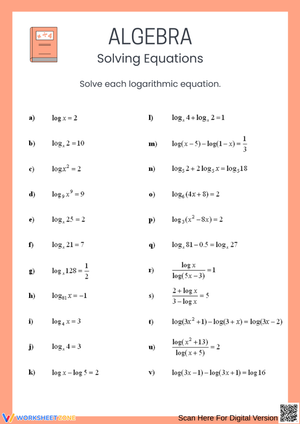
Strong practice sets pull from three problem families: equations with a single logarithm you isolate and rewrite in exponential form, equations with multiple logs you condense first, and equations where two logs are set equal so you can match arguments. Mixing numeric bases like base 2 and base 10 with natural log (base e) problems on the same page better prepares students for standardized test items that vary the base without warning.
Answer keys turn any of these into gradeable work, but the most useful worksheets also leave room for students to show the conversion step and the domain check, not just a final number. Those middle steps are where misconceptions surface, and where partial credit belongs.
The Three Core Solving Methods
Most logarithmic equations in an Algebra 2 course reduce to one of three approaches. Teaching them as named strategies gives students a decision tree they can apply under test pressure.
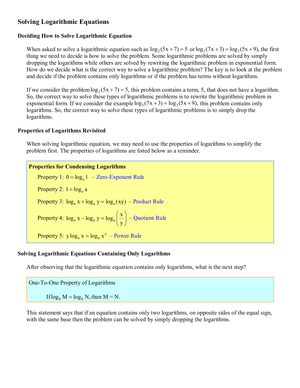
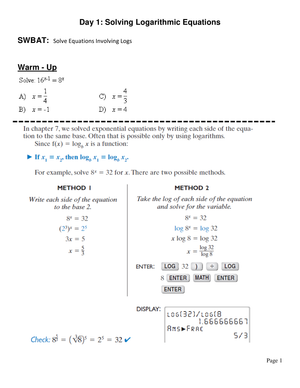
Single-log isolation. When one logarithm sits alone, isolate it and rewrite the equation in exponential form. For log base 2 of x equals 5, students convert directly to x equals 2 to the fifth power, or 32. This is the cleanest entry point and where scaffolded worksheets should start.
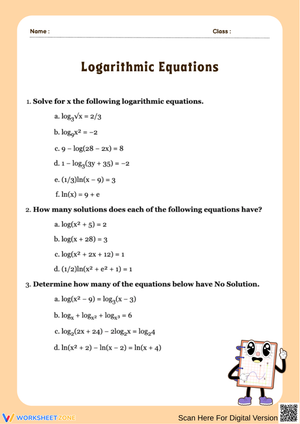
Condensing multiple logs. When two or more logs appear on one side, students use the product, quotient, and power properties to combine them into a single log before converting. An equation like log x plus log (x minus 3) equals 1 becomes log of x times (x minus 3) equals 1, which then converts to a quadratic.
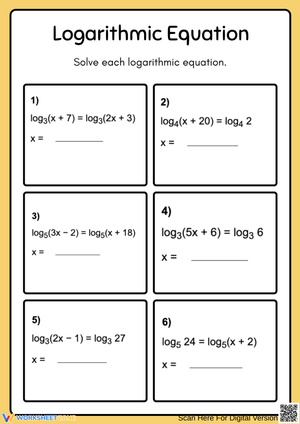
Equal-log matching. When the equation reads log of A equals log of B with matching bases, students can drop the logs and solve A equals B directly. This method feels almost too easy, which is exactly why it belongs on a mixed worksheet—students need to recognize when it applies.
Worksheets that label these three methods explicitly, rather than presenting a wall of undifferentiated equations, help students move from blind pattern-matching to genuine method selection, the skill that transfers to unfamiliar test items.
Connecting Practice to HSF-LE.4 and Real Contexts
According to the Common Core State Standards Initiative, standard HSF-LE.A.4 asks students to express as a logarithm the solution to a times b to the ct power equals d for bases 2, 10, or e, then evaluate using technology—one of only a handful of high school modeling standards that names logarithms directly.
That standard is easier to teach when the equations connect to contexts students recognize. The pH scale, decibel levels, compound interest, and population growth all resolve to logarithmic equations, and worksheets that frame a few problems in these settings raise relevance without changing the underlying math. A compound-interest problem that ends in a natural-log equation shows students exactly why the base e case on their worksheet matters instead of feeling like an arbitrary variation.
Sequencing Worksheets from Easy to Hard
Difficulty on a logarithmic equations worksheet should climb deliberately, not randomly. A workable order looks like this:
- Single log, one step: isolate and convert, such as log base 2 of x equals 4.
- Single log with coefficients: isolate first, then convert.
- Two logs, equal-log matching with the same base.
- Two logs requiring condensing into a single log.
- Condensed logs that produce a quadratic, forcing an extraneous-solution check.
- Mixed bases, including at least one natural-log problem.
This staircase lets students build confidence on early items and meet the hardest reasoning—condensing plus checking—only after the mechanics are automatic. It also makes partial-credit grading transparent, since each tier maps to a specific skill you can point to on the key.
Classroom Implementation
Worksheets work best when they fit a clear instructional moment rather than filling time. Try these placements:
- Exit tickets: two or three single-log problems to check understanding before assigning a full set for homework.
- Small-group intervention: a scaffolded page limited to isolation and equal-log matching for students still solidifying log properties.
- Mixed review: a full-range page before the unit test for students who already have the properties down.
- Station work: one method per station so students rotate through isolation, condensing, and matching.
Differentiation matters here. Students still shaky on the product and quotient properties need a worksheet that stays in the isolation lane, while test-ready students benefit from mixed sets that force them to identify the method first. Keeping an answer key attached makes any of these formats gradeable for classwork, homework, or a quick formative check.
One more practical move: ask students to label the method they used at the top of each problem. That single annotation turns a worksheet into a diagnostic, showing you at a glance whether a student is misclassifying equations before they even make an algebra mistake.
Frequently Asked Questions
1. What are the main types of logarithmic equations students need to practice in Algebra 2?
Three: single-log equations you isolate and convert to exponential form, multiple-log equations you condense using log properties, and equal-log equations where matching bases let you drop the logs and solve the arguments. A complete worksheet includes all three so students learn to identify the method before solving.
2. How do I check for extraneous solutions when solving logarithmic equations?
Substitute each candidate solution back into every logarithm in the original equation. If any argument becomes zero or negative, reject that solution because logarithms are undefined there. Have students write "valid" or "reject" beside each answer so the domain check is visible and gradeable.
3. What is a good order of difficulty for a logarithmic equations worksheet?
Start with single-log isolation, move to equal-log matching, then to condensing multiple logs, and finish with condensed equations that produce quadratics and require an extraneous-solution check. Add mixed bases, including a natural-log item, at the end to mirror test conditions.
4. How do logarithmic equation worksheets connect to Common Core standard HSF-LE.4?
HSF-LE.A.4 asks students to express the solution of an exponential equation as a logarithm for bases 2, 10, or e and evaluate with technology. Worksheets that mix these bases and tie problems to growth or interest contexts practice exactly that skill.
5. What common mistakes should teachers watch for when students solve logarithmic equations?
Watch for skipped domain checks, misapplied log properties during condensing, and dropping logs when the bases don't actually match. The most costly is the missing extraneous-solution check, especially on condensed equations that yield two roots where one makes an argument negative.













 Interactive Worksheet Maker
 Quiz Maker
 Word Search Maker
 Crossword Puzzle Maker
 Word Scramble Generator
 Sentence Scramble Generator
 Handwriting Worksheet Generator
 Name Tracing Generator
 Fill In The Blank Generator