


























Views
Downloads
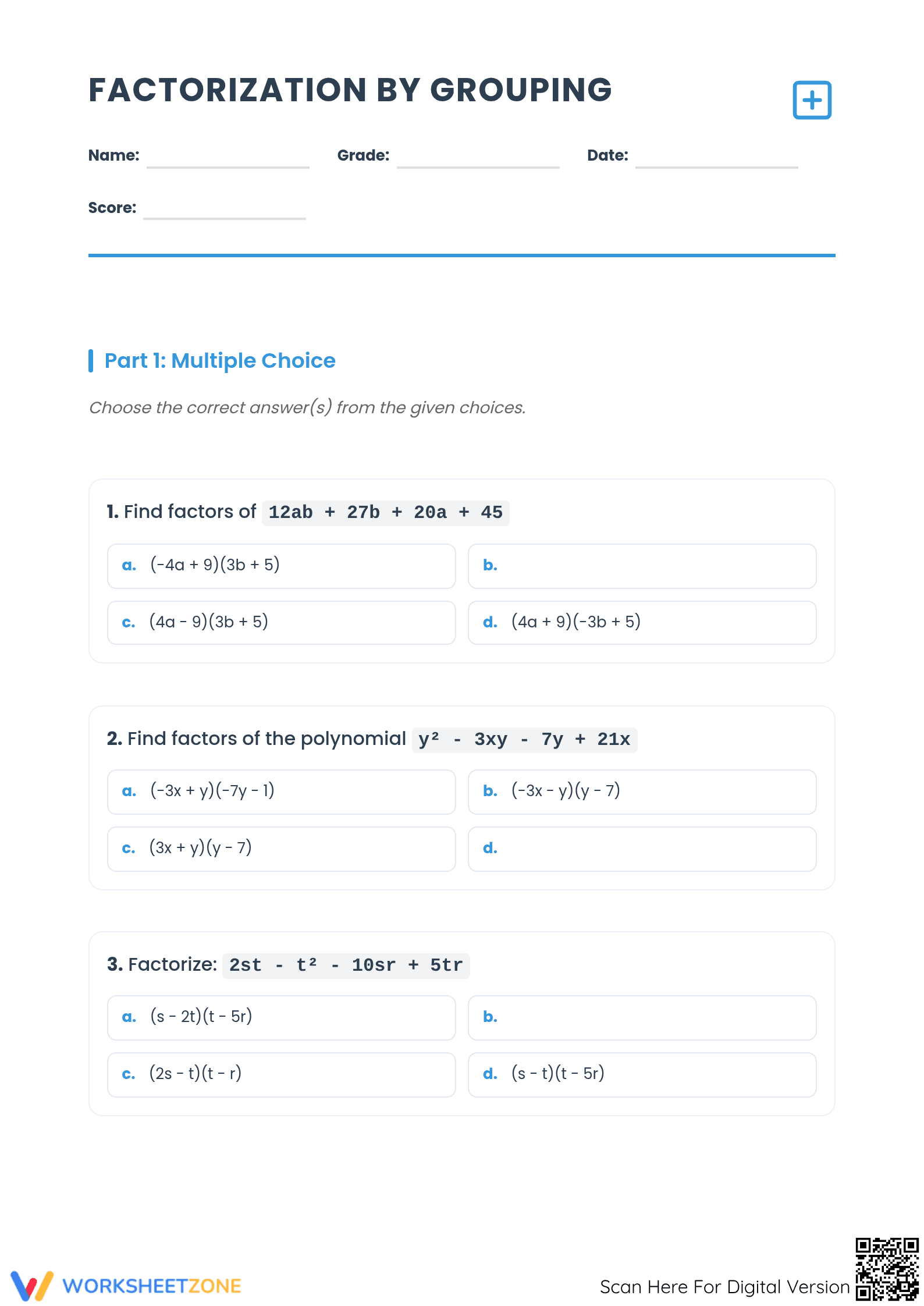


Printable Factoring by Grouping Worksheet | Grade 8 Math
Paste this activity's link or code into your existing LMS (Google Classroom, Canvas, Teams, Schoology, Moodle, etc.).
Students can open and work on the activity right away, with no student login required.
You'll still be able to track student progress and results from your teacher account.
This Grade 8 math worksheet provides targeted practice for students learning to factor polynomials by grouping. By working through these structured exercises, learners will develop the algebraic reasoning needed to identify common binomial factors and rewrite complex expressions, building a strong foundation for advanced algebra and quadratic equations.
At a Glance
- Grade: 8 · Subject: Math
- Standard:
CCSS.MATH.CONTENT.HSA.SSE.A.2— Use the structure of an expression to identify ways to rewrite it.- Skill Focus: Factoring by Grouping
- Format: 2 pages · 7 problems · Answer key included · PDF
- Best For: Independent practice and review
- Time: 15–20 minutes
This two-page resource features a carefully selected mix of problem types to assess student understanding. Part 1 includes four multiple-choice questions where students must identify the correct factored form of four-term polynomials. Part 2 transitions to three free-response questions, requiring students to show their step-by-step work to find the final factorized expressions. A complete answer key is provided to ensure accurate grading and immediate feedback.
The worksheet is designed to build student confidence through a clear progression of algebraic skills:
- Guided practice: The 4 multiple-choice questions allow students to use the process of elimination and verify their factoring by expanding the given options.
- Supported practice: Expressions are pre-arranged in standard grouping order, allowing students to immediately focus on finding the greatest common factor (GCF) of each pair.
- Independent practice: The final 3 free-response questions remove the scaffolding of multiple-choice answers, requiring students to independently execute the full grouping algorithm and show their work.
This gradual-release approach ensures students internalize the "I Do, We Do, You Do" methodology for factoring.
This resource is aligned to CCSS.MATH.CONTENT.HSA.SSE.A.2: Use the structure of an expression to identify ways to rewrite it. It also supports foundational skills for solving quadratic equations and simplifying rational expressions. Both standard codes can be copied directly into lesson plans, IEP goals, or district curriculum mapping tools.
This worksheet is highly versatile for middle school and early high school math classrooms. Assign it as independent classwork after direct instruction on factoring four-term polynomials. Alternatively, use it as a targeted homework assignment to reinforce the day's lesson. As a formative assessment tip, review students' written steps in Part 2 to ensure they are correctly factoring out negative signs—a common stumbling block in grouping. Most students will complete the seven problems in 15 to 20 minutes.
This resource is ideal for 8th-grade pre-algebra or algebra students, as well as 9th graders reviewing foundational factoring techniques. For students needing extra support, pair this worksheet with an anchor chart detailing the steps of factoring by grouping. Advanced learners can be challenged to create their own four-term polynomials that factor neatly, trading them with a partner to solve.
Research underscores the importance of recognizing algebraic structures for long-term mathematical success. According to EdReports 2024, instructional materials that explicitly teach students to analyze the underlying structure of mathematical expressions significantly improve their ability to tackle complex algebraic concepts and non-routine problems. By practicing with CCSS.MATH.CONTENT.HSA.SSE.A.2, students learn to use the structure of an expression to identify ways to rewrite it, which is exactly what factoring by grouping requires. Recognizing common binomial factors within a four-term polynomial trains the brain to see mathematics not as a series of isolated calculations, but as an interconnected system of logical patterns. This targeted practice ensures students move beyond rote memorization, developing the critical analytical skills necessary for higher-level mathematics, including calculus and advanced statistics. Consistent exposure to these structural exercises builds lasting mathematical fluency.


