


























Views
Downloads


Essential Factoring by Grouping Worksheet | Grade 8-9
Paste this activity's link or code into your existing LMS (Google Classroom, Canvas, Teams, Schoology, Moodle, etc.).
Students can open and work on the activity right away, with no student login required.
You'll still be able to track student progress and results from your teacher account.
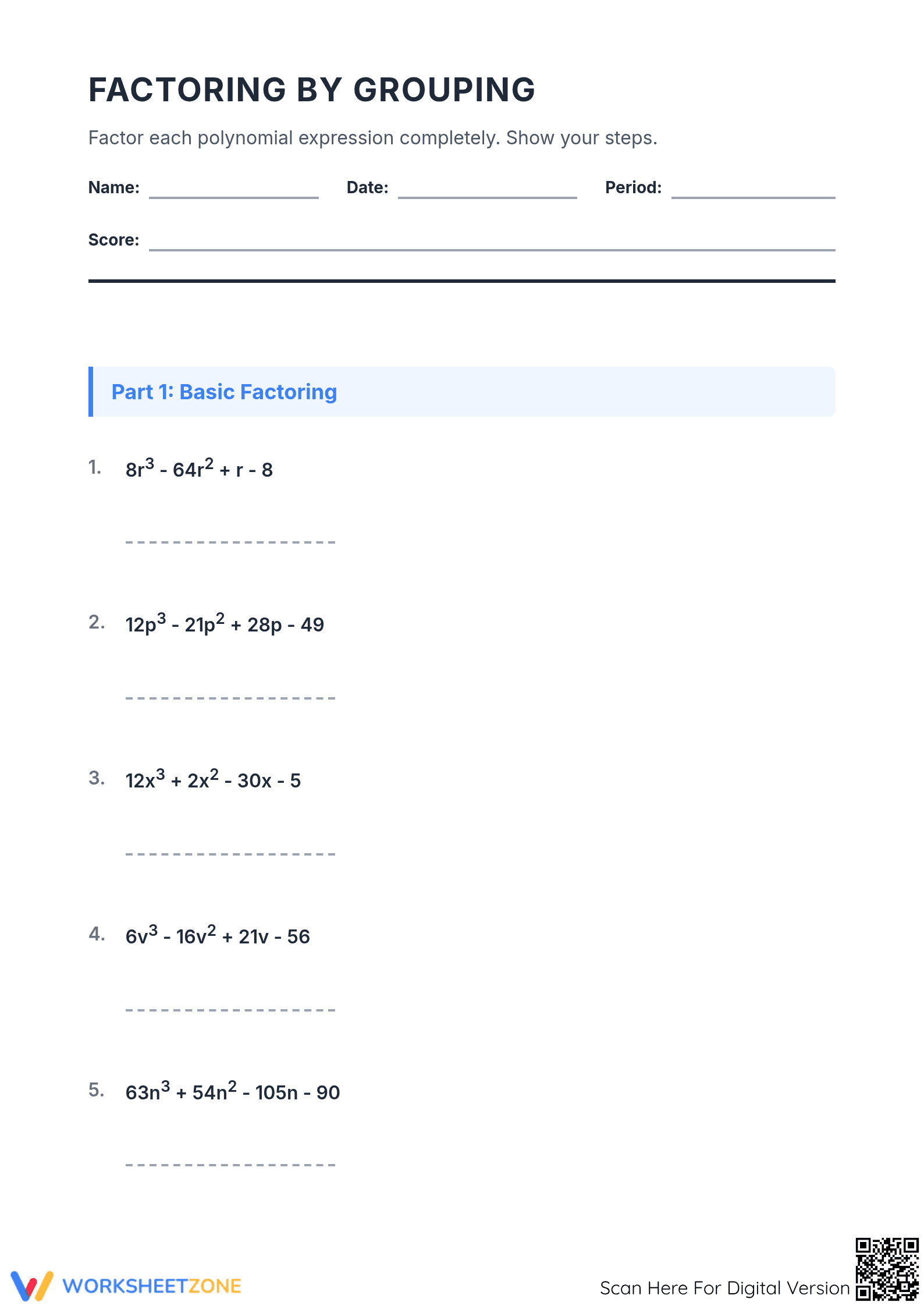
This Essential Factoring by Grouping Worksheet provides a comprehensive bridge between basic binomial factoring and advanced algebraic manipulation. Students will master the technique of grouping terms to reveal common binomial factors, a critical skill for solving higher-order equations and simplifying complex rational expressions. By the end of this practice session, learners will confidently identify and factor four-term polynomials.
At a Glance
- Grade: 8-9 · Subject: Algebra
- Standard:
HSA.SSE.A.2— Use the structure of an expression to identify ways to rewrite it- Skill Focus: Factoring four-term polynomials by grouping
- Format: 5 pages · 30 problems · Answer key included · PDF
- Best For: High school algebra independent practice and mastery
- Time: 45–60 minutes
This five-page PDF includes 30 meticulously sequenced problems designed to build confidence and fluency. The worksheet is divided into three distinct sections: Basic Factoring, Factoring with Negatives, and Advanced Factoring. Each problem provides ample white space for students to show their step-by-step work, including the identification of common factors within groups. A full answer key is provided for immediate feedback and grading efficiency.
Skill Progression
- Guided Practice (Problems 1-10): Students begin with 10 basic problems where terms are largely positive, focusing on the mechanical steps of splitting four terms into two groups and extracting the initial GCF.
- Supported Practice (Problems 11-20): The middle section introduces negative coefficients and constants, requiring students to carefully manage signs when factoring out common binomials.
- Independent Practice (Problems 21-30): The final set features advanced polynomials with larger coefficients and varying variable powers, challenging students to apply the grouping strategy to more complex structures.
The curriculum follows a gradual-release model, ensuring students have a solid foundation before tackling high-difficulty problems.
Standards Alignment
This resource is directly aligned with `HSA.SSE.A.2`, which requires students to use the structure of an expression to identify ways to rewrite it. Specifically, it focuses on recognizing expressions that can be factored as a product of binomials through the grouping method. Both standard codes can be copied directly into lesson plans, IEP goals, or district curriculum mapping tools to ensure compliance with secondary math frameworks.
How to Use It
Use this worksheet as a primary practice tool during the independent application phase of a lesson on factoring polynomials. It is ideal for mid-unit reinforcement or as a comprehensive review before an assessment on algebraic expressions. Teachers should observe students during the transition to Part 2 to ensure they are correctly handling the extraction of negative factors. Completion typically takes 45 to 60 minutes.
Who It's For
This resource is designed for Grade 8 and Grade 9 Algebra students who have already mastered basic Greatest Common Factor (GCF) extraction. It provides necessary scaffolding for struggling learners through its tiered difficulty while offering sufficient rigor for advanced students. It pairs naturally with a guided lesson on polynomial structure or an anchor chart detailing the "four-term factoring" checklist for algebraic success.
Factoring by grouping is crucial for recognizing structural patterns within polynomials. This worksheet aligns with HSA.SSE.A.2 by helping students identify the structure of binomials within four-term expressions. The 30 unique problems ensure the group-and-factor mental model is deeply ingrained, preparing students for more advanced algebraic concepts like quadratic trinomials or rational functions. The tiered practice, moving from positive to negative coefficients, supports long-term retention and reduces cognitive load, consistent with recommendations for high-quality instructional materials.


