


























Views
Downloads


Distributive Law Algebra Worksheet | Grade 7 Essential
Paste this activity's link or code into your existing LMS (Google Classroom, Canvas, Teams, Schoology, Moodle, etc.).
Students can open and work on the activity right away, with no student login required.
You'll still be able to track student progress and results from your teacher account.
This Grade 7 algebraic expressions worksheet empowers students to master the distributive law through comprehensive bracket expansion practice. By working through structured levels of difficulty, learners build a concrete understanding of how to multiply terms across parentheses, ensuring they are prepared for more complex algebraic manipulations. It is an essential resource for developing core mathematical fluency.
At a Glance
- Grade: 7 · Subject: Mathematics
- Standard:
7.EE.A.1— Apply properties of operations to expand linear expressions with rational coefficients- Skill Focus: Expanding brackets using the distributive law
- Format: 3 pages · 35 problems · Answer key included · PDF
- Best For: Independent practice or formative assessment sessions
- Time: 25–40 minutes
What's Inside
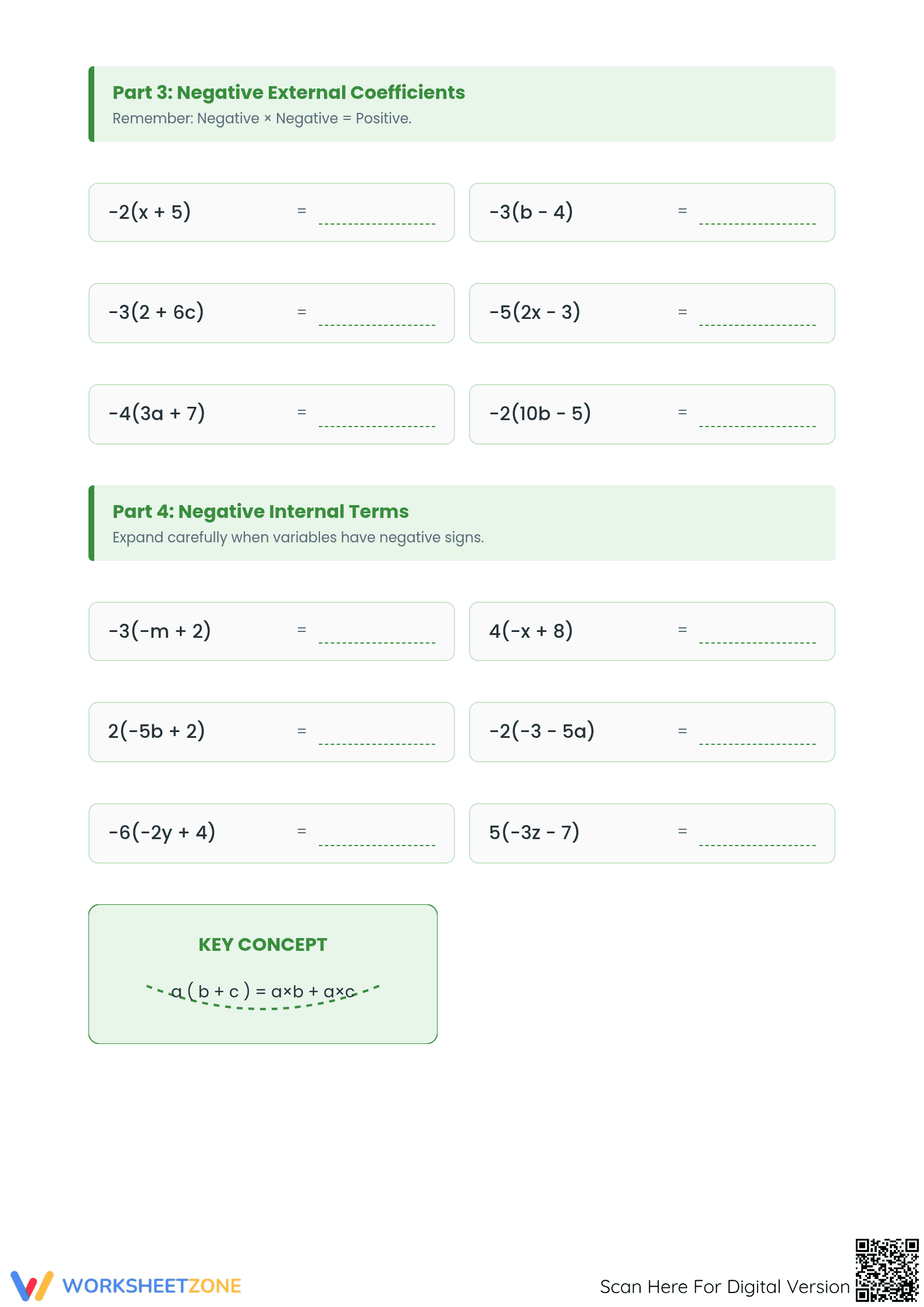
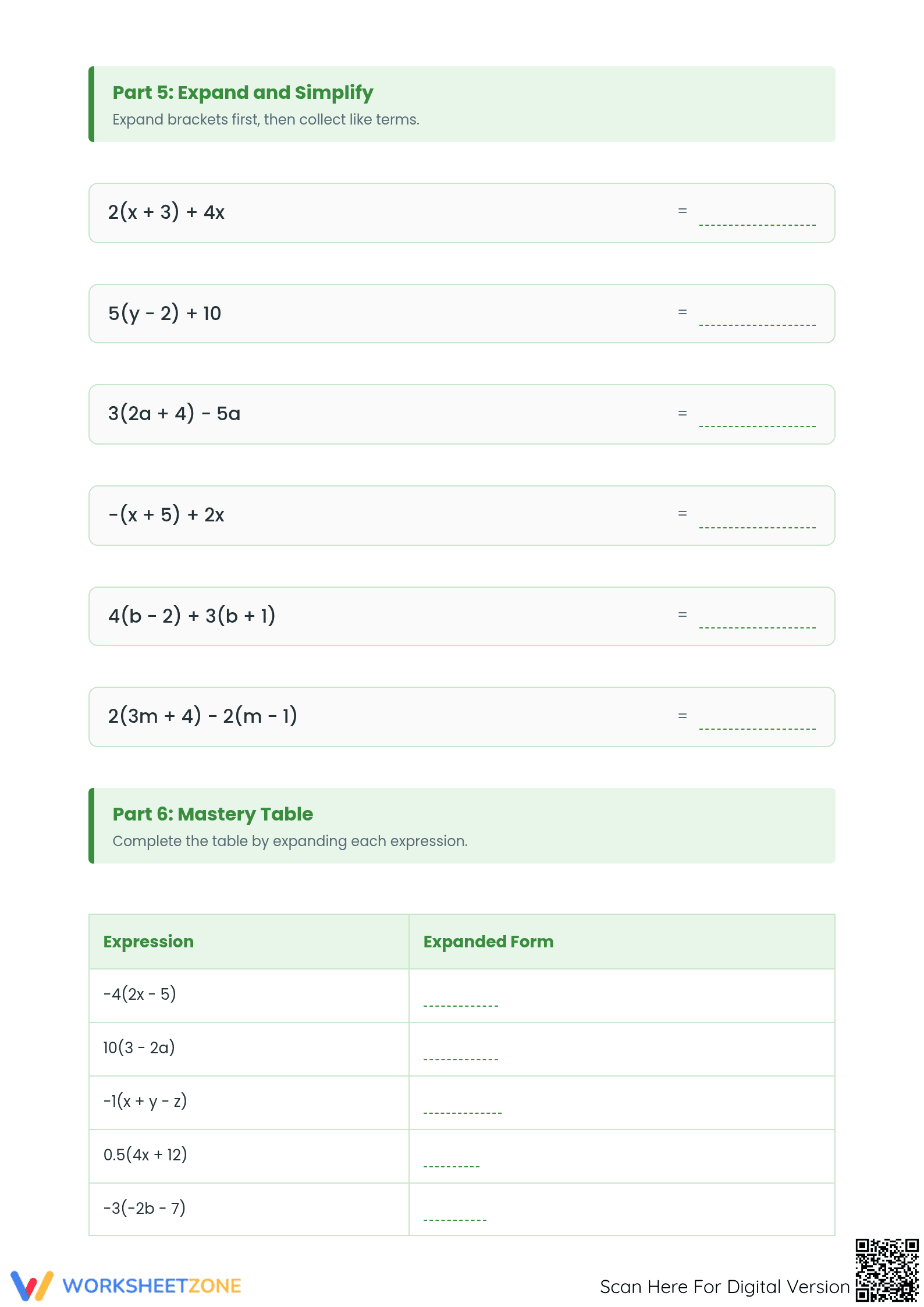
The packet contains three high-quality pages featuring 35 unique algebraic problems. It begins with basic expansion using positive integers and progresses into more challenging tasks involving coefficients inside the brackets and negative external numbers. The final page challenges students with "Expand and Simplify" problems and a comprehensive mastery table to verify their understanding of the distributive property across different contexts.
Skill Progression
- Guided Practice: Students begin with 12 foundational problems that focus on the basic rule, a(b + c) = ab + ac, providing immediate success and building confidence with positive integers.
- Supported Practice: The middle section introduces 12 problems featuring negative coefficients and internal terms, requiring students to apply integer rules while expanding to prevent common sign errors.
- Independent Practice: The final page offers 11 advanced tasks where students must expand and then collect like terms to simplify expressions fully.
This structure follows a gradual-release model, moving from isolated skill practice to integrated algebraic simplification.
Standards Alignment
The primary focus is 7.EE.A.1, which requires students to apply properties of operations as strategies to expand linear expressions. This resource also supports Grade 8 and High School Algebra standards (HSA-SSE.A.1) by establishing the foundational skills necessary for interpreting the structure of expressions. Both standard codes can be copied directly into lesson plans, IEP goals, or district curriculum mapping tools.
How to Use It
Use this worksheet as a main-lesson activity after introducing the distributive property; the progression allows you to monitor students as they transition from simple to complex tasks. Alternatively, assign the "Mastery Table" as a quick exit ticket to gauge which students need intervention on negative integer multiplication. Expected completion time is approximately 35 minutes for most middle school learners.
Who It's For
This resource is designed for Grade 7 and 8 students in Pre-Algebra or Algebra 1 courses. It provides excellent remediation for high school students who struggle with sign errors during expansion. It pairs naturally with a lesson on combining like terms or an introductory unit on linear equations.
Aligned to 7.EE.A.1, this resource targets the essential skill of expanding linear expressions with rational coefficients, a cornerstone of algebraic readiness. Research by EdReports (2024) states that procedural fluency in expression manipulation is a major predictor of success in higher-level mathematics. By providing 35 scaffolded opportunities, this worksheet addresses the cognitive load issues associated with multi-step algebraic expansion. Fisher & Frey (2014) highlight that structured practice with immediate feedback—facilitated here by the clear "Key Concept" diagrams and logical part-by-part progression—is vital for moving skills from short-term memory to long-term mathematical mastery. The inclusion of negative terms and simplification steps ensures that students confront and resolve the most common algebraic misconceptions before moving to equation solving. This data-driven approach supports robust student outcomes in diverse classroom settings.


