


























Views
Downloads
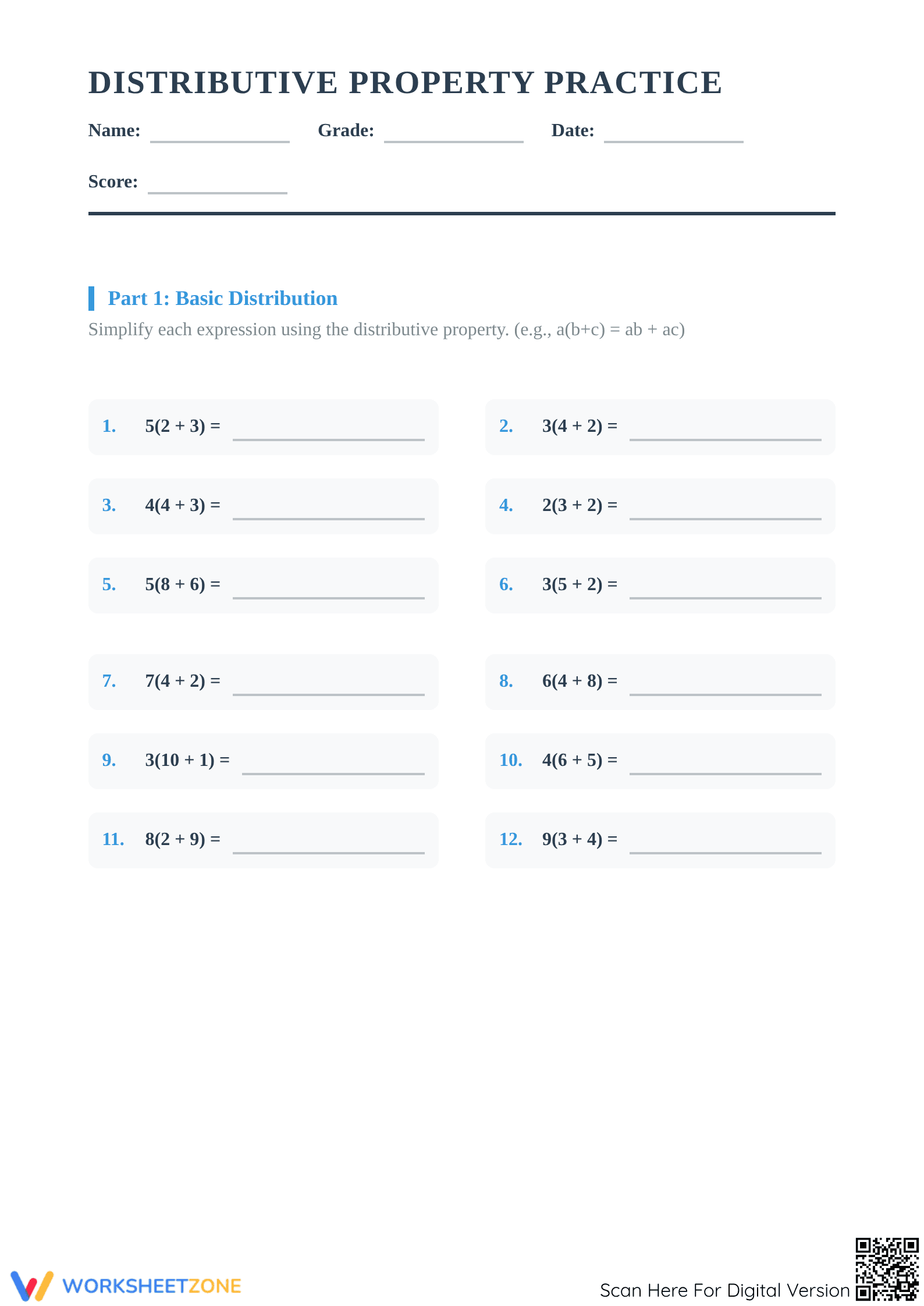


Printable Distributive Property Practice | Grades 6-8 Math
Paste this activity's link or code into your existing LMS (Google Classroom, Canvas, Teams, Schoology, Moodle, etc.).
Students can open and work on the activity right away, with no student login required.
You'll still be able to track student progress and results from your teacher account.
Students master the mechanics of equivalent expressions using the distributive property through this comprehensive practice set. This worksheet ensures learners can accurately multiply a sum or difference by a number, transitioning from concrete arithmetic examples to abstract algebraic variables. By completing these exercises, students build the foundational fluency required for solving complex linear equations.
At a Glance
- Grade: 6–8 · Subject: Math
- Standard:
6.EE.A.3— Apply properties of operations to generate equivalent expressions- Skill Focus: Distributive Property
- Format: 2 pages · 28 problems · Answer key included · PDF
- Best For: Independent practice and homework
- Time: 20–35 minutes
This two-page PDF resource contains twenty-eight carefully sequenced problems designed to facilitate mathematical fluency. The first page focuses on basic distribution with positive integers, while the second page introduces subtraction, algebraic variables (x, y, z, a, b, c), and multi-term challenge problems. A complete answer key is provided to support immediate feedback and self-correction during the learning process.
Skill Progression
- Guided practice: Problems 1 through 12 provide high-repetition arithmetic distribution to cement the concept of multiplying the outer term by each inner addend.
- Supported practice: Problems 13 through 24 introduce subtraction and single variables, requiring students to apply the property to more complex terms.
- Independent practice: The final section offers challenge problems with three terms inside the parentheses, testing the limits of student understanding.
This sequence implements a gradual-release model, moving from teacher-led demonstration to total student independence.
Standards Alignment
The content is strictly aligned to 6.EE.A.3, which requires students to apply properties of operations to generate equivalent expressions. It also supports 7.EE.A.1 as students expand linear expressions with rational coefficients. Both standard codes can be copied directly into lesson plans, IEP goals, or district curriculum mapping tools.
How to Use It
Use this worksheet as a primary practice tool after direct instruction on the distributive property. It is best implemented during the independent practice phase of a lesson or as a formative assessment to identify misconceptions regarding sign changes or variable handling. Teachers should observe students at problem 19 to see if they correctly maintain variable labels during distribution.
Who It's For
This resource is designed for middle school students in grades 6, 7, and 8 who are developing algebraic thinking skills. It serves as an excellent remedial tool for high school students needing a refresher on expression simplification. Pair this with a distributive property anchor chart or a short video tutorial for students requiring additional visual scaffolds.
Research from Fisher & Frey (2014) emphasizes that algebraic fluency is best developed through the gradual release of responsibility, moving from worked examples to independent problem-solving. This Distributive Property worksheet adheres to this principle by providing 28 structured tasks that transition from simple arithmetic to variable-based expressions. Mastery of the distributive property, particularly the standard 6.EE.A.3, is a critical predictor of success in later algebra courses, as it forms the basis for factoring and solving multi-step equations. By isolating the distributive mechanic across different contexts—including subtraction and multi-term parentheses—this resource ensures that students move beyond rote memorization toward a conceptual understanding of equivalence. According to the ScienceDirect TpT Analysis, high-repetition practice sets with immediate feedback loops, such as the included answer key, significantly reduce cognitive load for middle school math learners. This worksheet provides the essential scaffolding necessary for students to confidently navigate the transition from concrete arithmetic to abstract mathematical modeling.


