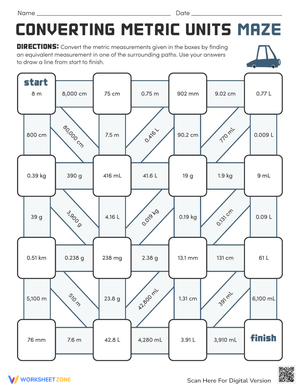
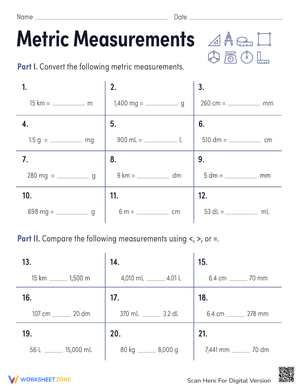
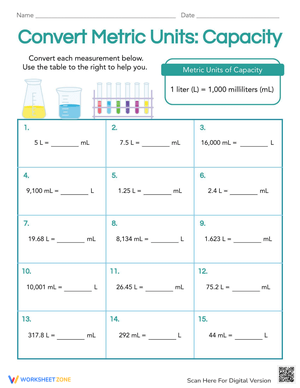
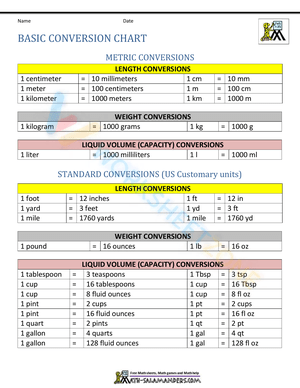
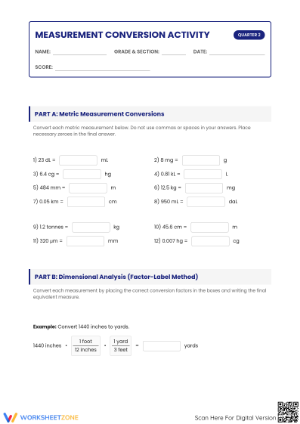
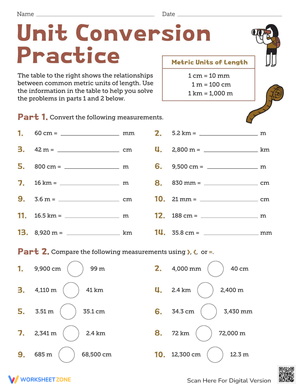
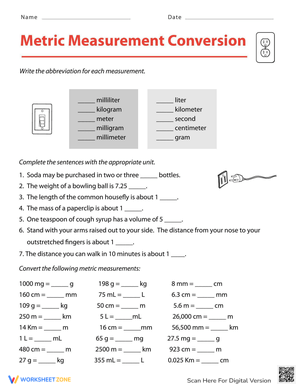
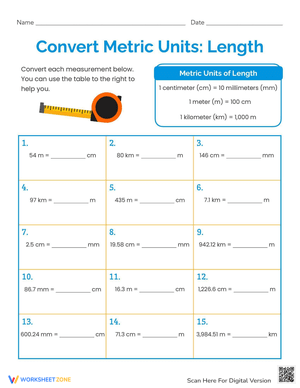
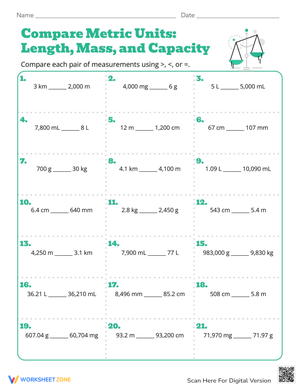
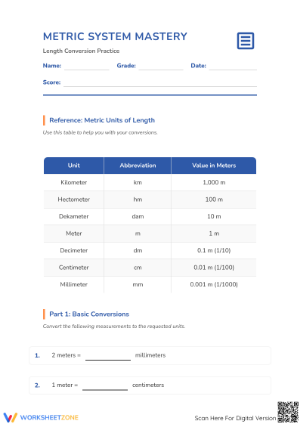
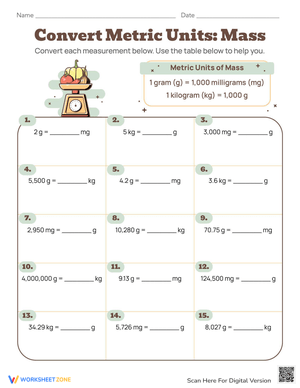
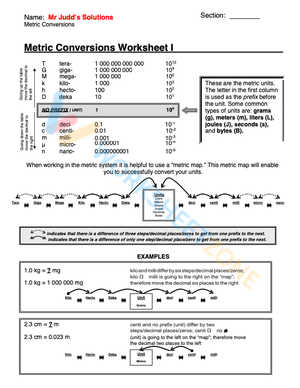
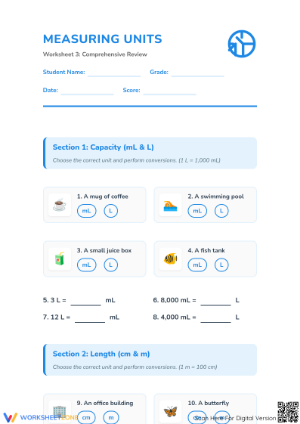
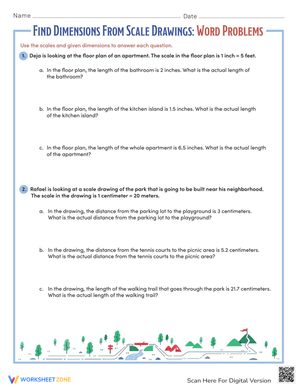
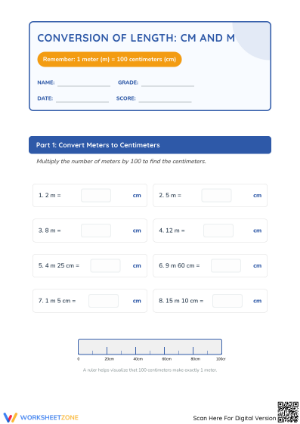
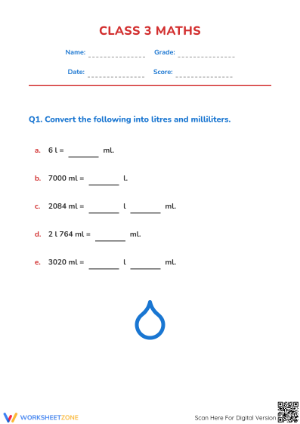
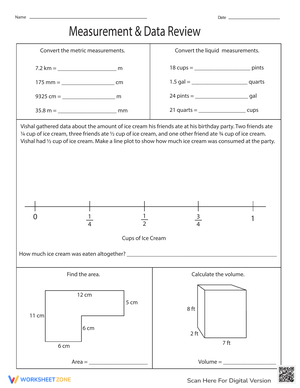
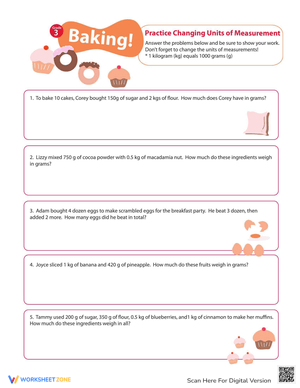
These converting metric units worksheets give 4th, 5th, and 6th grade teachers structured practice pages that move students from shaky prefix recall toward fluent, automatic conversion — the kind where a student stops counting steps on a mnemonic and just knows that 4.2 km is 4,200 m.
What's Covered In These Converting Metric Unit Worksheets?
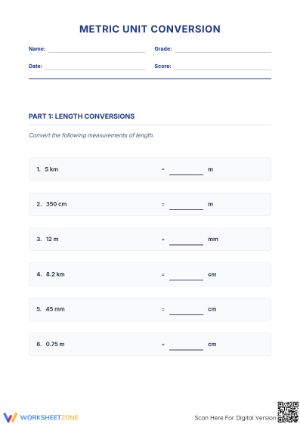
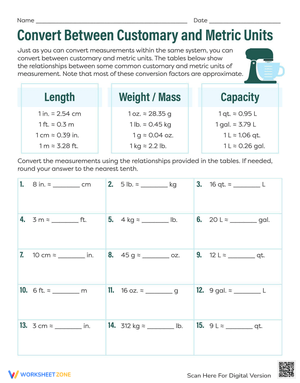
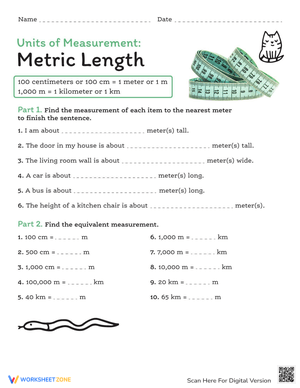
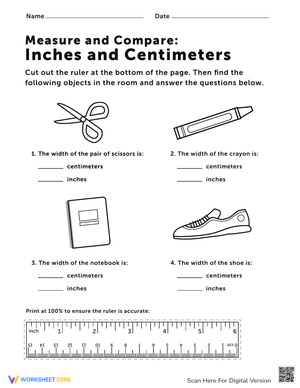
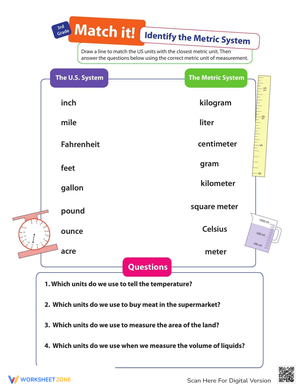
These worksheets cover the three measurement categories students encounter across science and math:
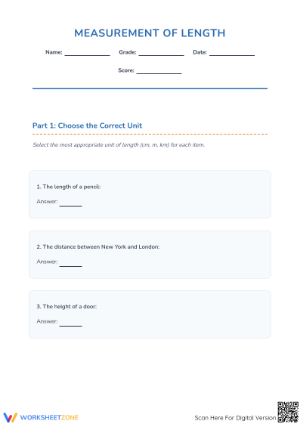
- length (millimeters through kilometers)
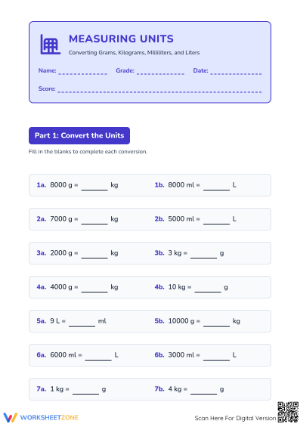
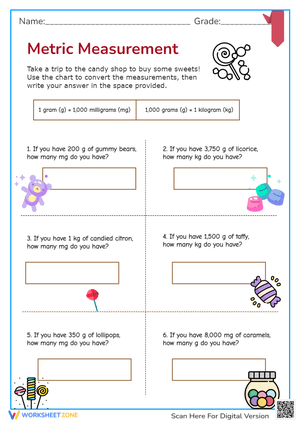
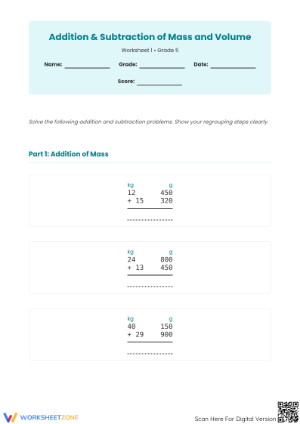
- mass (milligrams through kilograms)
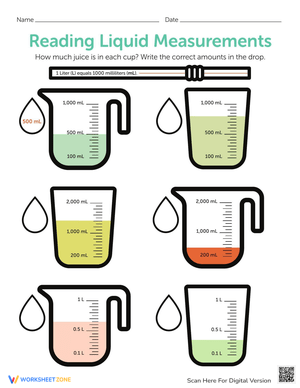
- capacity (milliliters through kiloliters).
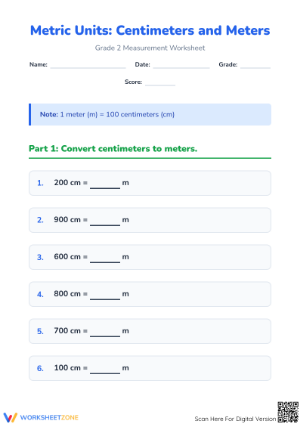
Within each category, problems progress from single-step conversions — convert 650 cm to meters — through two-step and multi-unit problems that require students to work across the prefix hierarchy. Later pages include word problems set in contexts like comparing liquid volumes in a lab scenario or adding distances along a route measured in mixed units. Students underline the given unit, identify the target unit, determine the direction and magnitude of the decimal shift, and record the converted value — a consistent four-step annotation routine that becomes habit over repeated practice.
Standards Alignment
CCSS.MATH.CONTENT.5.MD.A.1 is the anchor standard — it requires students to convert among different-sized measurement units within a single system and apply those conversions to multi-step real-world problems. That phrasing matters instructionally: the standard does not stop at simple unit swaps. It expects students to use conversions as a computational tool inside longer problem chains, which is why these worksheets include both isolated conversion drills and multi-step applications. The conversion skills introduced here also carry directly into 6th grade ratio reasoning (6.RP.A.3d), where students use ratio relationships to convert measurement units — so fluency built in 5th grade pays off the following year.
Common Mistake Of Students That Teachers Should Aware and Address
The most consistent error at this level is decimal-direction confusion. Students who understand that kilo- means 1,000 will still divide when they should multiply — they know the scale factor but not which way to apply it. A student converting 3.5 km to meters will write 0.0035 instead of 3,500 because they moved the decimal left out of habit from a recent division lesson, not because they misunderstand the metric hierarchy. A related error shows up in mass problems: students frequently confuse the direction of conversion between grams and milligrams versus grams and kilograms, getting those two exactly backwards. The worksheets catch both patterns because they interleave conversion directions rather than grouping all multiply-by-1,000 problems together — random interleaving forces students to determine direction on each problem rather than riding the momentum of a consistent setup.
A third pattern worth watching is unit-label omission. Students compute the correct number and skip the unit, which looks like carelessness but often signals that the student did not actually track what the number represents. Requiring students to write the full label — not just the numeral — surfaces that confusion during practice rather than on an assessment.
Recommended Lesson Planning Strategies To Take Full Advantages Of These Worksheets
The most common placement is the Monday warm-up after a weekend gap, when students need 8–10 minutes of low-stakes retrieval before new instruction. A single worksheet page — five to eight problems — fits that window cleanly. The pages also work well as the independent-practice segment of a gradual-release lesson: teacher models two problems, students work two with a partner, then complete the remaining problems alone while the teacher circulates. Because the problems are sequenced by difficulty within each page, that last group of problems serves as a built-in challenge tier for students who finish early without requiring a separate differentiated copy.
For formative use, a four-problem exit slip pulled from the capacity section gives clear data before the next day's lesson. One problem per conversion direction (milli-to-base, base-to-kilo, and their reverses) tells you immediately which students have the decimal-shift direction mapped correctly and which students need a small-group pull the next morning.
Adapting These Worksheets For Different Levels of Students
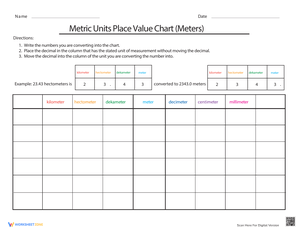
Students who freeze at the start of a conversion problem usually need the prefix hierarchy visible as a physical object, not just memorized. A laminated strip showing kilo — hecto — deka — base — deci — centi — milli kept on the desk removes the retrieval bottleneck and lets those students focus cognitive effort on the decimal-shift mechanics rather than prefix recall. Once the procedure is solid, the strip comes away and recall develops through repetition.
For students ready to move beyond single-step problems, the extension is to change the question structure: instead of "convert 2,400 mL to liters," ask them to determine which of several containers — measured in different units — holds the most, then rank them in order. That forces conversion as a tool rather than a goal, which is closer to how metric measurement actually functions in science class and in 6th grade math.
Frequently Asked Questions
My students know the mnemonic but still get the decimal direction wrong. What's happening?
Knowing "King Henry Died By Drinking Chocolate Milk" tells a student the order of prefixes — it does not automatically tell them which direction the decimal moves for a given conversion. Students need an additional explicit rule: moving from a larger unit to a smaller unit means the number gets bigger (multiply, shift right); moving from a smaller unit to a larger unit means the number gets smaller (divide, shift left). Pairing the mnemonic with that rule, and having students state it aloud before each problem during early practice, closes the gap faster than additional mnemonic repetition.
Do these work for students who are still shaky on decimal operations?
They work, but with a caveat. Students who have not yet internalized place value for decimals will treat every conversion as a separate arithmetic problem rather than a decimal shift — they'll laboriously multiply 4.7 by 1,000 in columns instead of moving the decimal point. That procedural path still gets correct answers, so the worksheets function, but the efficiency gain of decimal-shift fluency won't arrive until place value is solid. These are worth running alongside decimal place value review for that group, not instead of it.
Can these pages be used in a science class?
Yes — the measurement categories align directly with what students measure in upper elementary science (mass in grams/kilograms, volume in mL/L, length in cm/m/km). Science teachers running a lab unit on measurement often use two or three pages from the length and capacity sections as pre-lab skill checks before students handle equipment, which surfaces any students who will misread or misrecord metric measurements before those errors compound across a data collection activity.













 Interactive Worksheet Maker
 Quiz Maker
 Word Search Maker
 Crossword Puzzle Maker
 Word Scramble Generator
 Sentence Scramble Generator
 Handwriting Worksheet Generator
 Name Tracing Generator
 Fill In The Blank Generator