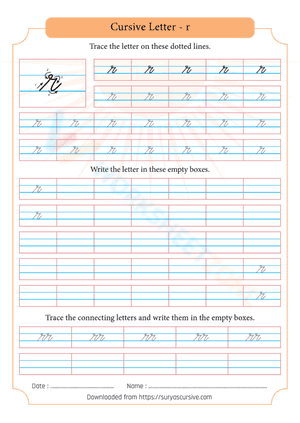
Why Cursive R Handwriting Worksheets?
Most cursive units move letter by letter, but a few letters stall the whole class. The capital R is one of them. Its loop-and-stem shape asks young writers to change direction three times in a single letter, and that's exactly why dedicated cursive R worksheets earn a spot in your handwriting rotation. Instead of burying R inside a full-alphabet packet, isolating it gives students the repetition they need before the letter shows up in names, sentences, and daily journaling.
This guide is written for K-2 and intervention teachers who need something ready to print on Monday morning. It covers where R belongs in your scope and sequence, how to teach the uppercase stroke, and how to fold targeted practice into small groups without adding prep time.
Where Cursive R Fits in Your Alphabet Sequence
Cursive is usually taught in strokes and letter families rather than strict A-to-Z order. Lowercase r tends to appear early because it shares the up-and-over motion of letters like n and m. The capital R, by contrast, is often held for later in the unit, once students are comfortable with looped capitals such as B and P.
In a typical 2nd or 3rd grade rollout, teachers introduce lowercase letters first, spend a few weeks on capitals, and then move to connected words. Slotting your cursive R worksheets right after students have practiced the tall stem and the forward loop means the pieces of the letter already feel familiar. That sequencing cuts down on frustration and keeps the pace steady.
If you teach mixed grades or run a pull-out group, you can decouple R from the calendar entirely. Pull the R sheet whenever a student is ready for it, and use the lowercase version as a warm-up before tackling the trickier capital.
Teaching the Uppercase Cursive R Stroke
The capital cursive R trips students up because it doesn't look like its print cousin. Handwriting specialists frequently list it among the harder capital letters, and the reason is mechanical: the letter combines a tall downstroke, a retrace, a forward loop, and a final kick-out tail. Each transition is a chance to lose control of the pencil.
Here's the detail that changes results in practice: most malformed capital R's fail at the retrace, not the loop. When a student lifts the pencil after the downstroke instead of tracing back up the same line, the loop starts too high and the tail collapses. If you watch only one thing during R practice, watch the retrace. Cueing students to slide back down the same road before making the bump fixes more R's than any amount of extra tracing.
Break the stroke into three spoken cues: down, retrace and loop, then swing out. Say the cues aloud while students trace the first few repetitions on the worksheet, then fade your voice as they move to the independent lines. For students who reverse the letter, a highlighted starting dot and a directional arrow on the first stroke keep them oriented.
Cursive R and State Cursive Mandates
Cursive is no longer a nostalgic extra in most of the country. A growing list of states has written handwriting back into elementary requirements, which means letter-level practice now supports a documented standard rather than filling spare minutes.
According to Zaner-Bloser, at least 24 US states now have laws or standards requiring cursive handwriting instruction in public elementary schools. That shift means letter-level practice sheets, including work on trouble letters like the capital R, increasingly tie to state requirements instead of teacher preference alone.
The momentum is recent. The 74 reported that Pennsylvania moved to bring cursive back into its schools in early 2026, joining states that already require it. California expects cursive across the early elementary grades, and Louisiana has looked for cursive proficiency since its 2016 mandate. If your state is on that list, documenting daily R practice gives you a clean paper trail for standards alignment.
Using These Worksheets In Real Classes
Fitting cursive R practice into a full teaching day is easier when it rides along with routines you already run. A few low-prep options:
- Morning warm-up: Put the lowercase r line on the board or a half-sheet as students settle in, then move to the capital later in the week.
- Literacy centers: Stock a handwriting station with laminated cursive R worksheets and dry-erase markers so students can trace, wipe, and repeat.
- Small-group intervention: Use the isolated R sheet with the three or four students who need extra reps while the rest of the class works independently.
- Exit tickets: Ask for one carefully formed capital R at the bottom of another assignment to check retention without a whole new page.
Whatever the format, keep the focus on quality over quantity. Five well-formed R's with a correct retrace beat a full page of rushed, looping guesses. Model the letter, watch the first repetitions closely, and give quick feedback before habits set.
Frequently Asked Questions
1. What grade level typically introduces cursive letter R?
Most schools introduce cursive in 2nd or 3rd grade, with lowercase r appearing early in the sequence and the capital R taught a bit later once students can form looped capitals. In states with early mandates, formal instruction may start in 1st grade.
2. Why do students struggle more with uppercase cursive R than lowercase?
The lowercase r is a short up-and-over stroke, while the capital R combines a tall downstroke, a retrace, a forward loop, and a tail. Those extra direction changes give students more places to lose control, which is why the capital shows up on most trouble-letter lists.
3. How many cursive R practice sessions are needed before mastery?
There's no fixed number, but short, frequent sessions work best. Many students need consistent practice across two to three weeks before the letter becomes automatic. Keeping dated sheets helps you see when formation has stabilized.
4. Can cursive R worksheets be used for handwriting intervention or IEP goals?
Yes. A single letter gives you a clear, measurable target, such as forming a legible connected R in four of five trials. That specificity makes isolated R sheets a practical tool for intervention groups and handwriting-related IEP progress monitoring.
5. How does cursive R practice fit into state-mandated cursive instruction?
In the growing number of states that require cursive, letter-level practice supports the broader standard. Documenting regular R work gives you evidence of standards-aligned instruction and a record of student progress toward proficiency.