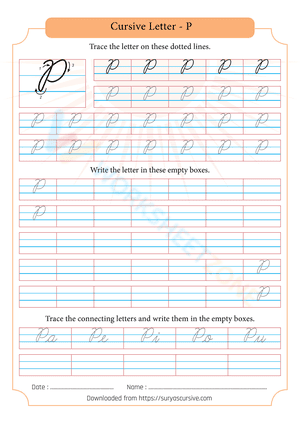
Capital letters in cursive are not just bigger versions of the lowercase forms students already know. Letters like G, Q, and Z use loops and entry strokes that barely resemble their print counterparts, which is why so many students stall out on capitals even after they have lowercase cursive down. Cursive uppercase letters worksheets give you a focused way to isolate that specific skill instead of folding it into general handwriting time where it tends to get rushed.
Occupational therapists working in elementary buildings frequently point out that many teachers now assigned to teach cursive were never taught it themselves as students, which means uppercase letter formation often has to be modeled from a reference sheet rather than from memory. A worksheet set with clear stroke arrows and grouped letter families gives those teachers a script to follow, not just an assignment to hand out.
Sequencing Uppercase Letters by Stroke Pattern, Not Alphabetical Order
Teaching cursive capitals in strict A-to-Z order is one of the most common inefficiencies in handwriting instruction. Letters share underlying stroke families: some start with an overcurve, some with an undercurve, and some rely on a loop that swings back through the letter body. Grouping worksheets by these shared motions lets students transfer what they just practiced to the next letter instead of relearning a new motor pattern every single day.
A practical grouping might start with letters that share a simple overcurve stroke, move to letters built on undercurves, and save the more complex loop-and-cross letters like F, Q, and Z for later in the sequence, once fine motor control has improved through repetition.
Fitting Uppercase Practice into Limited Handwriting Minutes
In a national survey, a majority of elementary teachers reported spending one hour or less per week on handwriting instruction overall, which leaves little room for uppercase letters specifically once lowercase forms, connectors, and sentence practice are accounted for. Short, targeted worksheet sets solve this by letting you drill three or four related capital letters in a five to ten minute block rather than trying to cover the whole alphabet in one sitting.
Rotating a small set of uppercase letters into morning work or a handwriting warm-up keeps the skill active without requiring a dedicated cursive period every day.
Classroom Implementation
Start each uppercase worksheet with a brief teacher demonstration on the board, tracing the letter slowly while naming the stroke, before students pick up a pencil. Have students trace the dotted or shaded model letters first, then move to independent formation on the same page, so the transition from guided to independent practice happens within a single sheet rather than across separate days.
Keep a visual stroke-family chart posted near the handwriting area so students can self-check their letters against a reference instead of relying only on you for correction. For students who need extra motor support, consider having them air-write or trace the letter on a desk with a finger before touching pencil to paper, which reduces frustration before the fine motor task begins.
Frequently Asked Questions
1. What order should teachers introduce cursive uppercase letters in?
Group letters by shared stroke patterns rather than alphabetical order. Letters that begin with a similar overcurve or undercurve motion are easier for students to learn back to back, since the motor pattern carries over from one letter to the next.
2. How much class time should be spent on cursive uppercase practice per week?
Since most elementary teachers report spending one hour or less per week on handwriting overall, plan for short, frequent sessions of five to ten minutes focused on just a few uppercase letters rather than one long weekly block covering the whole alphabet.
3. Which cursive capital letters are hardest for students to learn and why?
Letters such as Q, Z, and G tend to be the most difficult because their cursive form differs significantly from the printed capital, involving loops and entry strokes students have not used before in that combination.
4. How can teachers assess mastery of cursive uppercase letters?
Use brief, recurring formative checks that sample a handful of letters across different stroke families each week, rather than a single test at the end of a unit, so you can catch and address specific letter reversals or malformations early.
5. Are cursive uppercase worksheets useful for students with fine motor or handwriting difficulties?
Yes. Isolating individual capital letters lets you target the exact letters a student struggles with in a small-group or one-on-one setting, and pairing worksheets with tracing or air-writing warm-ups can reduce frustration for students who need extra motor support.