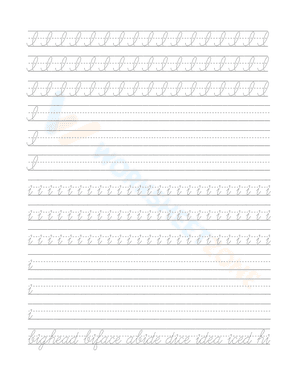
Where A Cursive i Handwriting Worksheet Fits in a Handwriting Unit
If you're teaching cursive this year, the lowercase i is a smart place to start. It's short, high-frequency, and built on an entry stroke that unlocks several other letters. These cursive i worksheets are designed to make that first win fast and legible.
Cursive lowercase i looks simple, but it carries two skills students need before they can write connected words: a clean undercurve entry and correctly timed dot placement. That's why cursive i worksheets earn a spot early in most handwriting sequences. This page breaks down how to teach the letter, what to watch for, and how to move students from isolated strokes to connected words like time, kite, and wait.
Most US classrooms introduce cursive between grade 2 and grade 3, when students are typically developmentally ready around age 7-8. Reading Rockets points out that fine-motor control and letter familiarity matter more than a fixed age, so the same worksheets can support grade 2-3 introduction and grade 4-plus review or handwriting intervention.
After cursive lost its place as a required K-8 skill around 2010, many states pushed back: mycursive documents a long list of states that now require cursive writing in public schools. For US teachers, that reversal means practicing a single stroke like cursive lowercase i is part of mandated instruction again, not an optional add-on.
The Cursive Lowercase i Stroke, Step by Step
Break the letter into three moves so students can self-check each one on the worksheet.
- Undercurve entry. Start at the baseline, swing up to the midline in a smooth undercurve. This same entry stroke shows up on several letters, so it is worth over-practicing.
- Consistent height. The stem rises to the midline, not the top line. A tall i is the most common sizing error and throws off the rhythm of a whole word.
- Retrace down and connect. Retrace back to the baseline and swing into the connecting stroke toward the next letter.
- Delayed dot. Add the dot only after the connecting stroke is finished, placed directly above the stem.
That last step is the heart of the letter. Unlike print i, where students dot immediately, cursive i asks them to hold the dot until the word (or at least the connection) is complete, which keeps the pen moving and the word legible.
Set students up before the first stroke. A slightly slanted paper, a relaxed tripod grip, and a starting dot on the baseline all make the undercurve entry easier to control. Worksheets with a visible baseline, midline, and start dot give students the reference points they need to self-correct without the teacher hovering.
Does Cursive Practice Worksheets Pay Off?
Teachers reasonably ask whether all this letter-level practice actually pays off, especially when instructional minutes are tight. The short, honest answer from the research is a qualified yes.
According to the Iowa Reading Research Center, cursive instruction can improve handwriting legibility, spelling accuracy, and writing fluency, though evidence that cursive beats print on broader cognitive measures stays mixed. That distinction matters: teach cursive i for legible, fluent output, not as a guaranteed shortcut to stronger thinking.
A 2023 study found that sustained print instruction in grades 1-2, before introducing cursive, outperformed split print/cursive instruction on fluency and spelling accuracy. The classroom takeaway is precise: don't rush cursive i into a grade 1 schedule already crowded with print. Wait until print is stable, then teach i as one of the first cursive letters so students earn an early, high-frequency win.
Using These Cursive i Handwriting Practice Worksheets In Real Classrooms
Fit cursive i into a short, predictable handwriting block or a literacy center rotation.
- Model first. Demonstrate the undercurve entry and delayed dot on the board before students touch the sheet.
- Short, frequent reps. Five to ten focused minutes beats one long session. Most students need several spaced practice sessions before a single cursive letter feels automatic.
- Formative checks. Circle one correct i per row and one to fix, checking slant, sizing, and dot timing.
- Scaffold to words. End each session by writing one real word that uses i so practice transfers immediately.
- Track over time. Keep one dated sheet per week in a folder so students and families can see legibility improve across the unit.
For grade 4-plus intervention, the same sheets work as a quick diagnostic: if a student's i is illegible, it usually reveals the exact stroke to reteach.
None of this requires a special curriculum. A predictable routine, a clear target, and a quick check turn a stack of cursive i worksheets into steady, visible progress.
Frequently Asked Questions
1. What grade level is appropriate for introducing cursive i worksheets?
Most US classrooms introduce cursive in grade 2 or grade 3, around age 7-8, once print is stable. Grade 4 and up can use the same sheets for review or intervention. The best signal is stable print handwriting, not a specific birthday.
2. How is cursive lowercase i different from print i?
Cursive i starts with an undercurve entry, connects to the next letter, and is dotted only after that connection is complete. Print i is often dotted immediately.
3. What mistakes do students make on cursive i, and how do worksheets help?
The big four are dotting too early, inconsistent slant, dots drifting off the stem, and oversizing. Midline-marked, target-zone worksheets give the repetition that corrects each one.
4. How many practice sessions does mastering one cursive letter take?
It varies, but short, spaced sessions over several days usually beat one long drill. Plan for repeated exposure rather than a single mastery lesson. Consistency across the week matters more than any single count.
5. Can cursive i worksheets support upper-elementary intervention?
Yes. In grades 4 and up they double as a diagnostic and a fix: a broken i points straight to the entry stroke or dot timing that needs reteaching.