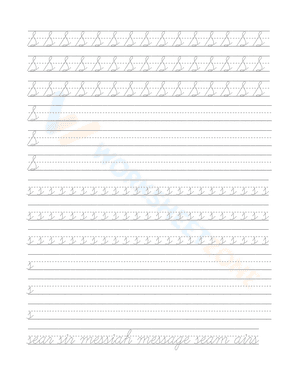
What Cursive S Handwriting Worksheets?
A strong cursive S hadnwriting worksheet does more than fill a practice block. It models the exact stroke path for both the uppercase and lowercase letter, gives students traceable guides, and then fades that support so learners write the letter on their own. For teachers in grades 3-4, that gradual release matters because the letter s is one of the first cursive forms students meet, and early habits tend to stick.
The lowercase cursive s is built around a narrow, slanted loop. Because that loop is short and repeatable, it works well as an entry point into a handwriting scope and sequence. A good worksheet isolates the shape, repeats it across a row, and then drops it into short words so students practice the stroke in the context they will actually write. Isolating the letter this way also lets you catch formation errors before they spread into connected writing.
Breaking Down the Cursive S Stroke Sequence
Model the letter before students touch a pencil. When you narrate the path out loud, you give the class a shared vocabulary for the stroke, which makes feedback faster later. Here is a simple breakdown you can post next to the worksheet.
For the lowercase cursive s:
- Start on the baseline and push a short line up and to the right at a slant.
- Curve back to the left to close a small pointed loop near the top.
- Come down and finish with a short tail on the baseline that connects to the next letter.
For the uppercase cursive S:
- Begin near the top with a small curve to the left.
- Sweep down in a single slanted line that mirrors the lowercase slant.
- Curl the bottom back to the left so the letter keeps its balanced, leaning shape.
Ask students to trace the stroke in the air two or three times while you count the steps. This warm-up primes the motor pattern before the paper practice begins.
Common Cursive S Errors Worksheets Should Address
Two mistakes show up again and again with the letter s. Some students leave the loop open, which makes the letter read like a lowercase r. Others round the whole shape instead of keeping the slant, so the s looks upright and loses its cursive rhythm. A worksheet that highlights the pointed loop and the slant line, rather than just repeating blank rows, helps students self-correct.
Here is a pattern worth watching for: the open-loop error and weak pencil control often travel together. In one survey, 70% of early educators reported a decline in students' fine motor skills, and students with that weaker control tend to release pressure at the top of the s, which flattens the loop. When you see an open loop, treat it as a motor signal, not just a shape mistake, and pair the worksheet with a short warm-up before reteaching.
Using These Worksheets In Real Classes
Fit cursive S practice into a short, predictable routine rather than a single long session. A ten-minute daily block usually outperforms one weekly marathon because handwriting is a motor skill that rewards spaced repetition.
- Warm up: Start with a fine motor activity, such as air-writing or finger tracing, especially for students with weaker pencil control.
- Model: Narrate the stroke path while students watch, then trace together.
- Trace: Assign the guided rows on the worksheet where the letter is dotted or shaded.
- Write: Move to the independent rows where students form the s without a guide.
- Apply: Finish with two or three short words so the stroke connects to real writing.
Keep completed pages in a handwriting folder so students can see their own progress across a unit. That visible growth keeps motivation high, particularly for learners who find handwriting frustrating.
Frequently Asked Questions
1. What grade level is best for introducing cursive S worksheets?
Third grade is the common starting point, since most students have the hand-coordination needed for a continuous slanted stroke by then. The lowercase s is usually taught early because its loop is simple, making it a confidence builder before harder letters.
2. How can teachers tell if a student is forming the cursive S loop correctly?
Look for a closed, pointed loop and a consistent slant. If the loop stays open, the letter reads like a lowercase r; if the shape rounds and stands upright, it loses its cursive slant. Watch the pencil during tracing to catch these early.
3. How many repetitions of cursive S are recommended before moving to connected words?
There is no fixed number, but a practical rule is several clean, independent repetitions in a row without a tracing guide. Once a student writes the s consistently on their own, move to st, sh, and ss combinations.
4. Can cursive S worksheets be used for intervention beyond the typical grade level?
Yes. The isolated, repeatable loop makes these pages useful for older students who reverse or open their letters. Intervention specialists can reuse the same sheets in small groups, since they remove the pressure of full-sentence writing.
5. What are the most common cursive S mistakes, and how do worksheets address them?
The most common errors are leaving the loop open and rounding the letter instead of slanting it. Worksheets that emphasize the pointed loop and slant line, paired with a fine motor warm-up, help students self-correct these habits.