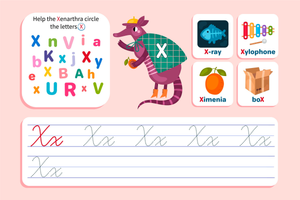
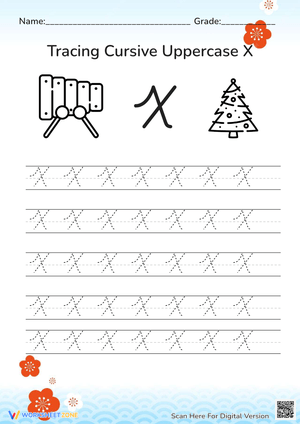
Where Cursive X Handwriting Worksheet Fits in a Handwriting Sequence
The cursive letter X almost never shows up first in a handwriting unit, and that's by design. Most sequences teach circle letters like c, a, d, g, o, and q early, then move to spike letters such as i, t, j, p, u, w, r, and s. Low-frequency, harder forms like x land near the end. If you teach cursive to a grade 2-4 class, X usually arrives after students already control the overcurve and undercurve strokes that power most letters.
That placement affects your pacing. By the time X appears, your students have weeks of muscle memory built on stroke families that X simply doesn't belong to. So plan a slower, more explicit mini-lesson for it instead of folding it into a fast alphabet review. A single dedicated worksheet gives students the repetition they need without stalling the rest of the unit, and it slots cleanly into a review or enrichment station once the whole-class lesson is done.
How to Form Lowercase and Uppercase Cursive X
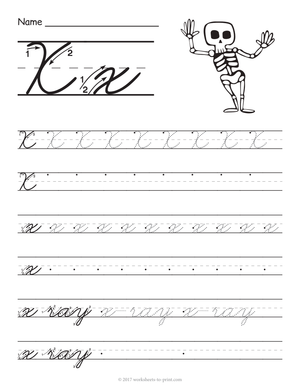
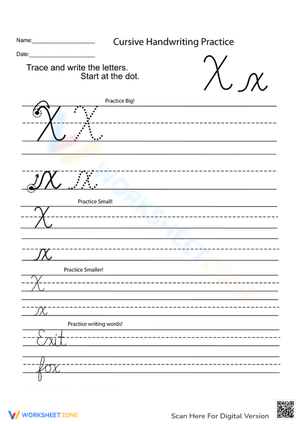
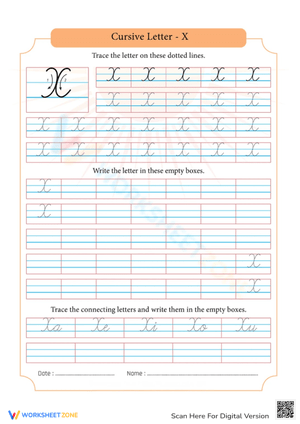
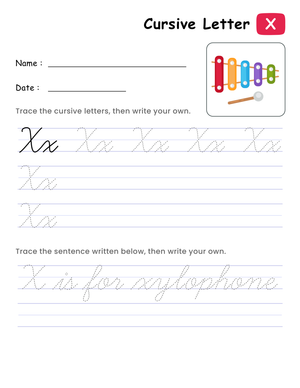
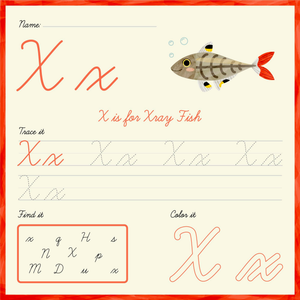
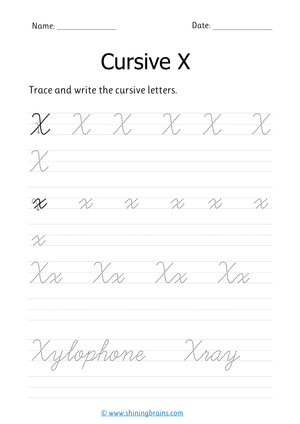
Lowercase cursive x starts like several other letters but finishes differently. Students bring the pencil up, curve over, and slide back down to the baseline to make the main body, then lift and add a small crossing stroke that slants from lower left to upper right. That second stroke is the part that surprises kids, because most cursive letters flow without a pencil lift. Say the steps aloud as you model, and have students trace over your directional arrows before they try it cold.
Uppercase cursive X is harder still. It uses two separate slanted strokes and does not connect neatly into the lowercase letter that follows. Teachers should expect an extra pencil lift and a restart here, which is normal for this form. Naming that break out loud helps students stop treating it as a mistake and instead plan for it, which is exactly the kind of self-monitoring you want a worksheet to reinforce.
Using These Worksheets In Real Classes
Start with a short board demonstration, then release students to guided practice on the worksheet. A predictable routine keeps the focus on the letter rather than the logistics. Here is a sequence that works well for a grade 2-4 mini-lesson:
- Model lowercase x twice, narrating the down-slide and the separate crossing stroke.
- Have students skywrite the letter with you three times before pencils touch paper.
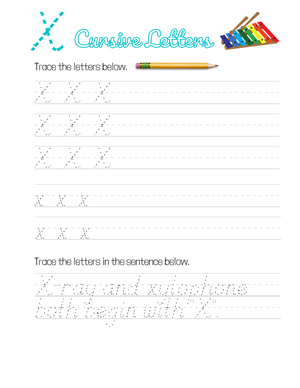
- Move to traced repetitions on the worksheet, watching for a clean pencil lift.
- Shift to independent rows, then have students circle their single best X in each line.
- Repeat the cycle for uppercase X, calling out the extra restart it requires.
Circling a personal best turns a repetitive drill into a quick self-assessment and gives you an easy point to check during a walk-around.
Frequently Asked Questions
1. How is the cursive letter X different from its printed form?
The cursive version keeps a similar crossed shape but is built from a curved down-slide plus a separate crossing stroke, and up to about 70% of cursive letters differ noticeably from print, so students can't just copy what they know.
2. At what grade should teachers introduce difficult cursive letters like X?
X typically comes late in a unit, often in grades 2-4, after students have mastered the circle and spike letters. Introducing it once the common stroke families are secure keeps the harder form from overwhelming beginners.
3. How many repetitions of a tricky letter like cursive X are recommended?
There is no fixed number, but plan for more than an easy letter. A few traced rows, then several independent rows spaced across the week, gives better retention than one long cramming session.
4. What are common student errors when writing cursive X?
Watch for a crossing stroke that misses the body, a reversed slant, and a skipped pencil lift. Naming the separate crossing stroke during your model and having students circle their best attempt helps correct these quickly.
5. Can cursive X worksheets be used for intervention or OT support?
Yes. Because the sheet isolates one letter, it works well for small-group reteaching and for handwriting or OT sessions that target the specific lift-cross-slant motion outside a full cursive unit.