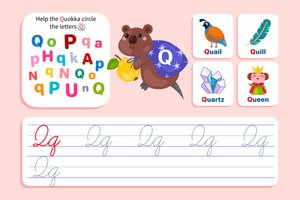
Cursive Q rarely comes up first when teachers plan a handwriting unit, but it is one of the letters students misform most often once instruction moves past the easier loop letters. Most classrooms introduce formal cursive around third grade, when fine-motor coordination has typically developed enough for students to manage the small, controlled movements cursive requires. By the time a class reaches Q, students have usually built some muscle memory with rounder letters like O and C, which makes this a good moment to check whether that foundation is actually transferring to trickier shapes.
How the Cursive Letter Q Is Formed
Uppercase cursive Q begins just below the topline. The pencil moves up and to the right, then curves down and to the left in a motion similar to starting the number 2, before finishing with a small tail that swings back to the right. Lowercase cursive q starts at the baseline, forms a rounded loop similar to a cursive a, then drops below the baseline into a short descender that curves left, ready to connect into the next letter. Because both versions include a stroke that breaks from the typical left-to-right rhythm of cursive, Q often needs more isolated practice than neighboring letters in the alphabet sequence.
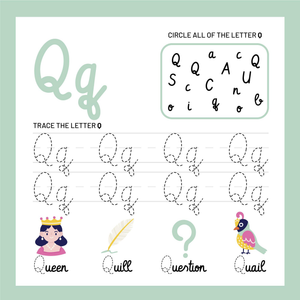
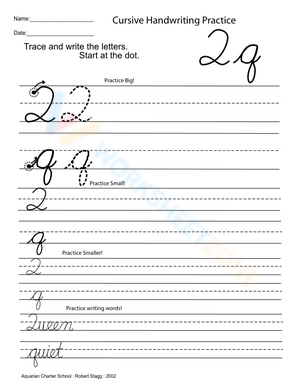
Worksheets built around this letter should show the full stroke path with numbered arrows, not just a finished model. Students copying only a finished letter tend to guess at stroke direction, which locks in a habit that is hard to undo later.
From Tracing to Independent Writing: A Practice Progression
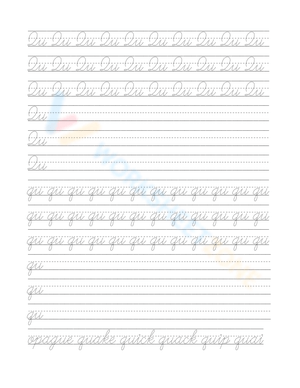
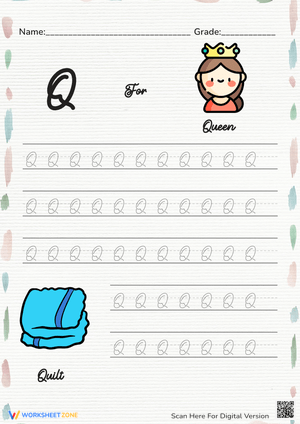
Worksheets that move students from guided tracing to independent writing tend to build accuracy faster than pages of repeated tracing alone. A practical sequence looks like this: full tracing over a dotted model, then tracing with the model fading to a lighter line, then copying the letter directly below a solid model, and finally writing the letter independently on blank lined space. Repeating this progression across a few short sessions, rather than one long worksheet, gives students more chances to self-correct before a habit sets in.
Classroom Implementation
Short, consistent handwriting sessions outperform occasional long ones for most elementary classrooms. A 10 to 15 minute daily or near-daily block, with a brief warm-up review of a previously taught letter before introducing new practice, keeps the skill active in students' hands without crowding out other instruction. For a letter like Q, plan at least two to three practice sessions spread across a week rather than a single worksheet, since the reversed-stroke error tends to resurface after a day or two without reinforcement.
Some students will need more repetition than others to stabilize the stroke pattern, and a quick small-group check-in for those students during independent work time is often enough without turning the whole lesson into a separate track. Keep the focus on stroke direction first; letter size and slant can be refined once the motion itself is reliable.
Frequently Asked Questions
1. What grade level is best for introducing cursive letter Q?
Most classrooms introduce it in third grade, after students have practiced rounder foundational letters and developed enough fine-motor control for the stroke changes cursive Q requires.
2. How is the cursive Q formed differently from print Q?
Cursive Q starts below the topline with an upward stroke and curves in a motion similar to the number 2, then connects into the next letter, while print Q is typically a closed circle with a separate tail added afterward.
3. How much daily practice time is needed to build cursive fluency?
Short daily or near-daily sessions of about 10 to 15 minutes tend to build more consistent letter formation than infrequent, longer handwriting blocks.
4. What words are good for practicing cursive Q in context?
Words such as queen, quiet, quilt, and quick work well because they reinforce the qu spelling pattern alongside the letter's cursive stroke.
5. How can teachers tell if a student is struggling with cursive Q formation?
Watch the stroke direction while the student writes rather than only checking the finished letter, since a reversed or disconnected stroke can still produce a shape that looks acceptable at a glance.