Where Cursive K Fits in Your Handwriting Sequence
If you teach cursive, you already know that letter order matters. Most sequences start with the easy undercurve letters, then build toward the trickier capitals, and the cursive letter K usually sits in that harder tier. That's exactly why students benefit from dedicated practice sheets for it. A focused set of cursive K worksheets lets you slot this letter into your unit at the right moment, instead of hoping it sticks during a rushed alphabet review.
Cursive is most often taught in the upper elementary grades, and the research supports that timing. According to the Iowa Reading Research Center, cursive instruction tends to work best in later elementary grades, after students have had sustained print handwriting practice in grades 1 and 2. That means your third, fourth, and fifth graders are usually the right audience for letter-by-letter cursive work, including the capital K.
What to Look for in a Cursive K Worksheet
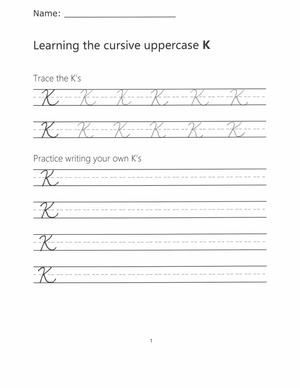
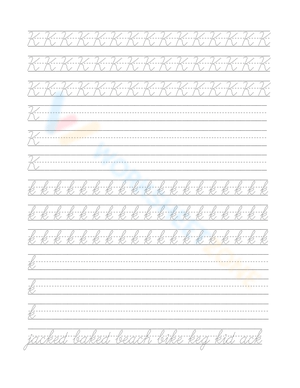
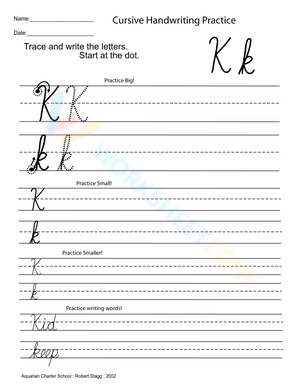
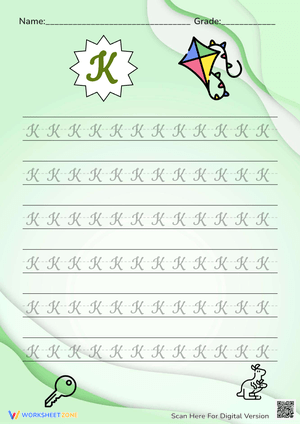
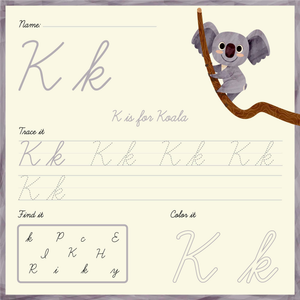
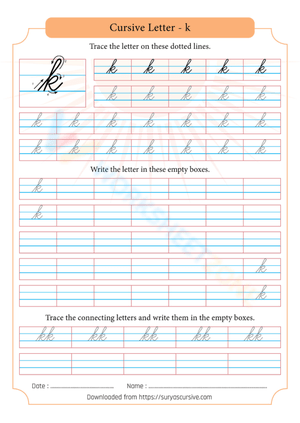
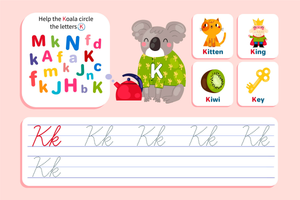
Not every tracing page is equally useful. The most effective cursive K worksheets give students a clear starting dot, directional arrows for each stroke, and a gradual release from full tracing to independent writing. Look for pages that include both the capital and lowercase forms, since students need to see how the two relate and, more importantly, where they differ.
A strong sheet also leaves room for connected practice. Isolated letters build the shape, but a worksheet that moves into short words keeps students from learning a beautiful K that falls apart the moment they have to join it to the next letter. Plenty of white space and consistent baselines matter too, especially for third graders who are still developing the pencil control that cursive demands.
Matching Cursive K Practice to State Requirements
Cursive is no longer a nostalgic extra in many states. It's a requirement you may need to document, which changes how you justify spending instructional time on a single letter like K.
As of 2025, roughly 25 states require cursive handwriting instruction in public schools, according to EdWeek reporting, about double the number from a decade earlier. Georgia's English language arts standards now expect students in grades 3-5 to read and write cursive, giving teachers a concrete mandate to plan around.
The handwriting publisher Zaner-Bloser, which tracks state cursive legislation, reports that these laws have spread steadily over the past decade. Maine offers a recent example: under a 2025 law, cursive instruction is expected to begin no later than grade 3, with competency by the end of grade 5. If your state uses similar language, a clear set of cursive K worksheets becomes evidence that you're covering the required letters systematically, not skipping the hard ones.
Classroom Implementation
You don't need a full class period for a single letter. A few well-placed routines make the cursive K stick without eating your literacy block:
- Warm-ups: Open handwriting time with three or four traced capital K's before students move into connected words.
- Small-group intervention: Pull the four or five students still struggling with the loop-and-cross and give them an extra tracing sheet while the rest of the class moves ahead.
- Homework reinforcement: Send a single practice page home after the in-class lesson so the motor pattern gets a second rep within 24 hours.
- Spiral review: Revisit K a week later inside a mixed-letter sheet so it isn't practiced only in isolation.
- Peer modeling: Pair a student who has the stroke down with one who is still practicing, and let them compare their traced K's side by side.
Because cursive falls in grades 3-5 for most schools, these routines fit naturally into a literacy block or a morning-work rotation without stealing time from reading instruction.
Frequently Asked Questions
1. What grade do students typically learn cursive letter K?
Most schools introduce cursive in grades 3-5. The Iowa Reading Research Center notes that cursive works best after students have had sustained print handwriting practice in grades 1 and 2, so the capital K usually lands in third or fourth grade for most classrooms.
2. Why is capital cursive K harder for students than lowercase k?
The uppercase K is a multi-stroke letter with a separate loop and an outward diagonal, while the lowercase k flows as one connected shape from the baseline. That extra coordination is why the capital needs noticeably more tracing repetitions than the lowercase form.
3. Do state cursive requirements affect my curriculum?
They can. With roughly 25 states requiring cursive as of 2025, many teachers now need to show they're covering each letter. A structured set of cursive K worksheets helps document that the harder capitals aren't being quietly skipped when time runs short.
4. How much practice time should I give a single cursive letter like K?
You don't need a whole period. Short, repeated exposures work better than one long session: a few warm-up traces, a homework page, and a spiral review a week later usually beat a single block that students forget by the next day.
5. Can cursive K worksheets help students who struggle with fine motor skills?
Yes. Tracing sheets give a guided path that lowers the motor load, letting students who struggle with fine motor control build the stroke pattern gradually before writing the letter freehand. Pair the sheets with slower pacing and short, frequent practice sessions.