


























Views
Downloads

Printable Cursive R Worksheet | Grade 1 English
Paste this activity's link or code into your existing LMS (Google Classroom, Canvas, Teams, Schoology, Moodle, etc.).
Students can open and work on the activity right away, with no student login required.
You'll still be able to track student progress and results from your teacher account.
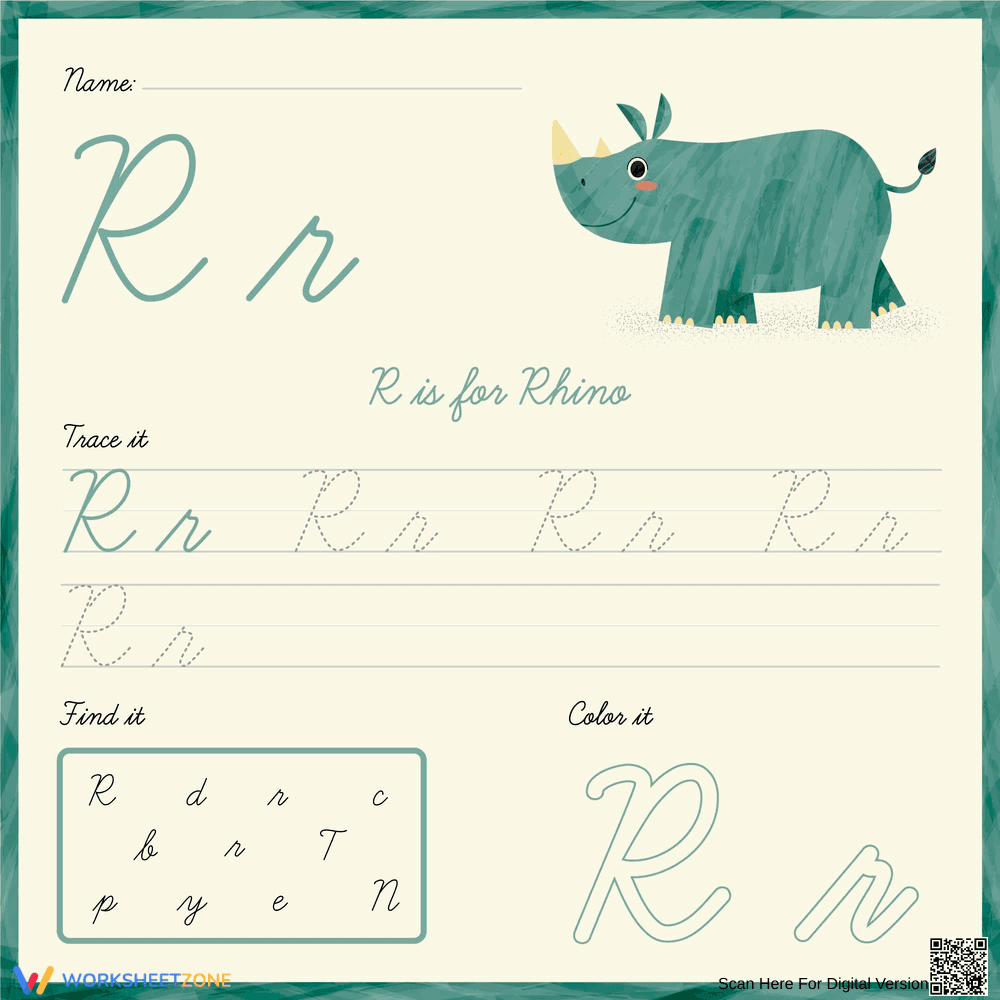
This Grade 1 handwriting worksheet helps students master the cursive letter R through targeted tracing and identification exercises. By combining fine motor practice with letter recognition, young learners build the foundational skills necessary for fluent cursive writing. The engaging rhino theme keeps students motivated as they practice proper letter formation.
At a Glance
- Grade: 1 · Subject: English
- Standard:
CCSS.ELA-LITERACY.L.1.1.A— Form upper- and lowercase letters- Skill Focus: Cursive Letter R Formation
- Format: 1 page · 3 problems · Answer key included · PDF
- Best For: Independent handwriting practice
- Time: 10–15 minutes
Inside this single-page resource, educators will find three distinct task types designed to reinforce cursive letter knowledge. The "Trace it" section provides five pairs of dotted uppercase and lowercase R's with directional guidelines. The "Find it" activity features a word bank-style box where students must visually discriminate the cursive R among other letters. Finally, the "Color it" section offers bubble letters for creative reinforcement. An answer key is included for quick reference.
This worksheet is designed for a smooth, zero-prep classroom experience. Print (1 minute): Download the PDF and print the required copies. Distribute (1 minute): Hand out the worksheets with pencils and crayons. Review (3 minutes): Briefly model the cursive R on the board before letting students work independently. Total teacher prep time is under two minutes, making this an ideal, self-explanatory activity for morning work, literacy centers, or a last-minute sub plan.
This resource is aligned to CCSS.ELA-LITERACY.L.1.1.A, requiring students to print all upper- and lowercase letters, which extends naturally into early cursive instruction. It also supports foundational reading skills by reinforcing letter-sound correspondence with the "R is for Rhino" visual cue. Both standard codes can be copied directly into lesson plans, IEP goals, or district curriculum mapping tools.
Teachers can utilize this worksheet during dedicated handwriting blocks or as a quiet transition activity after direct instruction on cursive strokes. For a formative assessment observation tip, watch students as they complete the "Trace it" section to ensure they are starting their pencil strokes at the correct point rather than drawing the letter backward. Expected completion time ranges from 10 to 15 minutes, depending on the student's fine motor control.
This resource is primarily designed for Grade 1 students beginning their cursive handwriting journey. It includes built-in differentiation notes, such as the large bubble letters for students who need gross motor practice before attempting the finer dotted lines. This worksheet pairs perfectly with a classroom alphabet anchor chart or a direct instruction lesson on continuous stroke handwriting techniques.
Effective handwriting instruction requires a combination of motor practice and visual discrimination. According to Fisher & Frey (2014), providing structured, multimodal tasks—such as tracing, finding, and coloring—enhances cognitive retention and fine motor automaticity in early elementary students. This worksheet targets CCSS.ELA-LITERACY.L.1.1.A by helping students form upper- and lowercase letters with precision. The plain-English skill of recognizing and writing the cursive letter R is reinforced through repeated, low-stakes practice. By integrating visual identification tasks alongside physical tracing, educators can ensure that students are not merely copying shapes, but actively internalizing the letter's unique structure. This comprehensive approach to handwriting builds the necessary muscle memory for fluent, legible writing in later grades, making it a vital component of early literacy development and long-term academic success.


