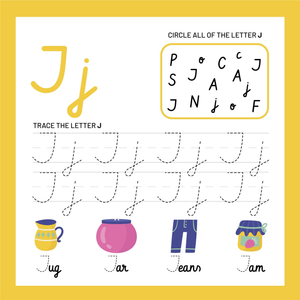
What makes the cursive j handwriting hard to teach
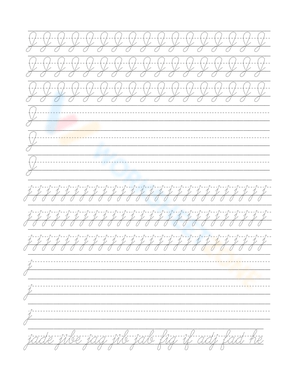
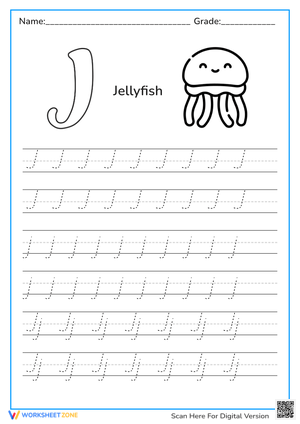
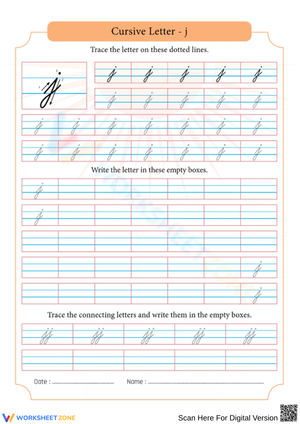
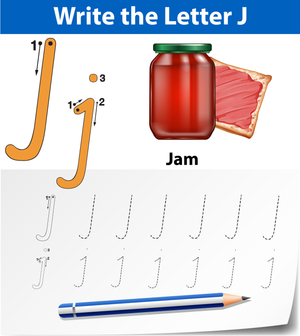
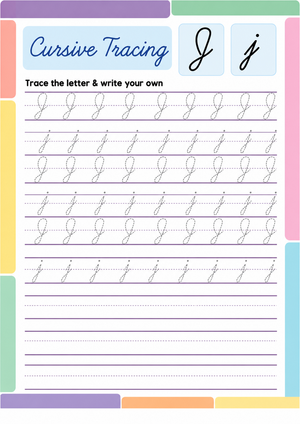
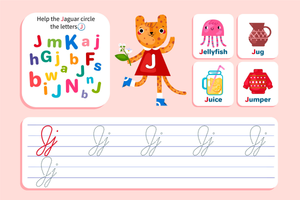
The cursive letter j asks students to do something most earlier letters don't: drop below the baseline and control a loop they can't rest their hand on. Lowercase cursive j starts with an upward curve at the midline, drives down through the baseline into a small hook or tail, then finishes with a dot placed above the letter. Uppercase cursive J is even more demanding, starting below the baseline, curving up to the top line, then descending below the baseline again before looping back through. That's a lot of directional change for one letter, which is why targeted cursive j worksheets matter more than another round of general practice.
Because j is a descender, it shares its trickiest motion with letters like g, y, and f rather than with the undercurve letters students usually learn first. Treating it as part of that descender family, instead of an isolated oddity, helps students transfer the loop control they build here to the rest of the alphabet.
Where cursive j handwriting fits in a grade 3-5 sequence
Most US classrooms introduce cursive j after students have secured simpler undercurve and overcurve letters, typically midway through a grade 3 to grade 5 cursive unit. Descender letters come later because the below-baseline motion depends on wrist and finger control that earlier letters build. If you introduce j too early, students tend to compress the loop or lift the pencil, and those habits are hard to unwind.
Sequencing also gives you a standards hook. New Jersey's cursive law, signed January 19, 2026, specifically targets grades 3 through 5, and Georgia's 2025 English Language Arts standards require students in those same grades to read and write cursive. Slotting cursive j into a deliberate mid-unit spot lets you show administrators exactly how the practice maps to grade-level expectations.
How to teach these cursive j handwriting in real handwriting lessons?
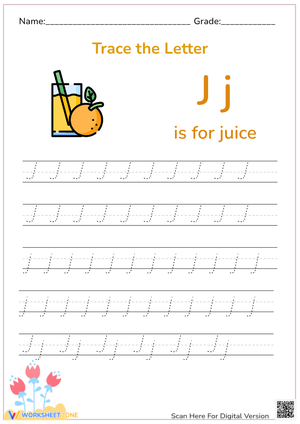
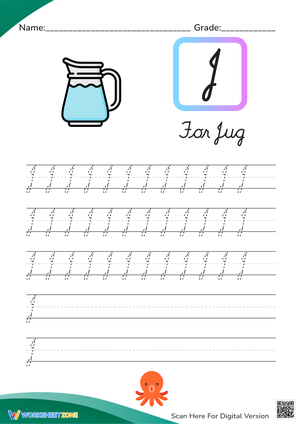
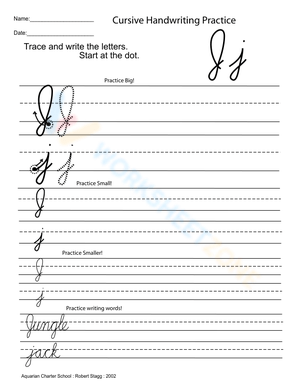
A workable rotation for a class of mixed handwriting ability runs about ten minutes. Open with sixty seconds of skywriting, move to two or three traced lines of lowercase j, then a line of independent letters, and close with a short self-check where students circle their best attempt. Keep the uppercase J on a separate day so students aren't juggling two loop directions at once.
Here's a pattern worth watching for: students who struggle with cursive j almost always fail in one of two specific ways, and the fix differs for each. An oversized loop that swings well below the writing line signals a student pressing too hard and over-traveling on the downstroke, best corrected by shrinking the practice space to a narrower rule. A disconnected tail, where the j sits apart from the next letter, signals a pencil lift at the baseline and needs a don't stop at the line cue instead. Sorting your intervention group by which error each student shows is faster than reteaching the whole letter to everyone.
Moving from isolated letters to connected words
Once a student's isolated cursive j is secure, pair it with connected-letter practice using high-frequency words such as jump, jar, and January. The connection out of j is where the tail either holds or breaks, so early words should keep the letters after j simple. Aim for a handful of clean repetitions of the isolated letter before layering in words, so the connecting stroke builds on a stable foundation rather than a shaky one.
Watch the transition closely. Many students who form a clean isolated j lose the tail the moment a second letter follows, which is the clearest sign they need a few more reps at the isolated stage before the word work sticks.
Frequently Asked Questions
1. How is cursive j different to teach than other lowercase letters?
Cursive j is a descender, so it drops below the baseline and adds a dot on top, unlike the undercurve letters students usually learn first. That extra directional change and the below-baseline loop make it closer to g, y, and f than to letters like i or t.
2. What grade level typically introduces cursive j?
In most US classrooms, cursive j appears midway through a grade 3 to grade 5 cursive unit, after students have secured simpler undercurve letters. New Jersey and Georgia both target grades 3 through 5 for cursive, which fits that timing well.
3. How can I help students who struggle with the below-baseline loop?
Start away from the paper with skywriting and a spoken stroke cue like down through the line, hook, and dot. Shrink the practice space to control an oversized loop, and use a don't stop at the line cue when the tail keeps disconnecting from the next letter.
4. How many repetitions are needed before moving to connected words?
There's no fixed number, but aim for several clean, legible repetitions of the isolated letter before adding words. Legibility matters more than a set count; a student who forms three reliable j's in a row is usually ready for words like jump or January.
5. Are cursive j worksheets useful for intervention or OT support?
Yes. The below-baseline loop in cursive j recurs in letters like g, y, and f, so mastering it pays off across the alphabet. That makes narrowed cursive j worksheets a strong fit for handwriting intervention groups and OT support, not just whole-class instruction.