Why the Cursive D Needs Its Own Practice Page
The lowercase cursive d is one of the trickiest letters to teach cleanly. It begins like a cursive a or c, then adds a tall retrace stroke that students often turn into an accidental loop. That single formation slip carries straight into words like dog, desk, and duck, so it pays to isolate the letter before pushing into connected writing. A focused set of cursive D worksheets gives you a clean way to model the stroke, watch students form it in real time, and correct habits before they harden.
Cursive is also back on the schedule in a lot of US classrooms. As of the 2025-2026 school year, 24 to 25 states require cursive handwriting instruction in public schools, and single-letter drills like the D are usually where a sequence begins. If you teach grades 3-5, a dedicated D page fits neatly into the letter-by-letter progression your handwriting block already follows.
How to Form the Lowercase and Uppercase Cursive D
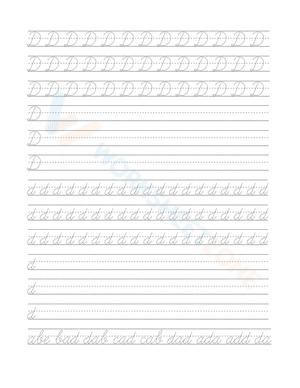
Start the lowercase d the way you start a: a small curve that opens to the left and closes into a round body sitting on the baseline. From the top of that body, the pencil climbs straight up to full letter height, then retraces back down the same line without a loop. Students who add a loop are usually lifting the pencil early or rounding the up-stroke, so cue them to keep the tall stroke thin and straight.
The uppercase D is a different motion. It starts with a downward stroke from the top line, curves back up into a wide bowl, and closes near the baseline with a small tail that leads into the next letter. Model both letters slowly, name each stroke out loud, and have students trace before they write independently. Worksheets that show numbered starting points and directional arrows make this modeling far easier during whole-class instruction.
Fitting Cursive D Into a Grade 3-5 Handwriting Sequence
New state rules have pushed cursive squarely into the upper-elementary grades, which changes when and how you introduce a letter like the D. Instead of an optional early-grades add-on, cursive is now a graded skill with a deadline in several states.
Florida's new cursive law, reported by WFLA, requires handwriting instruction in grades 3-5 with proficiency demonstrated by the end of grade 5, effective the 2026-2027 school year. That timeline gives teachers a concrete target: students should form and connect every cursive letter, including the D, before they leave fifth grade.
Georgia's 2025 ELA standards likewise require students in grades 3-5 to read and write cursive, and Pennsylvania's Act 2 of 2026 added cursive to the required school code, effective April 12, 2026. Whatever your state's rule, the practical starting point is the same: teach letters in a logical order and give each one, including the D, enough repetition to stick.
Classroom Implementation
Keep the D page inside a short, predictable routine so practice stays focused. Open with a 60-second model on the board, tracing the lowercase and uppercase forms while you name each stroke. Then have students trace the guided rows, and finish with two or three independent repetitions where they write the letter with no tracing support.
Walk the room during the independent rows, not the tracing rows. That's when you can spot backward loops, wrong starting points, and inconsistent slant while there's still time to reteach. For whole-class instruction, project the same worksheet you handed out so every student is looking at the identical stroke path you're describing.
Plan two or three versions of the task for mixed-readiness groups. Students who need support get large letters, tracing dots, and a starting-point marker; on-level students get a mix of tracing and independent rows; students who already form the D cleanly move straight to connecting it inside words. The same D page can flex across all three without extra prep.
Small-Group Intervention and Fine Motor Support
The cursive D is a strong diagnostic letter because its tall retrace stroke demands both controlled pencil pressure and a clean directional change in a single motion. A January 2026 survey of 1,163 early educators found 70% report declining fine motor skills in their students, and those are exactly the skills the D up-stroke exposes. For a small group, slow the letter down: oversized D tracing, then normal-sized, then a short line of independent D's, watching for the loop that signals a pencil lift.
For students with fine motor difficulties, pair the worksheet with a stable grip and slightly wider line spacing. The goal in intervention isn't speed; it's a repeatable, correctly-formed D that the student can produce without a model in front of them.
Using the Cursive D as a Quick Formative Check
A single-letter worksheet is an efficient formative assessment. Before you move a group into full-word cursive, collect one row of independent D's and scan for three things: stroke direction, slant consistency, and whether the exit stroke is ready to connect. Those three checks tell you more than a full page of tracing, because tracing hides the errors you most need to see.
Build a simple three-level look-for. At the first level, the body of the D is closed and round. At the second, the tall stroke goes up and back down without a loop. At the third, the letter sits on the baseline with a consistent slant that matches the student's other letters. A student who clears all three is ready for connected words; a student who misses one gets a targeted reteach on that specific stroke instead of a full redo.
Keep a few of these dated D samples in a folder. Over a unit, they show growth you can share at conferences or in an intervention meeting, and they give you evidence that a required cursive skill is actually being met, not just assigned.
Frequently Asked Questions
1. What grade level typically introduces the cursive letter D?
Most US sequences introduce cursive letters in grades 3-5, and several states now mandate it there. The D usually appears after students have practiced the round-body letters it's built on, such as a and c.
2. How should teachers correct common cursive D formation mistakes?
The two most common errors are a looped up-stroke and a wrong starting point. Cue students to begin the body like an a, then keep the tall stroke thin and straight with no loop. Watch during independent writing, not tracing.
3. How many repetitions of a single cursive letter are recommended before connected words?
There's no fixed number, but a practical rule is a few guided tracing rows plus two or three independent repetitions per session, continued until the student can form the D correctly without a model before moving on to words.
4. Do state cursive mandates specify which letters to teach first?
Most mandates set a grade band and a proficiency goal rather than a fixed letter order. Florida, for example, targets proficiency by the end of grade 5 but leaves the specific sequencing to teachers and their chosen curricula.
5. How can cursive D worksheets help students with fine motor difficulties?
Use oversized tracing, wider line spacing, and a stable pencil grip, and slow the pace. Break the D into its round body and its tall stroke, and build up to independent writing only once each part is steady.