What Cursive L Handwriting Worksheets Actually Teach
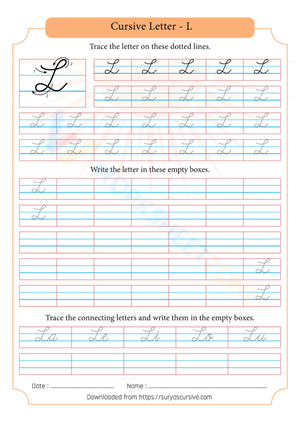
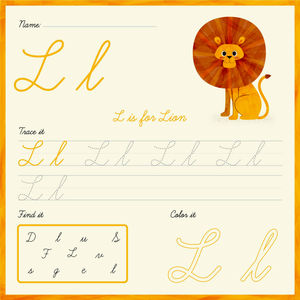
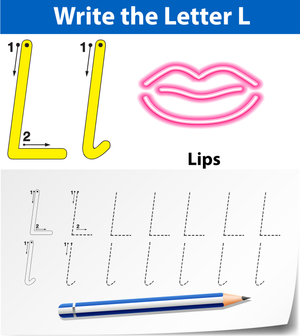
Cursive L worksheets give students repeated, guided practice on one of the trickiest looped letters in the cursive alphabet. The uppercase L and lowercase l share a family of curves, but each has its own entry point, loop size, and slant. A good practice sheet isolates those strokes so students can build the muscle memory that legible cursive depends on. For US teachers working under new state cursive requirements, these sheets turn a single letter into a focused, ten-minute lesson.
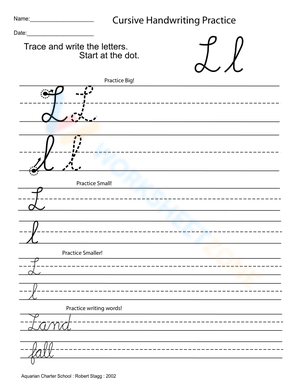
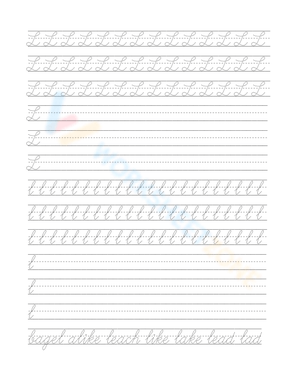
Most cursive L worksheets move through a predictable arc: trace a modeled letter, copy it beside the model, then write it from memory. That progression matters more than the number of lines a student fills. When you use a worksheet as the backbone of a short routine rather than as busywork, the L becomes a stroke pattern students can transfer to other looped letters.
The Cursive Lowercase l Stroke, Step by Step
The lowercase cursive l is a tall loop letter, and its formation is worth modeling stroke by stroke before students touch a pencil. Start the pen just under the topline, loop upward and to the right, curve back to the left into a small hoop, then travel straight down to the baseline. The letter should reach full height and finish with a short exit stroke that connects to the next letter.
Common formation errors are easy to spot once you know what to watch for. Students often make the loop too narrow, so the l collapses into a straight line and looks like a lowercase t without the cross. Others stop short of the topline, which makes the letter blend in with shorter letters like e or i. Slant is the third issue: an inconsistent tilt across a word signals that the student is drawing each letter separately instead of writing in one connected motion.
Forming the Cursive Capital L
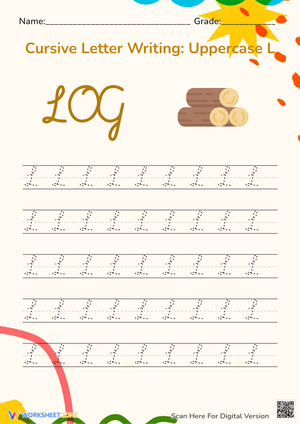
The uppercase L is a different animal. It starts near the topline with a curve that swings up and loops left, sweeps down in a long vertical stroke, and finishes with a rounded base that curls to the right along the baseline. Because the capital L doesn't always connect neatly to the letter that follows, many programs teach it as a standalone shape first, then practice it in names and sentence starters where capitals actually appear.
When students practice the capital and lowercase forms on the same sheet, point out what they share: both rely on a controlled loop and a confident downstroke. Naming that shared motion helps students see cursive as a system of reusable strokes rather than 52 unrelated shapes.
Where the L Fits in Your Cursive Sequence
Handwriting programs rarely teach letters in alphabetical order. Instead, they group letters by stroke similarity so motor patterns transfer. The lowercase l belongs with the loop family: e, l, b, f, h, and k all use an upward loop as their signature move. Teaching these together lets a single practice block reinforce several letters at once.
Here's the part many pacing guides miss: the research case for cursive is narrower than the marketing around it. A 2023 study by Canadian researchers found it is unlikely cursive delivers more cognitive benefit than print, yet handwriting of any kind outperformed keyboarding on multiple measures in the elementary grades. The takeaway for teachers is practical. Spend your L practice on legibility and fluency, not on claims that cursive rewires the brain, and lean on the fact that pencil-and-paper letter formation still earns its place in the schedule.
Classroom Implementation
Cursive L worksheets work best inside a short, consistent routine. A reliable structure is trace, copy, cover, write: students trace the modeled letter, copy it independently, cover the model, then write the L from memory. This moves them from guided support to recall in a single session and keeps practice from becoming mindless repetition.
Before pencils come out, rehearse the stroke in the air or on whiteboards. Air-writing lets the whole class practice the loop and downstroke with big arm movements, which many students find easier than fine-motor control on paper. Narrate the stroke as you model it under a document camera so students hear the sequence while they see it.
For small-group intervention, slow the pace and shrink the target. Have students form three well-made L's rather than a full page of rushed ones, and give immediate feedback on loop size and topline reach. For whole-class review, a single worksheet can anchor a warm-up while you circulate and coach individual students on slant and spacing.
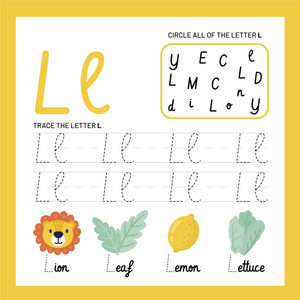
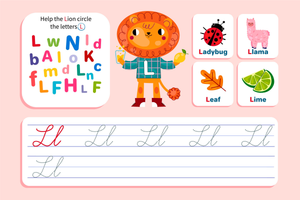
Close each session with a quick self-check. Ask students to circle their best L on the page and mark one thing to improve next time, such as a taller loop or a straighter downstroke. This 30-second reflection turns a worksheet into a feedback loop and gives you a fast read on who still needs small-group support.
Differentiation for Left-Handed and Fine-Motor Needs
Left-handed writers need a few adjustments so their hand doesn't cover what they just wrote. Let them tilt the paper clockwise, position it to the left of their body midline, and grip slightly higher on the pencil. Model the L from a left-handed angle when you can, since a mirrored view helps these students see the entry point clearly.
Students with fine-motor or occupational-therapy-informed needs benefit from tactile supports before worksheet practice. Tracing the L in sand, on textured cards, or with a finger on the desk builds the motor path without the pressure of a pencil. Raised-line paper and a slower tempo help these writers keep the loop open and the downstroke straight once they transfer to the sheet.
Frequently Asked Questions
1. How should I introduce the cursive capital L versus the lowercase l?
Teach them in separate short sessions. Introduce the lowercase l first because its loop appears in many other letters, then add the capital L when students practice names and sentence starters. Model each stroke sequence slowly and let students air-write before they use a worksheet.
2. How many practice sessions does a student need to master cursive L?
Most students need several short sessions spread across days rather than one long drill. Brief, distributed practice with feedback beats a single crowded worksheet. Watch for consistent loop size and topline reach as your signal that a student is ready to move on.
3. What are the most common cursive L mistakes and how do I fix them?
The frequent errors are a loop that's too small, a letter that doesn't reach the topline, and an inconsistent slant. Fix them by having students exaggerate the loop during air-writing, using topline reminders on the page, and encouraging one connected motion instead of drawing the letter in pieces.
4. How do cursive L worksheets differ for intervention versus whole-class use?
In intervention, use fewer repetitions with immediate coaching and tactile supports. In whole-class instruction, the same worksheet becomes a timed warm-up while you circulate and give quick feedback. The sheet stays the same; the pacing and support change.
5. Should beginners practice cursive L before mastering other letters?
Yes, because l is a foundational loop letter that feeds into e, b, f, h, and k. Introducing it early gives students a stroke pattern they'll reuse constantly, so it's a sensible early stop rather than a letter to save for later.