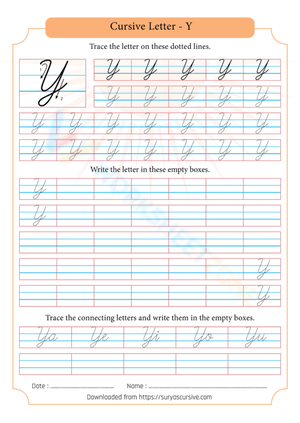
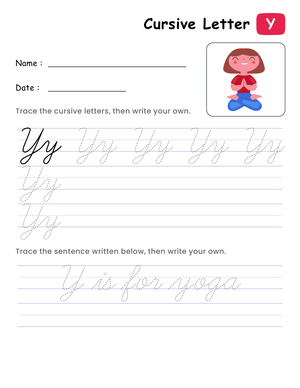
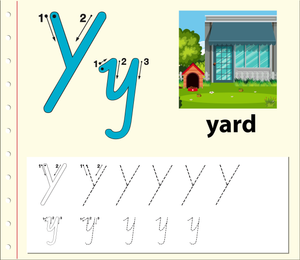
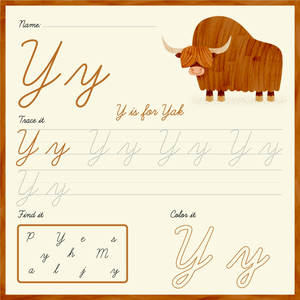
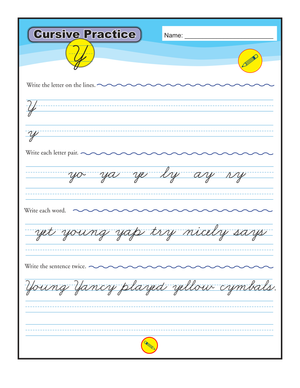
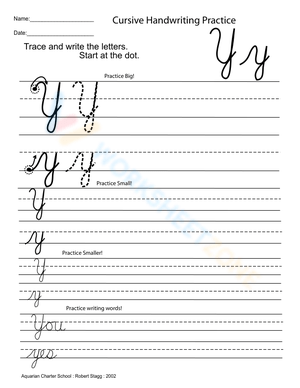
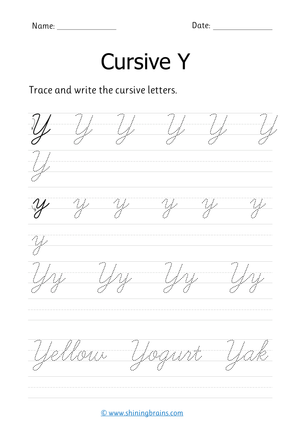
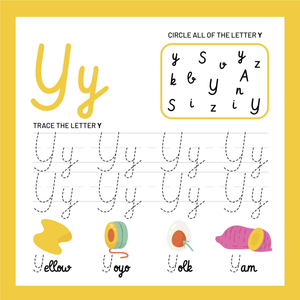
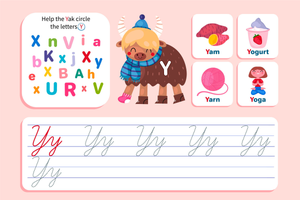
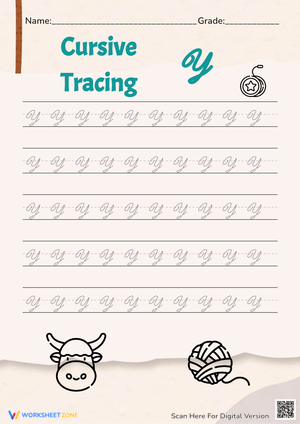
Cursive letter y worksheets keep showing up in search results for a reason: the lowercase cursive y is one of the letters students struggle with most when they move from print to joined writing. Unlike a printed y, the cursive lowercase version requires a smooth entry stroke, a rounded body, and a descending loop that swings below the baseline before curving back up to connect with the next letter. Many third and fourth graders either flatten that loop into a straight line or lose the connecting stroke altogether, which makes their cursive hard to read even after weeks of practice.
A dedicated worksheet set for letter y gives students repeated, low-stakes reps on that descender before they are expected to use it inside full words and sentences. That repetition matters more for y than for many other letters because the loop below the line asks for a different kind of pencil control than anything students used in print handwriting.
Step-by-Step Formation Guidance for Cursive Y
When you introduce or review the cursive letter y, break the stroke into three parts students can name out loud as they write:
- Start at the midline with a small entry curve, moving down and to the right, similar to the start of a cursive u.
- Round the top of the letter, then bring the stroke down through the baseline into a loop that swings below the line.
- Curve the loop back up to the baseline and finish with a small connecting tail that reaches toward the next letter.
Uppercase cursive Y follows a different pattern: a tall looped stem that starts above the midline, curves down through the baseline, and finishes with the same below-line loop as the lowercase form. Practicing both forms side by side helps students notice that the descending loop is the one feature they share.
Where Y Fits in a Typical Teaching Sequence
Most cursive programs group letters by the motor pattern they share rather than teaching them in alphabetical order. Lowercase y is commonly taught alongside other looped descenders such as g, j, and q, since all four require the same below-baseline loop and similar pencil control. Introducing y after students have already practiced g and j gives them a motor pattern head start, since the descending loop motion is nearly identical across all three letters.
Classroom Implementation
A few practical routines make cursive y worksheets more effective in a real classroom schedule:
- Use a short 5-minute warm-up at the start of literacy block for isolated letter tracing before moving into connected words.
- Pair whole-class instruction with a brief teacher demonstration on the board, narrating each stroke as you write it.
- Rotate cursive y practice into a handwriting center or morning work bin so students get spaced repetition across the week instead of a single dense session.
- For students who need more support, shorten the practice set rather than changing the letter formation steps, so the motor pattern stays consistent.
- Build in a quick self-check where students circle their best-formed y on the page, which builds handwriting self-monitoring skills early.
These routines work whether you are introducing cursive y for the first time in grade 3 or using it as a quick review and intervention tool in grades 4 and 5 for students who need extra reps on looped descenders.
Frequently Asked Questions
1. At what grade should students learn to write a cursive letter y
Most state guidelines and classroom programs recommend introducing cursive instruction in grade 3, when fine-motor coordination typically supports joined letterforms. Letter y, with its descending loop, is often taught slightly after simpler letters once students have built basic cursive control.
2. Why is lowercase cursive y hard for students to master
The below-baseline loop asks for a different kind of pencil control than print writing, which stays above the line. Students frequently flatten the loop, make it too small, or fail to connect it smoothly to neighboring letters.
3. How many states currently require cursive handwriting instruction
As of 2026, at least 24 to 27 states have passed laws mandating cursive instruction in public elementary schools, with several new laws in New Jersey, Pennsylvania, and Georgia taking effect in 2025 and 2026.
4. How often should students practice cursive letters like y for retention
Short, frequent practice sessions of about five minutes, spaced across the week, tend to support retention better than one long weekly session. Rotating letter y into a handwriting center or morning routine keeps the skill fresh without crowding out other instruction.
5. How can teachers tell if a student is ready to move from print to cursive
Look for consistent print letter formation, steady pencil grip, and the ability to write on and between baseline and midline without heavy guidance. Students who still struggle with basic print spacing usually benefit from more print practice before starting cursive instruction.