Start Cursive O at the Baseline, Finish at the Midline
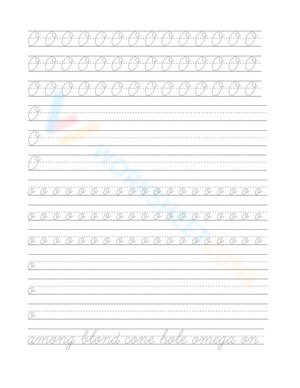
Lowercase cursive o is one of the shortest letters your students will write, but the shape carries real instructional weight. The stroke starts at the baseline, curves up and around like a small circle, and closes at the midline in a spot that's ready to link to the next letter. That ending point is what separates cursive o from a printed o, and it's the detail most worksheets need to reinforce first.
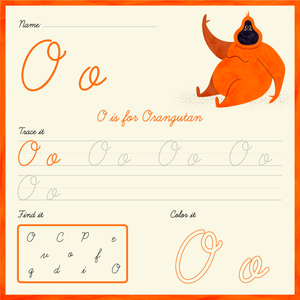
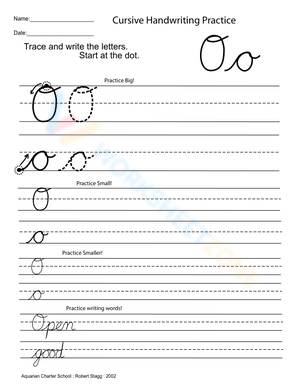
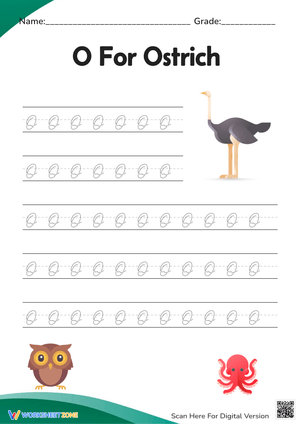
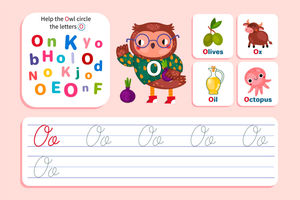
When you introduce cursive o worksheets, the opening job is stroke direction. Students who already write print o tend to start at the top and drop down. Cursive o asks them to begin low, swing up, and come back around to the midline. Tracing pages that mark a starting dot on the baseline and add directional arrows help students retrain that first move before speed turns it into a habit that's hard to undo.
On a three-line worksheet, the o should fill the space between the baseline and the dashed midline and never poke above it. That single height cue corrects a surprising number of oversized circles and keeps the letter proportional to the words it will eventually join.
Teach Cursive O With the Circle-Letter Family
Cursive o belongs to the overcurve group that also includes a, c, d, g, and q. These letters share the same rounded body, so grouping them in your teaching order gives students repeated reps on one motion instead of six separate shapes. Many sequencing guides introduce the simpler circle letters first and save o for slightly later, because its connecting stroke is trickier and students often confuse the finish with q and g.
The confusion with q and g comes from the exit. All three round the same direction, but q and g drop a tail below the baseline while o stays up top and ends at the midline. Calling out that difference before students practice keeps the stray tail off the o. That order also matters when you pull worksheets: if you hand out a cursive o page before students can form a clean c or a, you're asking them to manage the connection and the circle at the same moment. A cleaner path is to teach the family in a deliberate sequence, then use the o worksheet as the checkpoint where students prove they can link a finished circle into a word without losing the shape.
Common Cursive O Errors Worksheets Catch
A completed worksheet works as a quick diagnostic. Watch for a few predictable errors as you scan a row of o's:
- Wrong start point: the student begins at the top like a print o instead of curving up from the baseline.
- Open circle: the loop doesn't close, so the o reads like a u or drifts into the next letter.
- Low finish: the exit stroke drops to the baseline instead of ending at the midline, which breaks the link to the next letter.
- Backward curve: the student rounds the circle counter to the modeled direction, usually a leftover print habit.
Because these show up right on the page, a cursive o worksheet doubles as an error log you can use to plan the next mini-lesson or small-group pull, and you can track whether the same error repeats across a week.
Using these worksheets in real classes
Handwriting sticks through short, frequent blocks rather than long, rare ones. Five to ten focused minutes a day give students more quality reps than a single thirty-minute session each week, and that fits cursive o drills into a packed schedule. A simple routine keeps the practice consistent:
- Model the o stroke on the board while students trace the first line and say the motion aloud.
- Have students complete a tracing row, then a faded row, then one independent row.
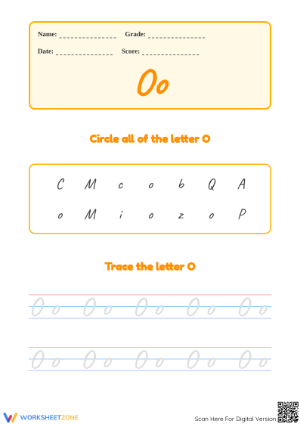
- Circle one best o and one to fix, so students self-assess before you collect the page.
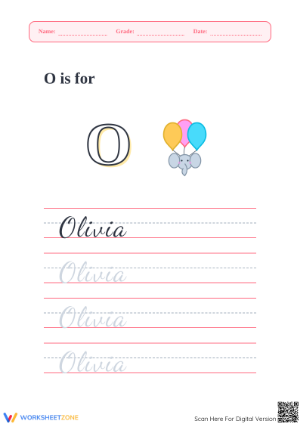
- Close with two or three words that use o so the connection gets daily reps, not just the isolated letter.
Keep finished worksheets in a folder so you and the student can see progress across the week. That running record also gives you concrete samples for conferences and a clear before-and-after when a student finally locks in the stroke.
Frequently Asked Questions
1. How should teachers introduce cursive o to students who already know print o?
Name the difference out loud. Show that print o starts at the top while cursive o starts at the baseline, curves up, and ends at the midline. Have students trace with a starting dot and arrows for the first few sessions so the new direction replaces the old print habit.
2. What common errors do students make with cursive o, and how do worksheets catch them?
The frequent errors are an open loop, a wrong start point, and an exit that drops to the baseline instead of the midline. Because each one shows on the page, a completed worksheet gives you a visible record you can use to target the next mini-lesson.
3. How many practice sessions before students connect o smoothly to other letters?
It varies, but short daily sessions over one to two weeks usually get most students to a reliable connection. Frequency matters more than length, since brief, consistent reps build the stroke faster than an occasional long session.
4. Can cursive o worksheets be used for intervention with older struggling writers?
Yes. The repeated rows give older students the volume they need without new material to process, and the isolated letter keeps the focus on formation. Pair the sheet with a few o-heavy words so the practice transfers to real writing.