Start Cursive Instruction With the Lowercase a
When you open a cursive unit, the lowercase a is one of the smartest letters to teach first. In curricula like Zaner-Bloser and D'Nealian, cursive a belongs to the single-story oval family alongside c, d, g, o, and q. That means the entry stroke your students practice on a set of cursive a worksheets transfers directly to five more letters. Instead of teaching six separate shapes, you teach one oval motion and reuse it, which is the kind of instructional efficiency that matters when handwriting competes with everything else on your schedule.
This grouping is really a sequence. Once a student can close the oval cleanly and add the correct exit stroke, you can layer on the tall stem for d, the descending loop for g, and the tail for q. Worksheets built around cursive a give you a repeatable warm-up that anchors the whole oval family in one block.
How the Cursive a Stroke Differs From Print
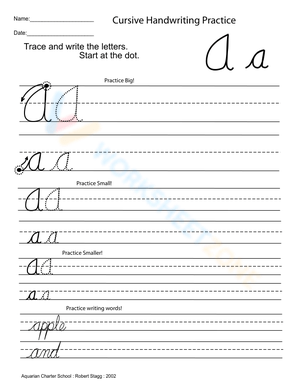
Print a is usually taught as a circle plus a straight line, with two separate pen lifts. Cursive a is a single continuous motion: an under-curve entry, up and over into a closed oval, then a retrace down the right side into a connecting exit stroke. There's no pen lift in the middle, and that exit stroke is what eventually links a to the next letter in a word.
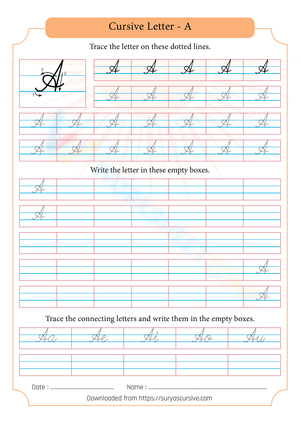
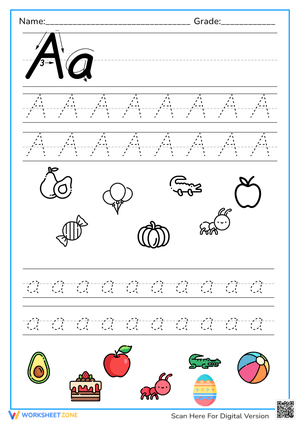
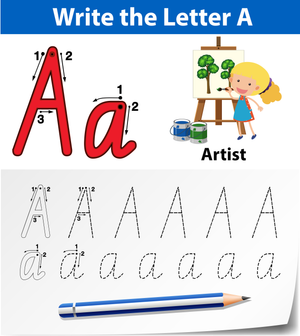
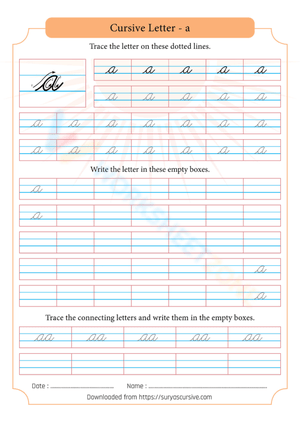
That continuity is where students stumble. Many will draw the oval clockwise out of print habit, which leaves a gap at the top and a stroke that won't connect. Strong cursive a worksheets show the counter-clockwise direction with numbered arrows and start dots so students internalize the motion, not just the finished shape.
The Research Case for Daily Practice
Handwriting instruction carries real academic payoff, and that gives you a reason to protect a few minutes for it every day.
Here's the part many schedules miss: the gains from cursive show up less in the tracing itself and more in what handwriting frees up. When letter formation becomes automatic, students stop spending working memory on how to make each stroke and can spend it on spelling, sentence length, and ideas instead. That's why the strongest effects cluster in grades 4-7, after the mechanics are in place. A daily cursive a drill isn't busywork; it's how you push formation toward automaticity so the higher-order writing can happen.
The Iowa Reading Research Center reports that consistent cursive instruction is linked to gains in legibility, writing length, spelling accuracy, and storytelling ability, with the largest effects appearing in grades 4 through 7. Students given steady print instruction in grades 1-2 before cursive outperformed peers taught both scripts in the same year.
Grade-Level Sequencing for Cursive a
State timelines vary, but a common pattern works well. Introduce cursive lowercase letters, including a, in grade 2 or grade 3 once students have solid print foundations. Reserve grades 4 and 5 for reinforcement, speed, and connecting letters into words. As of 2026, at least 24 states require cursive in public elementary schools, most expecting proficiency somewhere between grade 3 and grade 5, so this sequence keeps you aligned with typical mandates.
The research supports waiting rather than rushing. Students who get consistent print instruction through grades 1-2 before they transition to cursive tend to outperform peers taught print and cursive in the same year. If you teach primary grades, that's permission to build print fluency first and bring cursive a worksheets in once handwriting is steady.
Classroom Implementation
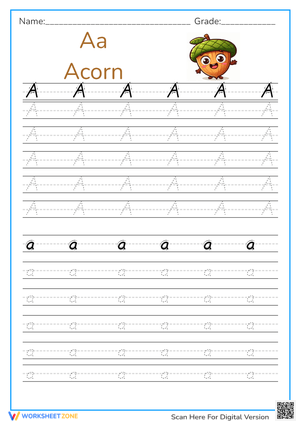
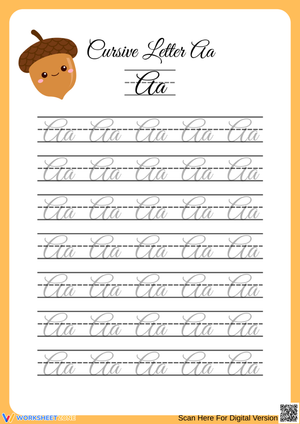
Keep cursive practice short and frequent. Five to ten focused minutes a day beats one long weekly session, because letter formation is a motor skill that responds to spaced repetition. Open with a shared cursive a on the board, model the counter-clockwise oval while narrating each stroke, then let students trace, copy, and finally write the letter from memory on the worksheet.
- Model first, always. Say the stroke path aloud as you write so students hear and see the motion together.
- Use the oval family as a warm-up. Practice a, then extend to c, d, g, o, and q in the same block.
- Check the exit stroke, not just the oval. A letter that looks right but won't connect needs a quick reteach.
- Treat a daily worksheet row as a formative check. Scan for closed ovals and correct direction, then group students by what you see.
Small-Group Intervention for Reversals
Some students reverse the oval or leave it open at the top well after their peers have moved on. Pull these students into a short small-group block and slow the motion down. Start dots and directional arrows on the worksheet help, but so does multisensory practice: have students trace a large cursive a with a finger, write it in a sand tray, or air-write it before returning to paper.
Because a anchors the oval family, fixing the entry stroke here often clears up c, d, and g at the same time. That makes cursive a worksheets an efficient intervention target: one corrected motion, several letters improved.
Why Cursive Is Back on So Many Schedules
Cursive requirements have picked up momentum. Pennsylvania's Act 2 of 2026, effective April 12, 2026, added printing, joined italics, and cursive to the required writing curriculum. In 2025 a Missouri bill requiring cursive proficiency by grade 5 passed the state House and moved toward a Senate vote. Coverage from EdWeek notes that while cursive is making a comeback, districts still face challenges around instructional time and teacher preparation.
For you, the takeaway is practical: cursive is increasingly something you're expected to teach and document, not an optional extra. A predictable set of cursive a worksheets gives you both the instructional material and a simple record of practice you can point to.
Frequently Asked Questions
1. What grade should students learn the cursive letter a?
Most US classrooms introduce cursive lowercase letters, including a, in grade 2 or grade 3, then reinforce through grades 4 and 5. Many of the 24-plus states that mandate cursive expect proficiency between grade 3 and grade 5, so introducing a in grade 2-3 keeps you on a typical timeline.
2. How does cursive a differ from print a in stroke formation?
Print a is often a circle plus a separate line with a pen lift. Cursive a is one continuous counter-clockwise motion: an under-curve entry into a closed oval, then a retrace into a connecting exit stroke that links to the next letter.
3. Why are more states requiring cursive instruction again in 2025-2026?
Legislators point to research linking handwriting to reading and writing gains, plus concerns that students can't read historical documents or family letters. Pennsylvania and Missouri both advanced cursive requirements in 2025-2026, part of a broader return of state-level mandates.
4. How can teachers use cursive a worksheets for students who reverse or malform the letter?
Use worksheets with start dots and directional arrows, and pair them with multisensory practice such as finger tracing, sand trays, or air-writing. Because a anchors the oval family, correcting its entry stroke often improves c, d, and g as well.
5. How much daily practice time is needed to master cursive lowercase letters?
Short, frequent sessions work best. Five to ten focused minutes a day, with modeling followed by tracing and independent writing, generally outperforms a single long weekly block because letter formation is a motor skill that improves with spaced repetition.