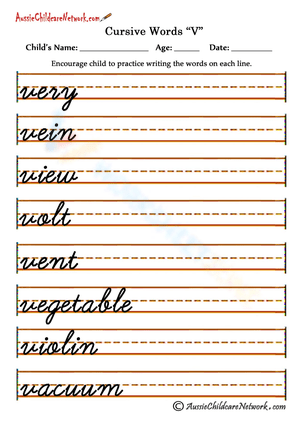
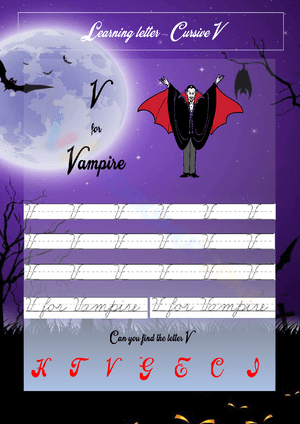
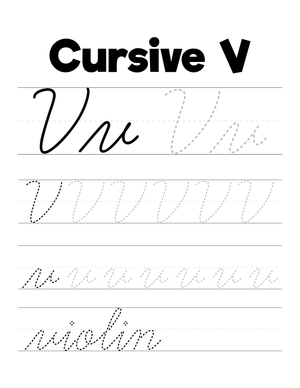
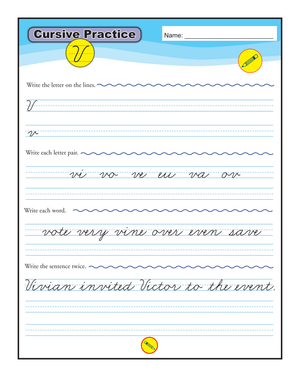
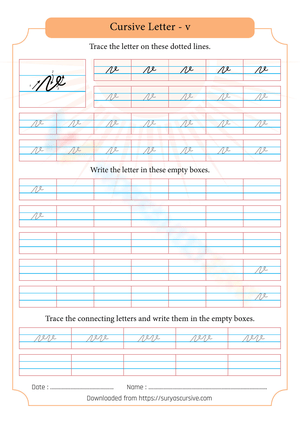
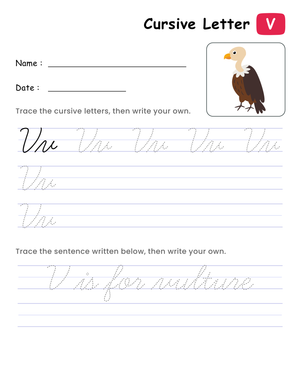
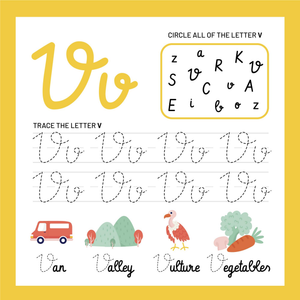
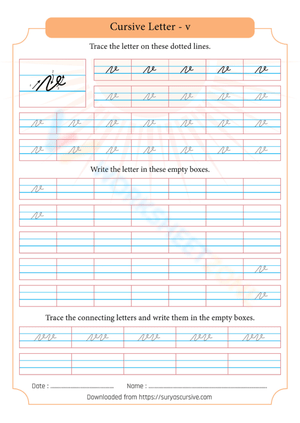
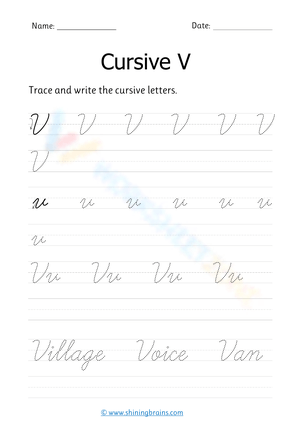
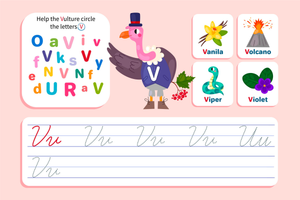
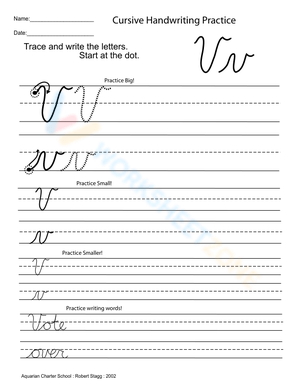
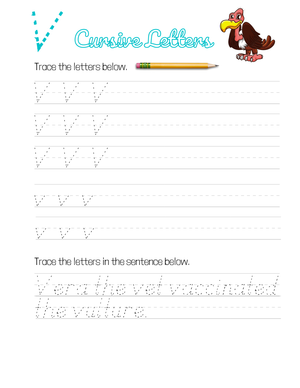
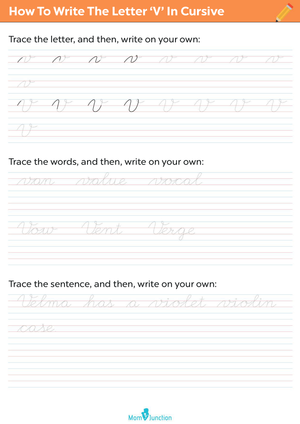
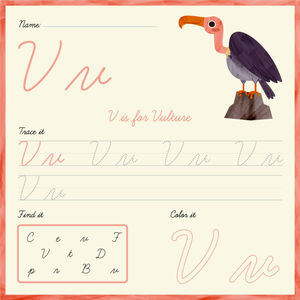
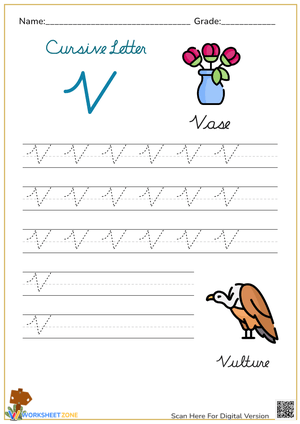
The cursive letter v handwriting workshet looks simple, but it trips up more second and third graders than almost any other lowercase letter. Its pointed bottom and tall exit stroke sit right next to u in most alphabets, and students who rush the connector end up writing words no one can read back. Strong cursive V worksheets isolate that pointed stroke, give students repeated tracing, and then move them into real connections so the letter holds up inside words like very, love, and seven.
Where the Cursive V Fits in a Grades 2-4 Handwriting Plan
Most cursive scope-and-sequences introduce v after students can already form the undercurve letters, because it reuses the same up-and-down rhythm with a sharper turn. Teachers usually slot it into a small cluster with u, w, and y, since those letters share the tall exit stroke that connects to whatever comes next. Placing the letter here means students already have baseline and midline control before they attempt the angle.
Timing matters because cursive is back on the required list in a growing number of states. That policy pressure is changing how much dedicated handwriting time schools protect each week, and it makes a clean single-letter worksheet more useful than a scattered alphabet packet you photocopy once and forget.
If you are rebuilding a cursive block after years without one, resist the urge to march through the whole alphabet at one letter per day. Cluster related strokes, give v its own short focus, and circle back for review, because a single pass rarely produces the muscle memory that legible cursive needs.
Here is the detail most packets miss: the cursive v is the first lowercase letter where the connector stroke leaves from the midline instead of the baseline. Because the exit tail departs high, any letter that follows v begins its stroke from the top of the x-height, not the bottom. Students who never see that shift keep dropping the next letter to the baseline, which is why ve and vi pairs collapse. Worksheets that show the high hand-off, not just the single letter, prevent the problem before it spreads across a whole word.
How to Form the Cursive Letter V, Stroke by Stroke
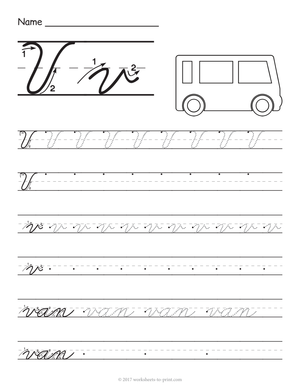
In D'Nealian-style cursive, the lowercase v follows a predictable path that worksheets should reinforce with arrows and start dots:
- Start on the baseline and push up to the midline with a slanted stroke.
- Angle sharply back down to the baseline, forming a clear point, not a curve.
- Rise again to the midline and finish with a small connector tail that carries into the next letter.
The uppercase cursive V starts just below the top line, curves down and back up toward the top line, then exits with a small tail for the next letter. Because the capital shows up far less often inside words, spend most practice time on the lowercase form and reserve capital drills for names and sentence starts.
Worksheets support this sequence best when they include start dots, directional arrows, and a fading trace that moves from solid gray letters to blank practice lines. That gradual release lets students lean on the model early, then build independence within the same page. Watch that the arrows mark the sharp turn at the baseline, since a generic rounded arrow quietly teaches the u shape you are trying to avoid.
The v-Versus-u Mix-Up and How These Worksheets Fix It
The single most common error teachers flag is a rounded bottom on the v. When the bottom curves, the letter reads as u, and words like have turn into haue. The fix is not more speed drills; it is slow, deliberate practice on the point itself. Worksheets that shade or box the bottom angle give students a visual target, and pairing v and u on the same page lets them feel the difference between a sharp turn and a rounded one.
According to Education Week's reporting on state handwriting policy, the number of states requiring cursive instruction has grown to at least 24 for 2025-2026, up from roughly 14 less than a decade earlier. That shift puts renewed weight on clean single-letter practice for letters like v across grades 2 through 5.
Frequently Asked Questions
1. How should teachers introduce the cursive V to students who already know print?
Start from what they know. Show that the print and cursive v share the same pointed bottom, then add the entry stroke from the baseline and the high connector tail. Framing cursive as print plus connectors lowers anxiety and gets students writing the letter within the first lesson.
2. What is the most common mistake with cursive v, and how do worksheets fix it?
The bottom rounds out and the letter reads as u. Worksheets that box or shade the bottom angle give students a visual target for the point, and placing v next to u on the same page makes the sharp-versus-rounded contrast obvious.
3. How much practice time does one cursive letter like V usually need?
Plan for short, distributed practice: a few sessions of two to ten minutes across several days rather than one long block. Most students reach a legible, connected v within a week of brief daily reps, with intervention students needing a few extra sessions.
4. Are cursive worksheets still relevant with today's technology?
Yes. With at least 24 states requiring cursive instruction for 2025-2026 and new laws like Pennsylvania's Act 2 of 2026, dedicated single-letter practice is back in many required curricula, and clean worksheets make that mandated time efficient.
5. How can teachers use cursive V worksheets for both whole-class and small-group review?
Use the same letter sequence for both. Run the full class through tracing and word application together, then pull a small group that still rounds the bottom for extra boxed-point reps while the rest move on to enrichment sentences.