




























Views
Downloads
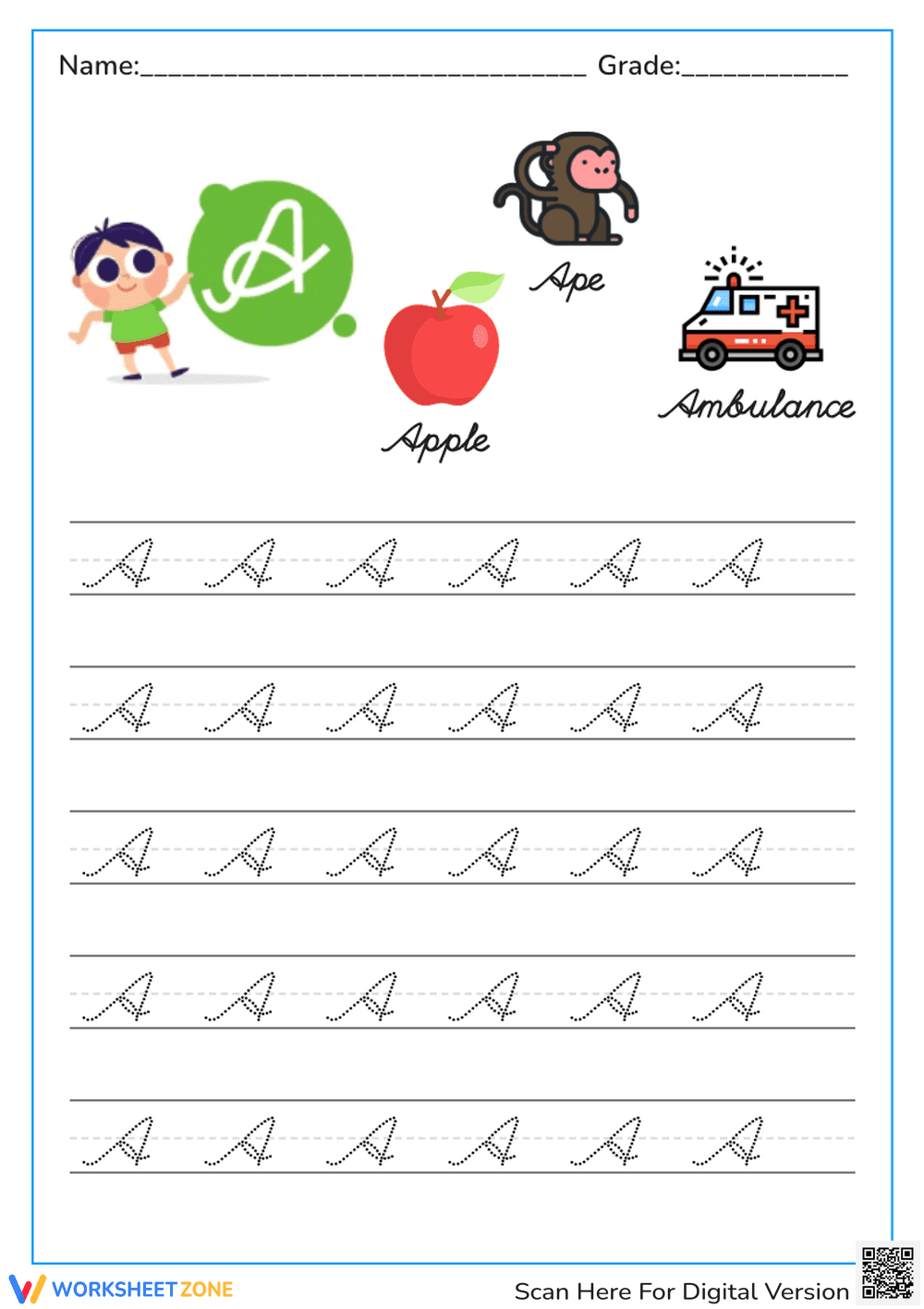

Cursive Letter A Worksheet | Grade 2-3 Essential

Paste this activity's link or code into your existing LMS (Google Classroom, Canvas, Teams, Schoology, Moodle, etc.).
Students can open and work on the activity right away, with no student login required.
You'll still be able to track student progress and results from your teacher account.
This Grade 2-3 cursive handwriting worksheet provides a focused environment for students to master the uppercase letter A. By combining repetitive tracing with visual word associations, learners develop the muscle memory required for fluid penmanship. This resource ensures students transition from manuscript to cursive with confidence and precision.
At a Glance
- Grade: 2-3 · Subject: Handwriting
- Standard:
CCSS.ELA-LITERACY.L.3.1— Write legibly in cursive, focusing on uppercase letter formation and spacing- Skill Focus: Uppercase Cursive Letter A
- Format: 1 page · 33 tasks · No answer key needed · PDF
- Best For: Daily morning work or handwriting centers
- Time: 10–15 minutes
The worksheet features 30 individual tracing opportunities for the uppercase letter A, organized across five structured lines. At the top, students engage with three colorful illustrations—an apple, an ape, and an ambulance—each paired with its name written in cursive. This layout reinforces letter-sound correspondence while modeling how the letter A connects to subsequent characters in common words.
This resource is designed for a zero-prep classroom workflow. Teachers can print the single-page PDF in less than 30 seconds. Distribution takes approximately 1 minute during transition periods. Reviewing student progress is immediate; teachers can provide real-time feedback on stroke direction and line placement as they circulate. Total teacher preparation time is under 2 minutes, making it an ideal sub plan addition.
Aligned to `CCSS.ELA-LITERACY.L.3.1`, this worksheet supports the requirement for students to demonstrate command of the conventions of standard English capitalization and penmanship. While CCSS focuses on general legibility, this specific practice targets the foundational strokes of uppercase letters. This standard code can be copied directly into lesson plans, IEP goals, or district curriculum mapping tools.
Use this worksheet as a formative assessment during the first 10 minutes of a literacy block. Observe students to ensure they begin the letter A at the correct starting point to prevent habituating improper stroke order. It also serves as an excellent quiet-time activity for students who finish primary assignments early, providing meaningful skill reinforcement without requiring additional teacher instruction.
This practice page is ideal for second and third-grade students beginning their cursive journey. It is also highly effective for older students requiring occupational therapy support or fine motor intervention. Pair this worksheet with a cursive anchor chart or a short reading passage about the letter A to create a comprehensive handwriting lesson.
According to Fisher & Frey (2014), the gradual release of responsibility in handwriting instruction—moving from guided tracing to independent production—is vital for developing automaticity. Research from the RAND AIRS 2024 report indicates that students who practice cursive handwriting show improved neural activation in areas associated with memory and language processing compared to those who only type. This worksheet provides the structured repetition necessary for this cognitive development. By focusing on 30 specific tracing tasks, the resource ensures that the uppercase letter A becomes a permanent part of the student's motor repertoire. The inclusion of vocabulary like Ambulance and Apple further bridges the gap between isolated letter formation and functional writing. This evidence-based approach to penmanship supports long-term literacy outcomes and legibility across all academic subjects.


