


























Views
Downloads

Grade K Letter A — Printable No-Prep Worksheet
Paste this activity's link or code into your existing LMS (Google Classroom, Canvas, Teams, Schoology, Moodle, etc.).
Students can open and work on the activity right away, with no student login required.
You'll still be able to track student progress and results from your teacher account.
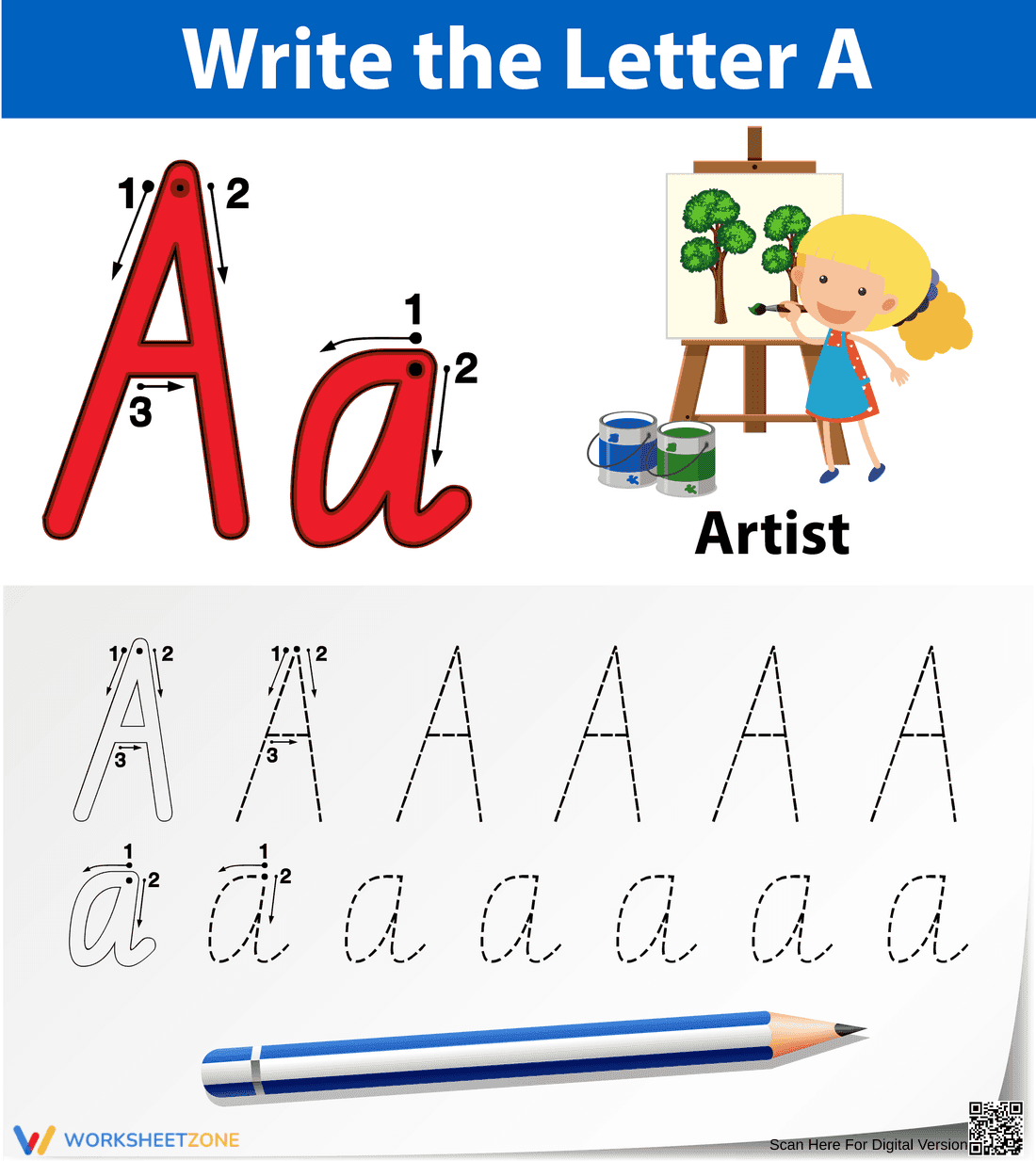
This foundational handwriting worksheet helps early learners master the formation of the uppercase and lowercase letter A. By providing clear, numbered stroke guides alongside guided tracing practice, students develop the fine motor control required for fluent writing. The engaging "A is for Artist" visual context reinforces letter-sound correspondence.
At a Glance
- Grade: Kindergarten · Subject: Handwriting
- Standard:
CCSS.ELA-LITERACY.L.K.1.A— Print many upper- and lowercase letters- Skill Focus: Letter A formation and tracing
- Format: 1 page · 12 problems · No answer key needed · PDF
- Best For: Independent morning work
- Time: 10–15 minutes
This single-page resource features a layout designed for early writers. The top section displays large models of the uppercase and lowercase letter A, with numbered arrows indicating proper stroke direction. An illustration of an artist provides a helpful mnemonic. The bottom half contains 12 dashed tracing models—six uppercase and six lowercase—allowing students to practice pencil control on standard lines.
This resource is designed for immediate classroom implementation:
- Print (30 seconds): Generate enough copies for your literacy centers or whole-class instruction directly from the PDF file.
- Distribute (1 minute): Hand out the sheets along with standard pencils or primary crayons. No additional manipulatives are required.
- Review (30 seconds): Briefly model the numbered stroke paths on the board before releasing students to work independently.
Total teacher preparation requires under two minutes, making this an ideal, reliable option for emergency sub plans or quick morning work routines.
This activity aligns directly with CCSS.ELA-LITERACY.L.K.1.A, which requires students to print many upper- and lowercase letters. By isolating the letter A and providing explicit directional cues, the task ensures students build correct muscle memory rather than simply drawing the shapes. This standard code can be copied directly into lesson plans, IEP goals, or district curriculum mapping tools.
Deploy this worksheet during morning arrival to settle students into the learning environment. Alternatively, incorporate it into a handwriting station during literacy rotations. While students work, observe their pencil grip and ensure they start strokes from the top down, as indicated by the guides. Most early learners complete the tracing tasks within a 10 to 15-minute timeframe.
This practice page is primarily designed for preschool and kindergarten students who are just beginning formal handwriting instruction. It also serves as an effective intervention tool for first-grade students who struggle with letter reversals or improper stroke sequencing. Pair this worksheet with a tactile activity, such as tracing the letter A in a sand tray, to further reinforce the motor pathways before moving to pencil and paper.
Developing automaticity in letter formation is a critical precursor to expressive writing and overall literacy success. When students practice with explicit directional models, such as those aligned with CCSS.ELA-LITERACY.L.K.1.A to print many upper- and lowercase letters, they actively reduce the cognitive load required for basic transcription. This allows young writers to focus mental energy on idea generation and phonetic spelling rather than the mechanics of holding a pencil. According to a recent ScienceDirect TpT Analysis, structured handwriting interventions that utilize numbered stroke cues significantly improve legibility and writing fluency in early childhood classrooms. By combining visual mnemonics with repetitive, guided tracing tasks, educators can effectively bridge the gap between letter recognition and independent written production, establishing a strong foundation for future academic achievement.


