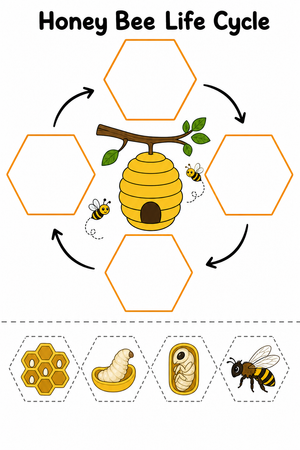
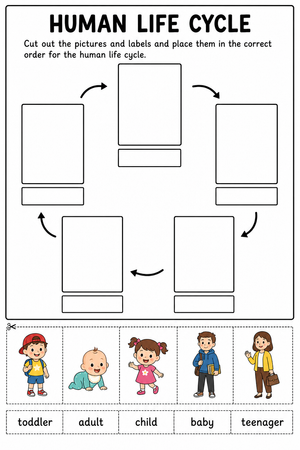
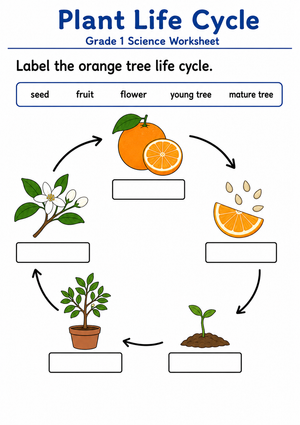
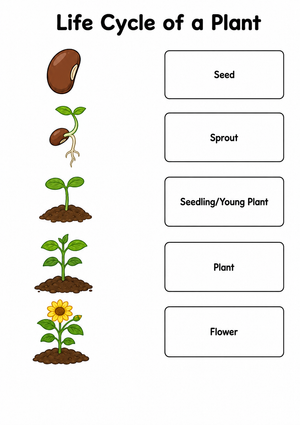
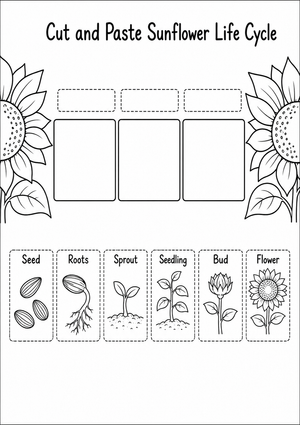
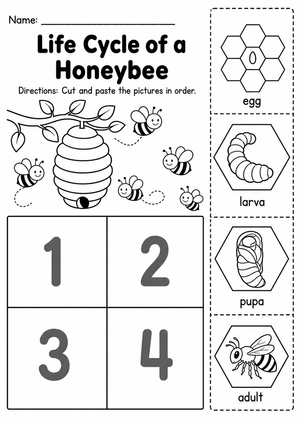
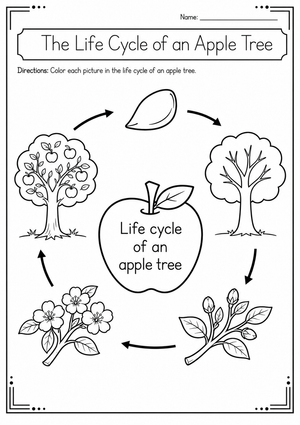
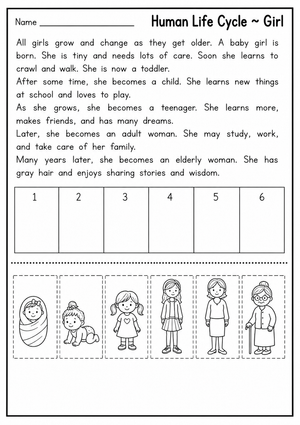
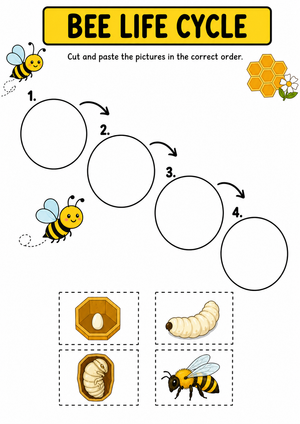
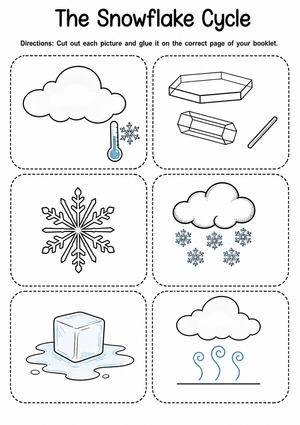
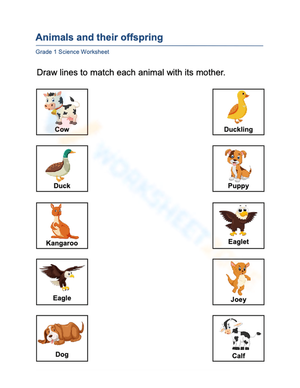
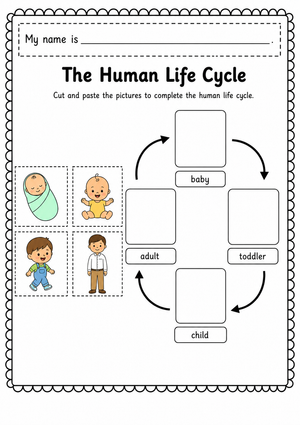
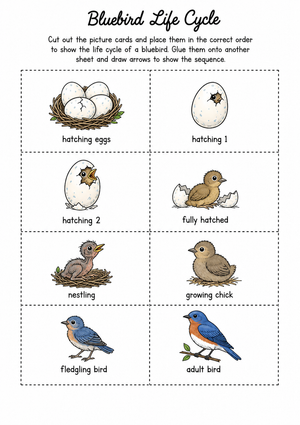
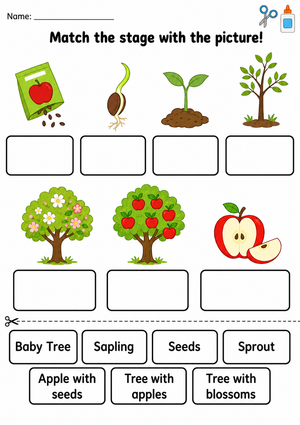
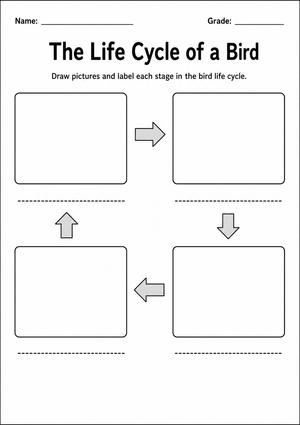
Life cycle printable worksheets for 1st grade give teachers a concrete entry point into one of the harder conceptual challenges in early science: helping six-year-olds understand that living things don't just grow toward an endpoint — they circle back to a beginning. The set covers butterfly metamorphosis, frog development, chicken hatching, and plant growth from seed to flower, with cut-and-paste sequencing, labeling diagrams, and drawing tasks spread across the worksheets.
The Organisms and Tasks in Each Worksheet
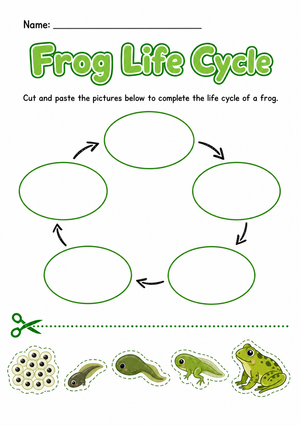
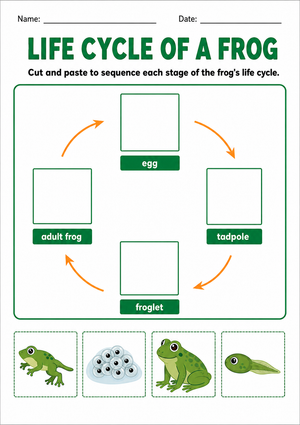
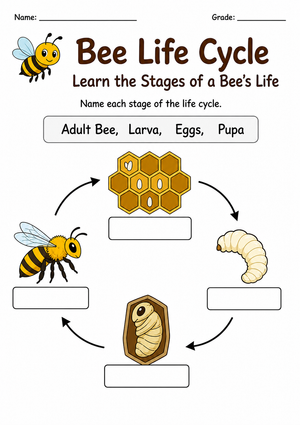
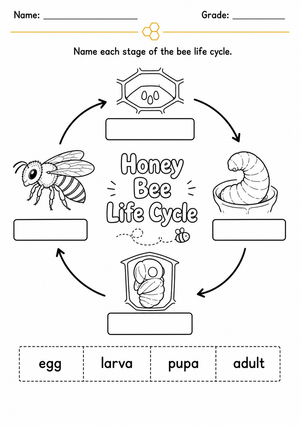
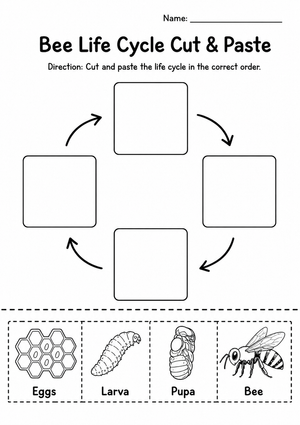
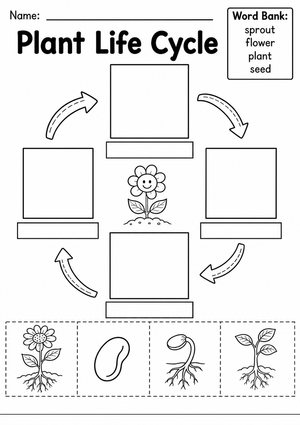
Each worksheet pairs a specific organism with a specific task type. The butterfly worksheet uses a circular diagram showing all four stages of complete metamorphosis — egg, larva, pupa, adult — with a visible return arrow from adult back to egg. Students cut stage cards, arrange them in order, and label each from a word bank. The frog development worksheet tracks the progression from pond eggs through tadpole, froglet, and adult, and it opens a natural conversation about habitat: the organism starts entirely aquatic and eventually lives on land, which most first graders find surprising enough to actually remember. Plant worksheets use sunflowers and pumpkins as anchor examples because those seeds are large and recognizable — a student can hold the actual seed while looking at its printed image on the diagram. The chicken worksheet brings a parent-offspring angle by showing the hen sheltering chicks, giving students a concrete example of the protective behavior that NGSS 1-LS1-2 specifically asks them to identify and describe.
Frequent Student Errors Worth Catching Before They Solidify
The most persistent problem first graders have with life cycles is treating the sequence as a line rather than a loop. A student can correctly arrange egg, caterpillar, chrysalis, and butterfly in order and still mark a hard stop at the adult stage. The circular diagram with its return arrow does some corrective work, but it isn't sufficient on its own. Teachers need to point at that arrow and say it plainly: the adult butterfly lays eggs, and the whole process starts again. Without that explicit moment, half the class reads the circle as visual style rather than scientific meaning.
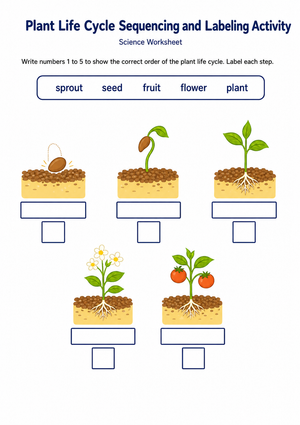
Plant vocabulary creates a separate, more specific error. Students consistently treat "germination" and "sprouting" as the same thing, partly because adults use the terms interchangeably in everyday speech — "the seeds sprouted" and "the seeds germinated" both appear in classroom read-alouds without distinction. On the labeling worksheets, a student who correctly identifies a seedling in the picture will still swap the two labels, writing "germination" next to the visible green shoot and "sprout" next to the underground stage. This isn't guessing — it reflects a real conceptual gap. Germination happens below the soil before anything is visible above ground, and that invisible process is genuinely hard to picture without direct instruction.
Standard Alignment
NGSS 1-LS1-2 asks students to recognize that young plants and animals resemble, but are not identical to, their parents. The life cycle printable worksheets for 1st grade in this set address that standard most directly through the butterfly and chicken worksheets, both of which place parent and offspring within the same diagram sequence. A caterpillar and a butterfly share no visible physical resemblance, yet completing the sequencing task establishes that they are the same organism at different stages — a distinction that abstract description alone rarely communicates to six-year-olds. The chicken worksheet adds the behavioral dimension: students describe how the hen shelters her chicks as a specific, named example of the parent-offspring behavior the standard requires.
Building These Worksheets Into Your Science Block
Using life cycle printable worksheets for 1st grade as retrieval practice at the start of the week — students sort stage cards before gluing them down — makes a measurable difference in how well they retain the sequence. Sorting from memory requires reconstructing knowledge rather than copying a visible diagram, and that retrieval effort is where durable retention actually builds. It's the same principle behind flashcard recall being more effective than rereading notes.
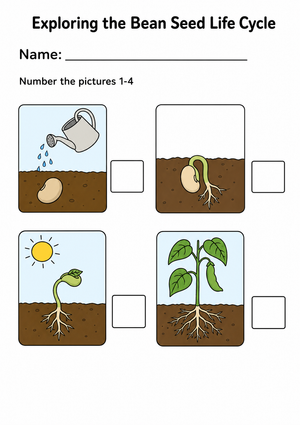
For plant units, assign the seed-to-flower sequencing worksheet before students plant their own seeds. It creates a predictive framework: students know to look for root emergence before a shoot breaks the surface, and they can check off stages on their completed worksheet as the real plant hits each one. The worksheet becomes a long-term observation record rather than a single-session task. Labeling worksheets are better suited to small-group instruction than independent stations when vocabulary is still new. A student who writes "pool" for "pupa" at a quiet station will repeat that error undisturbed; the same student in a small group gives you the opportunity to catch and correct it before it calcifies.
Differentiating the Worksheets for a Range of Learners
Students still developing fine motor control do better starting with labeling tasks before attempting cut-and-paste sequencing. Circling a word from a word bank puts far less physical demand on small hands than cutting stage cards cleanly and placing them in precise order. For students who are ready for more, remove the word bank entirely and ask them to generate their own labels. A further extension pairs two different organism worksheets and asks students to identify stages that appear in both cycles — both butterflies and frogs begin as eggs, for instance — and stages that are unique to one. That comparison requires thinking across worksheets rather than within a single one, and it's genuinely harder than anything on either worksheet alone.
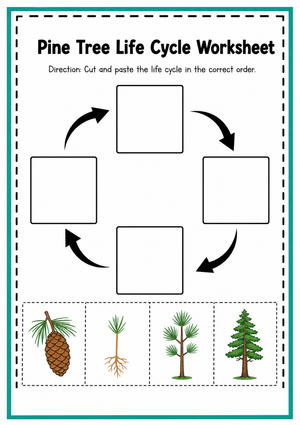
Students who consistently reverse the sequence or struggle with the circular layout benefit from a physical step before gluing: arrange the cut cards in a straight line in the correct order, verify the sequence, then physically bend the line into a circle until the last card nearly touches the first. That action — curving a correct line into a loop — builds the spatial understanding that the printed diagram often fails to convey on its own. Life cycle printable worksheets for 1st grade are particularly well suited to this kind of pre-gluing manipulation because the cut-and-paste format gives students the stage cards to handle before committing anything to the page.
Frequently Asked Questions
Can these worksheets be used in kindergarten or extended into second grade?
The labeling worksheets with word banks are accessible to kindergartners who have heard the vocabulary in a read-aloud or shared reading context — particularly in the second half of the year. Cut-and-paste tasks are within reach for most kindergartners by spring. For second grade, the worksheets work well as review at the start of a life science unit or as entry-level material for students who didn't fully consolidate the concept in first grade.
How long does each worksheet typically take to complete?
Cut-and-paste sequencing tasks take most first graders 15–20 minutes, longer if students spend time coloring the stage images. Labeling worksheets with a word bank run closer to 10–15 minutes. Neither is designed as an extended independent work block — they fit naturally into a science center rotation or as a warm-up before a hands-on investigation.
How do I use these alongside a live butterfly kit?
Introduce the butterfly worksheet before the kit arrives so students already know the stage names. Once caterpillars are in the habitat, students can update their worksheet in real time — circling the current stage, adding a date, or sketching the actual caterpillar alongside the printed image. When the adult butterfly emerges, return to the worksheet and trace the arrow from adult back to egg together, discussing what would have to happen for the cycle to continue. That closing discussion is easy to skip but essential for making the concept of a cycle explicit rather than assumed.